Posts Tagged ‘randy hasper’

It’s odd what juts out from the past, in our minds, as we story and restory what we live through. Bits of narrative lift above the landscape, like mountains pushed up by continental drift, and we grab on to these, to make some sense of the past.

The parking lot lights weren’t working, but we were —  seventy to eighty people swarming the buildings,  fixing, cleaning, painting, planting. We were renewing our church. Then suddenly in the outer hall there was a guy in front of me saying, “I’m an electrician. What would you like done?”

“Really?” I said, “That’s perfect! I’ve got something for you.”

I didn’t know his name, and I wasn’t sure how he knew about what we were doing, but there he was, offering free labor, and I knew what to do with that.

“The parking lights don’t work,” I said, and as I opened a closet door on a couple of old, rusted, steel boxes mounted on the wall, I added,  “We think it’s these timers.”

That was enough. He went to his truck, came back, and he was on it. In short order — problem solved.  He replaced the old boxes with new — clean, bright, functional —  perfect mechanisms that light up the church, on command.

I drove home coasting! Happy! Thankful! Surprised.

That day, that fix, that surprise stands out for me because it’s part of a pattern.

It rained. We found a roof leak in one of the church buildings. It was serious — $5,000 worth of serious. There was no offer of free labor. Right around that time, I can’t remember the exact chronology,  a woman came to me after church one day and said that in her retirement settlement she had received some money, and she wanted to give some to the church. It was a check, for $5,000.

It was odd, in a way I like — the numbers were the same.

There’s more.

As part of our site remodel, we ripped into the old nursery, the  old carpet,  the broken furniture, the chipped walls, the horrific curtains. About that time an older couple began to attend the church. One day, after church, he came to me and said, “You mentioned needing a couch. What about this one?” and he showed me a picture torn from an ad.

“Great,” I said.

“What day would you like it delivered?” He asked.

I remember a couple of us ripping off the protective plastic and cardboard that covered the new couch when it was delivered. Then we just gasped and hooted. It was gorgeous, the perfect shades of brown and dark brown to match our newly painted nursery. The babies and their moms would now repose, in style! Then he bought two more new couches. It was like Christmas, a furniture Christmas.

There were also the cabinets, in the upstairs kitchen. They were a piece of work, right out of the seventies, pine, burnt with a blow torch, and then coated with thick shiny layers of polyurethane. They looked like what they were — remanents of a fire!

What to do?

I went down to Dixieline,  the home repair store just down the street from the church, and asked if there were any cabinets that had been brought back from a job, something that hadn’t worked out, and were being sold for less than they were worth. There were some, but I was told I would need to talk to the manager.

So I made an appointment. I went up to his office, upstairs, nice, impressive. We talked. I’ll always remember his question to me. It took me back. I wasn’t sure how to respond. The cabinets were gorgeous, a whole bank of them, and drawers and doors beyond what I had expected.

He looked across his big desk at me in his big office and asked, “What do you want to pay for them?”

My mind raced. If I said too much I would miss the chance for a deal. If I said to little it would be insulting. They were worth between $1,500 and $2,000, by my best guess.

I said, “We can give you $200.”

“Good,” he enthused. “I’ll have them delivered for you next week.”

The other day I was in the upstairs kitchen. The cabinets are in, installed free by a local cabinet-maker who not only donated the labor, but also gave us the counter tops for them.

I could get used to this. I have.

A donated landscape design by a local landscape architect, a restoration consultation by a woman specializing in historic building remodels, the no-cost installation of huge, new sanctuary windows by a man who had formerly worked for a glass company — all this and more has landed our our doorstep. Surprise!

At every turn we have been given — gifts.

When we decided to install new lighting in the worship center we were looking at an $8,000 project, at least $16,000 if we paid for labor. We didn’t. All the lights were purchased at cost through a friend who works for a lighting company. All the labor, hours and hours, plus the use of a lift were donated by an amazingly generous electrician and a few of his friends. All the labor, days of it, free.

The lights in — beautiful, functional, lovely, perfect for the building.

A patio garden — the dirt, irrigation, labor — free!

A hardwood floor sanded and refinished, free except materials.

The painting of the interior of our worship center — free, even those difficult upper levels, brushed in by a local professional painter, done safely, nicely, a gift, more than we could have asked for

There is more, but the more that really sticks out to me is what has been added to us that is human, not mineral or material.

A renewed site, a growing congregation — we needed staff to care for them.

We went to our local seminary and asked for an intern.

In asking, we were taking a risk. We weren’t controlling who we would get, we didn’t know the outcome, we didn’t even know if we could afford it, we just knew we needed help. We were a continent, of people, drifting.

That was two years ago.

The result of that inquiry is now on paid staff, well-funded for this next year, uniquely suited to our needs, trusted by our people — she is perfect for us! I almost don’t feel surprised anymore.

Things stand out, in the past, bits of narrative rise up, pieces of our continuing story. Our past has a pattern in it. The pattern is good. One could almost draw certain conclusions — that  it was orchestrated.

We have.

Renewal is stubborn, especially at the fringes and edges and the corners of the former. Think of what it takes to restore a classic car or a classic church.

A while back, I was in room 5 at my church, which is a classic,  and there it was, where the tile met the wall —  clean! I remember when it wasn’t.

When I took the job as the pastor of the church four years ago, a nice herd of children attended the private, Christian preschool that operated there.  I loved coming to work to children.  I loved being surrounded by those precious, diminutive, destructive monsters. While I could see that they were vectors (the runny noses and coughs) and carried diseases, I’d had my shots and they were super cute and said funny stuff and gave me chances to tell stories and laugh and get hugs and comfort them when they cried for their mothers, which they did a lot, especially late in the day.

I tend to like the generic noises children make,  the hum that they collectively emanate, punctuated with the yelling, laughing and crying. I especially like it when I’m not immediately responsible for it.

But there was a problem with the school, and so we said a prayer over it — and buried it. It was a private day care operation that was leaking money in the recession, threatening the financial solvency of the church. It had been in existence for forty years. It had thrived, filled the patio with children, helped parents who were working, cared for the children of the church, but it was done, (no children from the church even attended anymore),  and so were we.

The church board discussed it, discussed it again, and again, made the decision, grieved the loss and let it go. We paid the director and the teachers severance and vacation pay, told the parents and children about why we were quitting and closed the doors — at Christmas — on a huge mess. Four big rooms and an office complex of mess.

The preschool classrooms hadn’t had an update in 20 years. They were full of over-painted children’s furniture — red and blue and white paint-encrusted wooden benches, bookshelves and cubes for backpacks. This inexpensive, even homemade furniture, was all paint-chipped, kid scratched and dirty. And so was the floor —  filthy.

We trashed, sold and gave away the school — except a few nice tables and chairs. We gutted the rooms. Huge truck loads went to other schools, and  to the dump. We sold a ton of stuff at a garage sale.  Through this we saw how it is at the end of the end of things institutional.  At the end of visions, dream and institutional successes is a junk yards and a dump. Dumps are full of the ends of schools and businesses and homes and lives. It’s sad, and it’s necessary, and it allows something new to begin.

Once the rooms were almost empty, we painted the walls, scraped paint off the windows,  and tackled the floors.  The floors were the worst. The piles of furniture, the weight of time, the tendency not to see the familiar, the lack of funds — all  this had left the floors layered with filth.

We removed the base boards, and we got on our knees at church, not to worship, but to clean, which is a form of worship, and with our heads bumping the walls, we confronted the spaces where the universes had overly accumulated. I remember it well. I remember the night we employed every means known to man and woman to scrub wax, grime, grit, gunk, hair, insect body parts, dust, paint and whatever disgusting residue human children leave behind them  —  off the floor.

We ran an old buffer with a massive yellow, electrical umbilical cord (we found it lurking in an old closet) over the floors, grinding away at the dirt embedded in the tile. The buffer was wild and could get away from you and clobber the wall,  or your leg, so we let one person run it while the rest stood back and laughed. Once I got on it and rode it, to increase its wieght, and another guy ran it on a spot that just wouldn’t come clean. It did. Then  we got out scrapers and razor blades and scrub pads and attacked the edges and corners. I remember telling the volunteer crew stuff like, “Let’s hit that spot again,” or “I want it better than that.” I remember being fanatical about getting the dirt up, even coming back on my own over the next few weeks with a razor blade, scraping yellow wax and brown grime.

Then I paid to have the carpeted areas cleaned, twice!

Why?

Last week I went into room 5 on a Wednesday evening. It is the church’s new vision, “The Connection,” a place for children and their parents to learn, to recover, to renew.  The room was full of children, so many they were spilling out the back door. Four or five adults hovered over them. There was a quiet hum of voices with a background track of sandpaper running over wood. The children, all who attend the church, were making pine box derby cars.

I walked toward the end of the room where we had attacked the tile floors. They shone. Curtains covered the beautifully clean windows at the end.  I looked back at the children and walked  back through them, just for fun. They showed me their cars. One gave me a hug. She always does. She’s my friend. She used to attend the preschool.

As I left for the evening, I glanced along the wall where we had confronted the most stubborn layers of dirt — good, clean, repurposed.

There is something about a vision, about a church,  about God, about an old room, about scraping up the past, about making a clean space for something new.

I like it; I like the good that exists at the scraped corners and at the clean edges of the present and the future.

Randy Hasper“Men lie in their lovers’ arms, but when they tell the truth, they stand up and deliver it from ten feet away.”

That storyline came to me a few weeks ago as I was drafting some thoughts about lying. The sentence might be classified as a truism, as axiomatic, or as proverbial truth housed in a mini-story. It is a story proverb.

The story is about a word man and a word woman who live in a word sentence. They are inauthentic lovers. One night they speak their endearments to each other and stroke each others’ hair and hold each other close. The two are together in that magically exquisite way in which humans who collide may also merge. But, after the “but,” in the sentence, the mood changes. He gets up, because he has kept something from her. He can no longer lie and lie. And then he tells her the truth. He knew she would be hurt and upset, so when he says it, he stands away from her, about ten feet away. It is a relative safe distance from which to wage conflict.

Perhaps he is afraid. Maybe she cries. He paces the room. There is now a moment of expanding distance and pain between them. Then what happens next?

I don’t know what happens next. It’s not in the line. The line is a fiction, an imagined narrative, unfinished so to speak, two acts, not three: love and then conflict, with no resolution. The story is frozen in print, unresolved, but for a purpose, so that it might aptly carry it’s content and no more than that. The content is something like this: Men lie while they lie, and the lie, once exposed, turns close lovers into distant enemies.

That’s life, or life similar.  Life includes lies and the story lines that follow those lies and a lot of pouting and crying and throwing things. But that’s not all life offers us. The narrative of  real life, a life still being lived, is different from a frozen, proverbial  narrative. A real, ongoing, present-tense story, like each of us is living, is not frozen or stuck in a sentence with a limited meaning and freighted with unresolvable conflict. Life, thankfully, is still malleable, and pregnant with a multi-stranded hope for more.  The life we are each currently living, while it is made up out of the multiple narratives of the past, loosely braided together in our minds, that life is yet still  capable of being further braided into something new.  We aren’t done, like a sentence penned.

Each one of us have options to live past our former storylines, to write a new sentence, to write new pages and even volumes if we will. What I am saying is that life includes redemption. Life includes second chances. Life offers us opportunities for rewritten endings. This is what God gave us when he made us like himself and gave us life — the power to story something good, even after something bad.

I believe that, because I’ve seen it and lived it. And I take from this, that it is my responsibility and yours to take the current pieces of our narrative and make some sense of them, to bring some kind of resolution to our conflicts where we can, even if it is only within ourselves, and to carry on with us our frayed and broken strands if we will, and weave them into something else. We can yet take up a thread of the old and braid it into the pattern of the new.  We can yet make choices to act out where we want the story of our lives to go. We are not frozen in words that do not resolve.

If there is a secret it can be told. If that creates conflict, that can be talked about. If there is pain, and brokeness, that can be healed, or learned and recovered from, even redeemed in perhaps another relationship. For instance, real people, who have “lied” in their lover’s arms, may eventually come to say, “I have learned from secrets kept in one relationship, not to keep them in another.”

I spoke to a woman this morning who said to me: “I am blessed that I have a mental illness and that I have been so physically sick. I am not happy about it, but I am blessed, because without it I would never have known God.  I know that if I had been rich and healthy, I would not have known God. ” This is shocking language, sure to unnerve some people, and yet look at how she is telling her story, making sense of it, stranding it into something good even in the center of something terrible. She is bipolar, and yet she is unipolar, focused when possible on a good narrative that she is struggling so bravely to write.

We are, each one of us, with God’s help, the novelists of our own lives. It is our responsibility and privilege to write a good story that moves toward order and understanding, to exert strength, to be human, to embrace the whole of it, loss, pain, sickness — health, gain and pleasure. All of it, taken as a whole,  makes sense, says something, defines what it means for us to be alive.

Story on.

You aren’t done.

There is no sentence in your past that you can’t rewrite in the future.

You are responsible for the ending of your own story.

Just write it.

Freedom is being responsible for nothing — plus every single choice we make.

If you and I were to slip into a crack and fall to the center of the earth, at the center of the precise center of the earth, we would be weightless. With nothing between us and the middle, there would be no gravitational pull on us, so we would weigh nothing, which of course we wouldn’t realize nor would we even remark on to each other. It would be too hot for chattiness — over 5,000 degrees — about as hot at the surface of the roiling, roasting, egg-frying sun, and so we would just bake together — weightless.

Cool! In a warm, high-pressure, floaty kind of way.

This postulated, in other words, say you and I do fall into a chute that leads to the earth’s core, lets agree to something. Let’s agree that if you don’t want to go there, it is your option to snag a root on the way down, or fall on your ice axe, if you have one. I want to experience 5,000 degrees and weightlessness and view the molten core within the core, but if you don’t then that is your choice.

Here is the thing in life. The places we go, the weightlessness we experience, the temperatures we allow ourselves, the self-arrestments we pull off, the times we choose to fall into a new landscape — these are up to each of us individually.

I’m thinking more and more these days: I am responsible, and you are too, for what we choose, and for where we are.

I am responsible, we are responsible, they are responsible and everyone else is responsible too! We are, the whole lot of us, choosers, travelers, Voortrekkers. Like the Afrikaan Voortrekkering pioneers, we choose to voyage toward the interior, to be “those who pull ahead,” or not.

I’m thinking of staying home less. I am crazed for the interior. I am wild for the core of things.

This summer I trekked to the beach. I hauled along some books and food; I ate the food; I ignored the books; I stared blankly at the ocean. I needed that big, bright blue expanse of liquid to leach from me a couple of pseudo-defamations, one or two persistent self-incriminations, a baker’s dozen addictive infatuations and a handful of snarled and tangled minor intimidations–and such.

Why? Why go there? Because I am responsible. I am responsible for the health of my psyche. I am responsible for where I go and what it does to my soul. I know this, and these days I am prepared to fight for every, freakin’, psychologically healthy moment possible.

I am going to the gym this afternoon to run until my heart pounds so hard I know I am alive. I am going to do this because I accept the premise that I become a very slightly different person with every choice I make, with every place I go, with everything I allow my soul to experience.

I am looking for opportunities these days to fall into deep, exhilarating, life-changing cracks of personal responsibility — cracks like God, love, justice, pain.

Recently I put myself up close to a person in extreme psychological pain. Why? They needed me, and mostly, I needed them, to remind me that life is full of extreme pain that must be attended to, that must be acknowledged, that must be endured, that must be experienced. Extreme pain is certain to make us temporarily insane, but afterwards, we may be able to move into a different future, knowing what we can only know after living in 5,000 degrees of mental anguish. What we know, after such heat, is the loss of weight, perhaps even the heavy fear and anxiety and selfishness that have kept us from rising up, and floating.

On the other side of responsibility, of our responsibility for engaging extreme experiences, experiences like meeting God, doing justice, choosing to love, being healthy, embracing other people’s pain — there is a strange and wonderful landscape with a super-animated kind of beauty — it’s weightlessness.

I’m Voortrekking toward it.

Why?

I am taking responsibility for the health of my own soul and of others.

Do you want to go with me?

As I was driving down a street this week, I glanced through my driver’s side window and found myself looking through a bus window in the lane besides me. And through my window and the bus window, I saw a set of eyes looking at me. We saw each other through two moving windows — my car, his bus —  right in the eyes, maybe six feet away. He was an older gentleman, Mexican I think, with a serious expression.

We were both moving along the street,  framed in our windows and with that one, short glance we traveled together until I looked back at the road to see where I was going.

As I drove on I wondered, “What was he thinking? Was it, ‘I’m glad I don’t have to drive, that I can just ride home peacefully on the bus.’  or perhaps, ‘I hope someday I have a car again, so I can come and go as I please.'” Was he perhaps thinking about something that has happened to him in a small village in Mexico, where he grew up, thinking so intensely about when he was a child, about that time when his mother …

I don’t know, but it brings up the question for me:  How present am I, in the community of the present, in the collaborative  of the moment, in the social within the now, in the car, watching the man in the bus, in the now of the now within the core of the very now?

I remember Pascal’s observation that we wander around in times that don’t really belong to us. Remembering the past, we miss the present; worrying about the future, we may not even see someone right in front of us.

That happens, but increasingly I am find myself wanting to travel in the present, which means to actually look over and see the man in the bus traveling beside me, to see him in all his obfuscated beauty, to not really understand him but nonetheless to  see him as my companion in the now, and understand that we have a shared, universal human journey, asserted and expressed in the raw, transient and yet extant present.

The bus rider and I share the same street, the same city, the same state, the same country, the same world, the same universe. He is my brother. We share the DNA of the present. We share the current animal, vegetable, mineral, social, political, spiritual now. Am I making too much of this? I am not making enough of this! We have missed, missed, missed and missed this infinitely.

I want to see my world. I want to live fully in it and with it.  To see it, I must look at it. To look at it, I must linger on it, for a moment. I must dawdle in time, fiddle around in the present, goof off in the slip and slide of the near and the immediate. Indeed, after seeing the man on the bus,  I should have pulled over at the next bus stop and gotten on, introduced myself as the man in the car, and asked him about himself. Then I would have discovered a bit of how different from me he is, and how much the same, how perhaps, he is really me, and I am him.

I have lived in the same community for a long time.  I know a lot of people! I talk with people all day long. Do I need another conversation, do I need another friend? Do I need to be getting on busses when I have a car, to be accosting old men on public transportation?

I do! We do! We should! We have not even begun to enter into what is present for us, to bridge, to connect, to converse, to empathize, to understand, to laugh, to grieve, to know each other, to actually see, touch, think with and understand each other.

There are no projects, no work loads, no places to get to, no duties waiting here, no responsibilities lingering there that should keep glass between us.

There are no class or economic or social or racial or religious differences that are so compelling that these should keep us from busing a short while with each other.

There are no memories so strong as to erase the moment of your unique presence here on this street with me; there are no worries so strong as to obscure the immediacy of the precious you-ness of you here with me.

I have a prayer I have been praying, and I recommend it to anyone who wants to live in the uniqueness of the social now.

“God, I beg you, send me my people. Send me Indian people. Send me Chinese people. Send me Brazilian people. Send me Mexican people. Send me anyone you wish, but please send them all. God, I beg you, drive your bus up my street and bring me my people so that I can befriend them and take care of them.”

Why pray this?

I pray this out of the awareness that this is my present-tense reality, and that I want more of it  — the bus, the window, another person, our eyes meeting.

There really is nothing else here, right now except this kind of divine, immediate sociality. The past is gone, the future not yet come, nothing but the present moment and all the beautiful people God sees fit to give me in it.


Drive from work to the gym.

Eight stop lights. Ten thoughts about work. Think about six people. One thought about wife. Bad ratio.

Run on the elliptical. Lift weights. One thousand five-hundred and fifty-one different movements.

Wash hands. Diseases on my mind. New gym; probably crawling with bacteria.

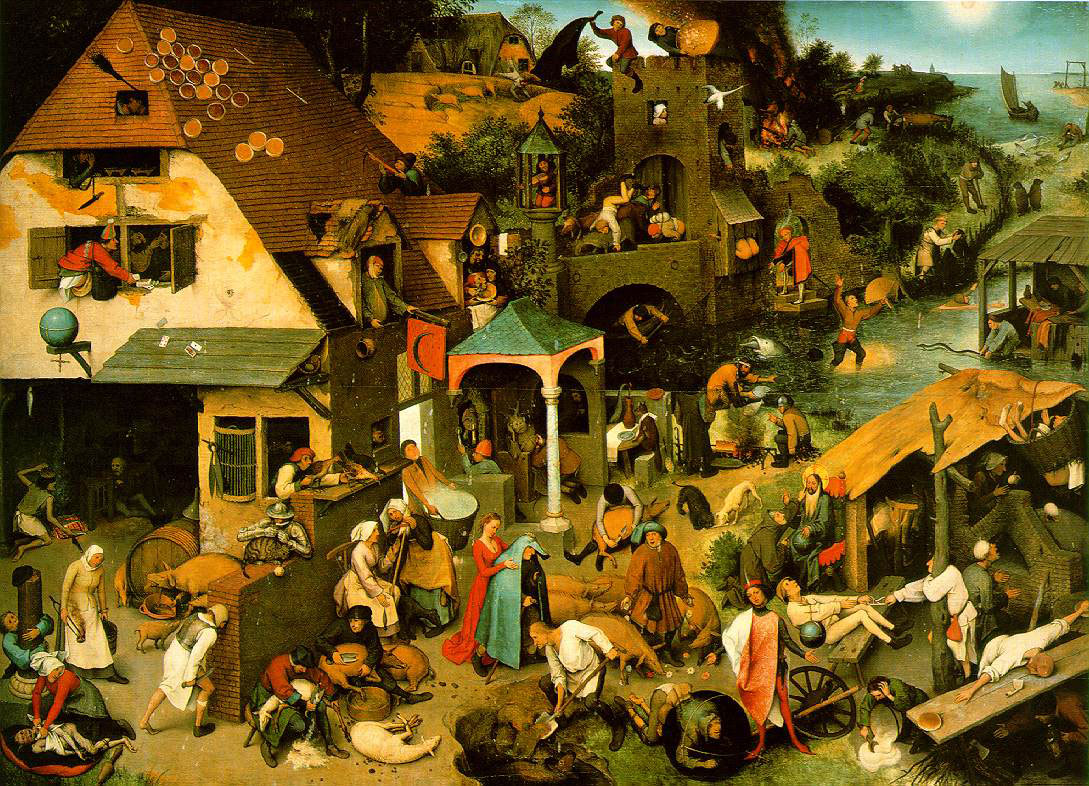
Stop and talk to the gym owner. He is going through third divorce. Sucks, for him. I live in a Brueghel — sweaty, pulsing, messy, high-density.

Drive home. One near miss. Eleven traffic lights. One incident. No hand gestures. Eleven emotions during whole drive.

Accelerate hard with the turbo-charged engine twice. Rocket forward. Smile twice. One phone call on car phone to wife. She’s in traffic. Our cars talk, then we talk.

Pull in garage. Car off. Break on. One car door. One backpack. One phone. One garage door button.

Greet my daughter and both cats. Stash backpack.

Make dinner. A hundred and seventy-two different steps.

Feed the cats in the middle of the process. Six motions.

Answer two texts. One from work.

Eat exhausted, with daughter, wondering if the homemade spaghetti is worth it. One hundred ten motions not counting chewing.

It wasn’t, worth it. Daughter didn’t like it, but it was good the next day as leftovers.

Do the dishes. Fifty four disparate movements.

Help my daughter change a setting her iPad. Stress! I didn’t want to.

Think about a bill I need to pay online. Decide to pay it in the morning.

Think about work. Eight thoughts in a row. Three were repeats.

Wife arrives home. Hug. Get her food. She likes the spaghetti. Ask about her day. Answer a text. Try to stop thinking about work.

Get a work related call. Ignore it.

Sit on the couch — exhausted. Turn on TV.

Run through the DVR list while scanning the news on my iPhone while answering a text.

Watch one show.

Go to my room. Think about life as a crush of details and problems. It’s clutter.

Think.

Read my Bible.

Pray.

Rethink.

Got it!

Life is simple.

There is the clutter, laden with detail, fraught with emotion, cargoed with movement, and then there is one simple thing.

I have only one thing to do.

I have just one choice to make.

One thought.

One movement.

One goal.

Love.

Simply love. Love them; love it.

All.

I go to sleep.

I’m okay.

When Africa crashed into Europe, the Alps jutted up from the earth

When India crashed into Asia, 40 to 50 million years ago, the Himalayas thrust into the sky. Marine fossils came to rest on the top of Mt. Everest, at over 29,000 feet! A crash put limestone sea beds on the roof of the world.

Modern geology has discovered powerful interior forces that have shaped the earth.

Yellowstone National Park, the unique steaming, hissing spouting world like-no-other is the result of an ancient super-volcano. Looking at the current landscape, ones sees nothing left poking up that resembles a volcano. Only the bubbling remains of Old Faithful tell of the tremendous heat that once blew this landscape apart.

4,000 years worth of supercomputer simulations of weather are now revealing an association between periodic changes in stratospheric wind patterns (the polar vortex) and similar rhythmic changes in deep-sea circulation.

The sky controls the sea!

Wow and superwow!

Interestingly, it is the same inside of our souls. We are beginning to understand how the psyche is formed. Superforces have been at work.

When one human, with its massive continent of thought and emotion, collides with another individuated mass of articulated humanification, a unique personality is thrust up. We are a product of the crash with our parents. The seabed of their lives ends up in the top of our heads. We discover their fossils at our highest altitudes.

And when hot human emotions collect beneath the surface, they eventually volcano, explode, and wipe the emotional landscape flat. The geography of human personality bubbles and hisses for years after.

And that’s not all folks. When the polar vortex of culture and tradition swirl above the people, the deep sea of human behavior circulates in a similar pattern below.

Life, inside and out, is shaped by hidden forces.

Interiority expresses itself in exteriority. This is the divine, the geological and the human order of things.

What to do? Search! Putter around, check out the clues, eyeball the landscape, ask the questions no one has dared ask, observe the revealing patterns.

Do you want to understand yourself? Then you must become a scientist of your own soul. Look at the framework under your own bridge.

Only discovers, seekers, microscope carrying hikers, hungry-to-know-what-happened rock-smashers and peak climbers, may read the clues left of the surface of exterior things and figure out what happened as a result of interior things.

A small tip for all psyche searchers looking to understand themselves and others.

Interiority often explains exteriority.

The drops of salt water spin off the football as it speeds away from me — beautiful, tiny, silver globes of light flying up and away from the ball

I love the combination of light, and water, especially as it flies in the air off a ball. I throw the football to my daughter. We are at a hot, sandy beach in Coronado, California. We love the beach. I raised my girls at at this beach and another favorite spot in La Jolla.

We laugh, we toss the football, it flies true, the water is bright.

I like the true and flying ball tossed between two people who are extremely okay with each other. My daughter and I are. We toss it back and forth. I like it when it spins in a perfect spiral. We each throw a couple perfect passes,  NFL kinds of passes out over the bright blue waters of San Diego.

Yesterday I ran into someone who pretended that it was okay between us. It isn’t.

People do that. They lie.

I find that to be singularly unattractive. No bright drops in the air here. No good tosses. Nothing true, righteous, good. For there is nothing that can fly back and forth in nicely spinning spirals between two word tossers when there are lies in the mix.

I don’t like pretending. I don’t like what is false. I don’t like what is spun wrong. And I’m not that fond of lies. I used to be, but I’ve pretty much gotten over that.

This morning I read some of the Psalms. I love the Psalms — lots of bright drops of truth spiraling through the air here. I ran across an interesting turn of phrase in Psalm 36:2.

In their own eyes they flatter themselves
    too much to detect or hate their sin.

We do that, think too much of ourselves to detect or hate our own sin, particularly if we are hooked on  highly additive substances like pride, greed or jealousy.

Crazy! True! And damaging. Lies are always damaging, and really the most damaging lies are the ones that we believe. We don’t call them lies but instead brand them as the truth. Scary, for really the most dangerous lies are when liars that tell them think that they are telling the truth.

I know, because I do this, deceive myself. We all do — from  time-to-time which can add up to most of the time.  We think we are honest, because we  admit small negatives about ourselves once in a while, when caught, but we do so only to hide our worse offenses behind the shabby ruses of a few minor confessions.

It’s something to get past.

How? Not easily.

I actually don’t think that we can get past our own lies very often, but I have seen that life can get us past them, past the self-flattery, the pretending and the ensuing falsehoods.  But to do this, life must get tough on us, and take a couple of whacks at us, right between the eyes.

If that happens, that we get pounded, I’d recommend we take the licking, and come up asking for more.

A beating, extreme trouble in life,  has a way of potentially knocking untruth out of us, so we may, if we will, become more humble, admit our falsity and put on stronger reading glasses. Then, through the clear eyepieces of bitter experience, perhaps we will be able to detect our private, personal and oh-so-deceptive prevarications, and then out the darkness in us.

Today, I went kayaking and snorkeling along the La Jolla cliffs with my wife, Linda. Beautiful, the bright blue water, the bright blue sky. It’s what we do in my family, and have done so many times, to clear our heads from too much work and a bit of untruth, especially the untruth that the world is only violent and ugly and full of lies.

Under the water, through my goggles, I ogle some shafts of sunlight shooting down to the bottom of the sea, illuminating a brilliant orange Garibaldi set against some bright green surf grass.

Nice! Bright. Real.  Orange. True.

Coming back to the kayak, I crawl in and Linda goes out for her snorkeling.  We take turns climbing out of and back into the craft,  and then we point and laugh at each other. We are ridiculous. Trying to get back into the boat, we hitch ourselves up on our stomachs and lay across the boat sideways. We look like beached seals, stranded on plastic.

It’s bright between us. Our relationship is full of truth. We laugh. We see ourselves as we are.

Then we head back. The water flies off our paddles as we power home though the bright light and truth.

The World is Flat, claimed Thomas Friedman in his 2005 national best seller.  The  book is  now seven years old, but it is still relevant, particularly in the competitive, dog-eat-dog world of economic stagnation and global competition and conflict.

For Freedman’s “flat” is about creating collaboration in the marketplace. He points out that in the international business community, people are working together as never before, wired together through the Internet. Freedman explains how economic cooperation between businesses all over the world has bulldozed a new, level playing field. Tutors in India now collaborate with American school children on their homework. UPS is now synced with Toshiba, fixing Toshiba’s laptops to save shipping expense and time.  People around the world build software together. Things are changing – fast. Are we?

When I read Friedman’s book, a few years ago, it got me to thinking hard about the spirituality. Is the spirituality growing more flat too? There is evidence for that. Many religious leaders now network internationally by email and mobile phone. Short-term missions’ trips to other countries are the norm in many churches. Megachurches are creating huge associations of thousands of churches that plug and play their curriculums. Globally, religious leaders of differing backgrounds are working more together to engage social issues like the HIV pandemic, poverty and addiction.

 And yet, while the concept of collaboration is inherently spiritual, and it is in vogue today, the religious landscape worldwide,  is still too often a rocky and jagged land of conflict and division.

 Knocked Flat

Christianity, the faith I know best, unfortunately, has a splintered look. Differences in belief and practice preserve deep canyons. A while back, I talked to a worship pastor who was told he couldn’t serve communion in his own church because his ordination was from another Christian denomination. And we often see little collaboration between churches in local communities.  The churches in my community too often do little more than rent rooms to each other. Sometimes it seems as if they are competing for attendees.

 In the upcoming presidential election, on some of the most significant issues, Christians are not likely to present a unified front. Four years ago, during our last Presidential election, instead of seeing Christians speak with one voice, we watched as fellow Christians handed out voting slates that followed party lines. On some issues, allegiance to the party seemed more important than allegiance to the body of Christ.

 On a very personal, pastoral level, flat is too often tragically missing. I once sat with a group of pastors openly discussing the high and low points of their careers. The low points? They all came when a decision was made by a church, a board or a colleague who ran over them. The stories all had messy endings. No eye-to-eye, on-the-same level, collaborative decision making here. It was the worst kind of flat, knocked flat.

 Sometimes it seems that companies like UPS, with their amazingly unified army of workers, process their conflicts better than the church. Starbucks seems to have created more shared culture between its stores than we have within our denominations.

 In our churches there are racial divides, political differences, belief barriers and hurt pastors. All this has gotten me to thinking. The church needs to flatten. I mean by this that we Christians need to humble ourselves and begin to better plough together through our differences. We need to learn to honor the value of a well-managed conflict. This is not naïve. A grand agreement won’t be possible on everything, but we can do better than this to beautify the bride of Christ.

 John M. Gottman in his book The Seven Principles for Making Marriage Work says that marital conflicts fall into two categories: solvable or perpetual. Perpetual conflicts are ones that remain in a relationship in some form or another. Gottman says 69% of marital conflicts are perpetual. In unstable marriages, these problems kill the relationship. In lasting relationships perpetual problems are acknowledged and discussed, again and again. The couple is constantly working them out, but they are always, for better or worse, working them out.

 The church has many perpetual problems. And on this planet, it always will, but is the bride of Christ doing its best to work them out, again and again?

 What Does Flat Look Like?

 While it is true that the business community is flattening, it is also true that it is still full of leadership hierarchy — CEO’s, supervisors, managers. Such authorities often make and drive key decisions. Of course this is also true of the church. Denominational presidents, committees, boards, executive pastors, senior pastors — such top-down leadership is often the source of vision and change. And it is precisely at that level that strong leaders should begin to affect needed change toward more collaboration.

 Act 6 shows us first-century, Biblical flat. And it evidences the effective use of collaborative decision-making among a leadership team.

 There was a problem. The Greek-speaking (or cultured) Jews complained to the Aramaic-speaking (or Palestinian) Jews that their widows were being overlooked in the daily distribution of food. So the twelve and all the disciples chose seven to take responsibility for the concern. Dr. Luke records that, “This proposal pleased the whole group, that is the twelve and all the disciples.” (Acts 6:5)

 That’s flat decision-making. A fairly good-sized, top-level leadership team met about a social problem. They talked openly and made choices that “pleased the whole group.”  They collaborated. The text doesn’t report that two sides polarized, that there was a split, that a new denomination formed, or that anyone left mad. Acts 6 flat was good; it produced a unifying decision. What pleased the group must have pleased God too.

 In the sacred places where we make decisions, we need such processes. We must not avoid dialogue, because if we do, we will avoid collaboration. And we must not avoid collaboration, for if we do, we may fail to take responsibility for “the Greek concern.” A few years ago the church I now pastor formed a new, outwardly looking vision statement. The process? Our leaders collaborated to hammer our vision out.  Swinging the hammer together worked.

 It is possible to get this right. But to do so, we must go to that sacred space where we sit down at the table and talk very honestly. This can happen, but first we will need to flatten our egos so we don’t flatten our neighbors, especially our neighbors from other backgrounds.

A while back I made friends with a young Muslim woman studying to be a lawyer. She told me of a tough incident in her life. One day, at the American University where she was studying, she stopped to help a student who was crying. The student looked up, and seeing my friend’s head covering, the crying student asked, “Are you going to hurt me?”

 “Why did she say that?” my Muslim friend asked me. “Ouch!” I winced inside over the insensitivity of her encounter. Then I tried to reassure my new friend that many Christians don’t hold this stereotype of Muslims. She invited me to her mosque. I went. I invited her to my church. She agreed to come. Dialogue built paths.

 Flat can be learned

 There is hope. Acts 15.1 shows the early church at an extreme impasse over differences between Hellenistic Jews and Hebraic Jews. It was no shallow conflict. It involved issues of Jewish law, the process of transformation, even of salvation.  

 It is fascinating to note how the dispute was handled. The disputing parties met together and they talked. They vigorously presented their views. One judge didn’t decide the case. Together they worked out an agreement that pleased, that worked for the group. They would accept differences. They wouldn’t require the non-Jews to be Jewish!

 And while the outcome was dramatic and defining, so was the process. The Jerusalem council modeled how the church should resolve its differences. Now we know from Paul’s letters that the Judaizers kept this battle going, lobbying for  Jewish law in Christian life to be continued. And really, the tension over the role of law, of rules and of traditions within the Christian faith has been perpetual, and it is still an issue today. But in Act 15, an environment was set up where people with differences talked. And this talk allowed a way to go forward in a manner that was highly productive. Gentiles were included in Christianity. It changed Chrisitianity from a small sectarian group into a world religion.

How did that work? The decision-making process was face-to-face. It involved the disputing parties. It was honest. It involved collaboration. It listened to feelings.  In these ways, it strikes me as similar to facilitative mediation, a process now offered to disputing parties, (with say family or business conflicts) who are seeking an alternative to court.

 The steps of facilitative mediation are roughly like this, as I learned them from the National Conflict Resolution Center training that I have gone through.

  • The sides meet.
  • Ground rules are set.
  • Both sides state the issue.
  • An area of shared value or experience is discussed.
  • The blocking emotions (anger, hurt, fear) are heard.
  • Together, the sides brainstorm solutions.
  • An agreement is written that fairly represent both interests. 
  • A win-win is achieved.

To have such a process, a wise mediator is crucial to help the sides listen, paraphrase and interpret how they are being affected. But a wise mediation is not simply someone trained in mediation. Mediation of deep conflicts can only be wisely handled by mediators who themselves have been knocked flat, who “get it,” because they’ve experienced it, because they have been humbled and because they have a deeply built in empathy and passion for win-win solutions. Then they can facilitate a discussion of shared values that moves towards a common ground. Only emotionally intelligent leaders will know that blocking emotions are something to resonate with, not stigmatize. And they will know, because they have themselves felt the emotions of hurt, betrayal and anger that if not allowed a place at the negotiating table, will sabotage the entire process.  

And then, the mutual solution giving — this is the good stuff. Both sides say what they can live with. Here is where a godly future is created. This is where the Greek problem is solved, the Jewish question answered. Here is where Christian love can make a difference, love that does not “insist on its own way,” (1 Cor.13:5, RSV) but commits to go our way, together, Jew and Greek, hand-in-hand.

This mediaton process is potentially highly restorative. It is Christian; it is spiritual; it is healthy; it is flattening. Steps like these can help us talk about even our perpetual problems. A process like this can set up a level playing field where we find ways to work together even when we don’t think alike. If we can be wise in this manner, we can limit the number of wounded and bleeding spiritual and political leaders. We can heal wounds.

And yet, we are not naïve. Progress won’t always follow a formula. Mediation of conflicts will sometime be messy and long. Some conflicts, especially when pride, jealousy, narrow-mindedness, greed, addiction and competition remain, will never be resolved. Others will take years, decades, even centuries to see progress.  Think of the partition of India and Pakistan. What a grave tragedy! And it remains.

To be realistic, some of our political and doctrinal conflicts will remain as perpetual problems. And our agreements, when they come on the big issues, may well come more through movements than meetings. But regardless of the road, the best solutions will be collaborative. We Christians should remember that even the  cannon of scripture and the doctrines of the faith were determined by councils. “Biblical” never has been one person’s or one church’s point of view.

Flat Is A Spiritual Shape

Conflict resolution through mediation, through rebuilding broken relationships is a challenging process. But it is a spiritual process too. God is a God of reconciliation and forgiveness. Wise men and women will mediate solutions that care for everyone involved.  (1 Corinthians 6:4) Working through conflict should be the norm in church offices and board rooms and religious leadership venues. The church, and the world that God wants is flat, when flat is defined as humility, love and working together.  Every pastor and denomination leader and world leader is responsible to resolve conflicts and engage in justice issues, and they would all do well to be more educated and skilled in facilitative mediation.

A few years ago, I traveled to South Africa. What beautiful Christians I came to know in the churches in Soweto. South Africans understand what conflict resolution can accomplish. When Soweto erupted in riots in 1976, the churches prayed that God would prevent a civil war. And God did, by using leaders like Nelson Mandela and  F. W. de Klerk. They eventually sat down together at the table of collaboration. They won a Nobel Peace Prize in for their work. 

Flat? It’s good, when it is a flat table where we sit down and allow round people a chance to have their say, to be understood, to collaborate, to participate in a shared solution, to create win-win endings.

That kind of flat is superb!

That kind of flat is a spiritual shape.


Marriage has four stages:

1. “I’m going to change her!”

2. “She’s not going to change!”

3. “My God, she changed!”

4. “What I just said, sounded exactly like her!”

That’s how it goes, and that’s how it lasts, as I’ve lived and seen it over thirty-three years of it.

For me, there are reasons to stay married.

The foods gets better — other things too.

Staying together is the only hope of driving away the kids.

I stay warm at night.

And I desparately need vowed, ringed, committed and unconditional love.

In fact, we all need and crave crazy-devoted love, die-hard love, romantic, gift-giving, promise-making, always-there love.

We want someone who won’t leave the house after we fight, who will be first to the hospital room when it all goes wrong and who will be still sitting beside us holding our hand when we are old and wrinkled and done.

And most of us can have that, or some of that,  if we will.

And if we can’t — we should get a cat, or a dog.

Animals are God’s antidote for an overdose of humans.

My other thoughts on marriage may be found at “The Modern Thought Proverbs of Randy Hasper,”   www.modernproverbs.net  Click on the category “Marriage.”