Everybody begs.

But not everybody is good at it.

The cats beg in the kitchen for food; children beg in the store for candy, husbands beg for favors, wives beg to be listened to. Singles beg God for good mates — or wisely thank God that they don’t have them — less begging.

And people beg for money.  A lot these days.

The other day a man came to me begging for some cash I told him, “No, I’m not going to give you any.” He left, mad.

A younger person looking on asked me why I didn’t give him anything. She said to me, “He said that his wife is pregnant and stranded on the freeway with no gas.’

“I don’t believe it,” I said. “He lied.”

“How can you tell?”she asked.

“When he began by telling me that at one time he was in the NFL I got a clue. When he rolled out the ‘pregant wife stranded on the freeway’  my suspicions geared up, but when he pretty much demanded I help him, then I figured thatI was up against a seasoned manipulator, who really wasn’t that good at begging.”

What if I was wrong?

Then maybe I’ll burn in hell for not helping him — or maybe not. I’m much not afraid because of what I know about God.  God is a God of mercy, and of truth, and He’s not that much into begging.

Well, you might ask: What about the parable of the  persistent widow? Wasn’t she rewarded for persistent begging.

Yes, but what about the man Jesus told to take up his mat and walk? He had to do something himself, for himself, before God helped him. And in the Old Testament, the Jewish people certainly didn’t gain much from begging. The were exiled when they proved to be unfaithful to God.

I do believe that God is into answering requests — and responsibility.

The other day a woman came to my office with one eye socket empty. That was interesting. She looked me full in the face and asked for money. I didn’t giver her any.

I have to confess that it crossed my mind that she had her glass eye in her backpack, and that she took it out just before she came into see me. Maybe I was wrong. Maybe I’ve read too much Flannery O’Connor, but I couldn’t help but feel that I was being manipulated.

In the current Presidential election this very  issue is at stake. Do we give people stuff, or do we expect them to step up and take care of themselves?

I know the right answer.

Both.

I felt good the other day when my wife again mailed off our monthly check to pay the fees of four children attending schoool in Tijuana. I like myself when I put other people’s kids through a school they otherwise could not afford. This is a good thing to do.

Foster children, the aged, the oppressed, the abused, the sick — we have lost all heart, all touch with reality and all Christian compassion if we think that everybody can and must take care themselves. They can’t. We must.

But, despite that, next week I’ll probably tell some person who comes to my office begging, “No.”  I do not believe that generosity makes a good partnersship with  stupidity, and I think that the good cease being good when they begin to take their marching orders from liars snd manipulators.

I’ll say “no’ and be okay with that if it seems to me that the missing glass eyeball is in the sack that they brought into the office with them.

Drive from work to the gym.

Eight stop lights. Ten thoughts about work. Think about six people. One thought about wife. Bad ratio.

Run on the elliptical. Lift weights. One thousand five-hundred and fifty-one different movements.

Wash hands. Diseases on my mind. New gym; probably crawling with bacteria.

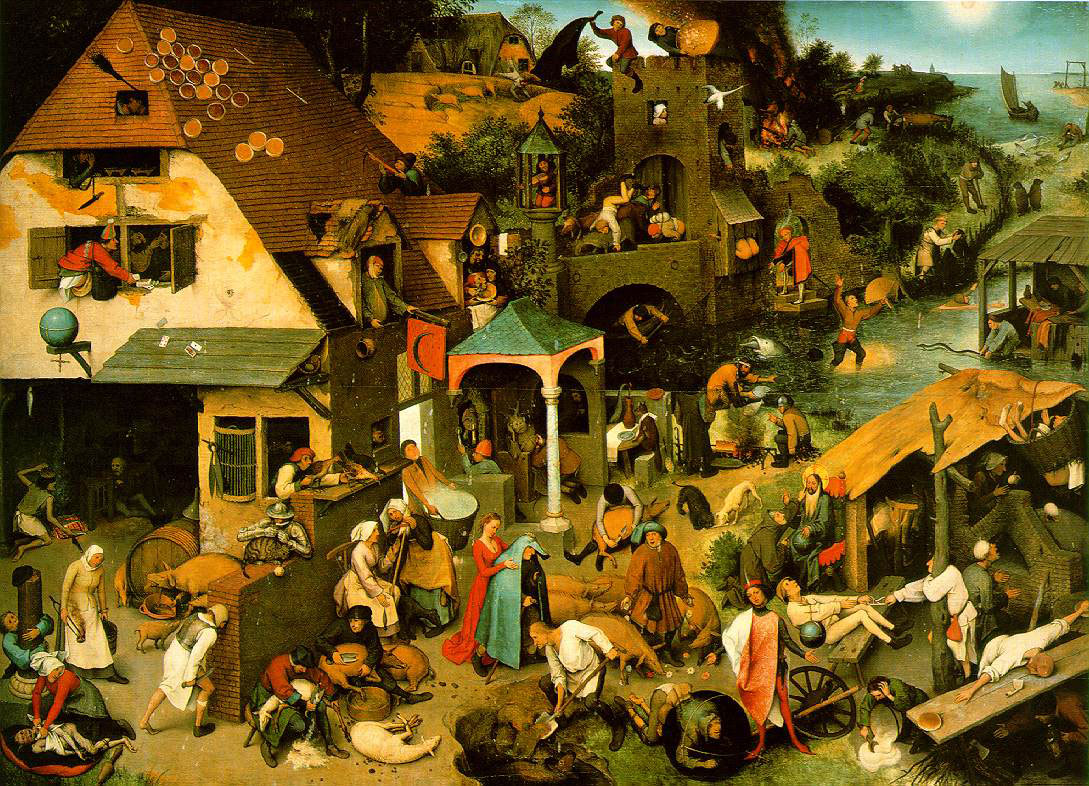
Stop and talk to the gym owner. He is going through third divorce. Sucks, for him. I live in a Brueghel — sweaty, pulsing, messy, high-density.

Drive home. One near miss. Eleven traffic lights. One incident. No hand gestures. Eleven emotions during whole drive.

Accelerate hard with the turbo-charged engine twice. Rocket forward. Smile twice. One phone call on car phone to wife. She’s in traffic. Our cars talk, then we talk.

Pull in garage. Car off. Break on. One car door. One backpack. One phone. One garage door button.

Greet my daughter and both cats. Stash backpack.

Make dinner. A hundred and seventy-two different steps.

Feed the cats in the middle of the process. Six motions.

Answer two texts. One from work.

Eat exhausted, with daughter, wondering if the homemade spaghetti is worth it. One hundred ten motions not counting chewing.

It wasn’t, worth it. Daughter didn’t like it, but it was good the next day as leftovers.

Do the dishes. Fifty four disparate movements.

Help my daughter change a setting her iPad. Stress! I didn’t want to.

Think about a bill I need to pay online. Decide to pay it in the morning.

Think about work. Eight thoughts in a row. Three were repeats.

Wife arrives home. Hug. Get her food. She likes the spaghetti. Ask about her day. Answer a text. Try to stop thinking about work.

Get a work related call. Ignore it.

Sit on the couch — exhausted. Turn on TV.

Run through the DVR list while scanning the news on my iPhone while answering a text.

Watch one show.

Go to my room. Think about life as a crush of details and problems. It’s clutter.

Think.

Read my Bible.

Pray.

Rethink.

Got it!

Life is simple.

There is the clutter, laden with detail, fraught with emotion, cargoed with movement, and then there is one simple thing.

I have only one thing to do.

I have just one choice to make.

One thought.

One movement.

One goal.

Love.

Simply love. Love them; love it.

All.

I go to sleep.

I’m okay.

When Africa crashed into Europe, the Alps jutted up from the earth

When India crashed into Asia, 40 to 50 million years ago, the Himalayas thrust into the sky. Marine fossils came to rest on the top of Mt. Everest, at over 29,000 feet! A crash put limestone sea beds on the roof of the world.

Modern geology has discovered powerful interior forces that have shaped the earth.

Yellowstone National Park, the unique steaming, hissing spouting world like-no-other is the result of an ancient super-volcano. Looking at the current landscape, ones sees nothing left poking up that resembles a volcano. Only the bubbling remains of Old Faithful tell of the tremendous heat that once blew this landscape apart.

4,000 years worth of supercomputer simulations of weather are now revealing an association between periodic changes in stratospheric wind patterns (the polar vortex) and similar rhythmic changes in deep-sea circulation.

The sky controls the sea!

Wow and superwow!

Interestingly, it is the same inside of our souls. We are beginning to understand how the psyche is formed. Superforces have been at work.

When one human, with its massive continent of thought and emotion, collides with another individuated mass of articulated humanification, a unique personality is thrust up. We are a product of the crash with our parents. The seabed of their lives ends up in the top of our heads. We discover their fossils at our highest altitudes.

And when hot human emotions collect beneath the surface, they eventually volcano, explode, and wipe the emotional landscape flat. The geography of human personality bubbles and hisses for years after.

And that’s not all folks. When the polar vortex of culture and tradition swirl above the people, the deep sea of human behavior circulates in a similar pattern below.

Life, inside and out, is shaped by hidden forces.

Interiority expresses itself in exteriority. This is the divine, the geological and the human order of things.

What to do? Search! Putter around, check out the clues, eyeball the landscape, ask the questions no one has dared ask, observe the revealing patterns.

Do you want to understand yourself? Then you must become a scientist of your own soul. Look at the framework under your own bridge.

Only discovers, seekers, microscope carrying hikers, hungry-to-know-what-happened rock-smashers and peak climbers, may read the clues left of the surface of exterior things and figure out what happened as a result of interior things.

A small tip for all psyche searchers looking to understand themselves and others.

Interiority often explains exteriority.

The drops of salt water spin off the football as it speeds away from me — beautiful, tiny, silver globes of light flying up and away from the ball

I love the combination of light, and water, especially as it flies in the air off a ball. I throw the football to my daughter. We are at a hot, sandy beach in Coronado, California. We love the beach. I raised my girls at at this beach and another favorite spot in La Jolla.

We laugh, we toss the football, it flies true, the water is bright.

I like the true and flying ball tossed between two people who are extremely okay with each other. My daughter and I are. We toss it back and forth. I like it when it spins in a perfect spiral. We each throw a couple perfect passes,  NFL kinds of passes out over the bright blue waters of San Diego.

Yesterday I ran into someone who pretended that it was okay between us. It isn’t.

People do that. They lie.

I find that to be singularly unattractive. No bright drops in the air here. No good tosses. Nothing true, righteous, good. For there is nothing that can fly back and forth in nicely spinning spirals between two word tossers when there are lies in the mix.

I don’t like pretending. I don’t like what is false. I don’t like what is spun wrong. And I’m not that fond of lies. I used to be, but I’ve pretty much gotten over that.

This morning I read some of the Psalms. I love the Psalms — lots of bright drops of truth spiraling through the air here. I ran across an interesting turn of phrase in Psalm 36:2.

In their own eyes they flatter themselves
    too much to detect or hate their sin.

We do that, think too much of ourselves to detect or hate our own sin, particularly if we are hooked on  highly additive substances like pride, greed or jealousy.

Crazy! True! And damaging. Lies are always damaging, and really the most damaging lies are the ones that we believe. We don’t call them lies but instead brand them as the truth. Scary, for really the most dangerous lies are when liars that tell them think that they are telling the truth.

I know, because I do this, deceive myself. We all do — from  time-to-time which can add up to most of the time.  We think we are honest, because we  admit small negatives about ourselves once in a while, when caught, but we do so only to hide our worse offenses behind the shabby ruses of a few minor confessions.

It’s something to get past.

How? Not easily.

I actually don’t think that we can get past our own lies very often, but I have seen that life can get us past them, past the self-flattery, the pretending and the ensuing falsehoods.  But to do this, life must get tough on us, and take a couple of whacks at us, right between the eyes.

If that happens, that we get pounded, I’d recommend we take the licking, and come up asking for more.

A beating, extreme trouble in life,  has a way of potentially knocking untruth out of us, so we may, if we will, become more humble, admit our falsity and put on stronger reading glasses. Then, through the clear eyepieces of bitter experience, perhaps we will be able to detect our private, personal and oh-so-deceptive prevarications, and then out the darkness in us.

Today, I went kayaking and snorkeling along the La Jolla cliffs with my wife, Linda. Beautiful, the bright blue water, the bright blue sky. It’s what we do in my family, and have done so many times, to clear our heads from too much work and a bit of untruth, especially the untruth that the world is only violent and ugly and full of lies.

Under the water, through my goggles, I ogle some shafts of sunlight shooting down to the bottom of the sea, illuminating a brilliant orange Garibaldi set against some bright green surf grass.

Nice! Bright. Real.  Orange. True.

Coming back to the kayak, I crawl in and Linda goes out for her snorkeling.  We take turns climbing out of and back into the craft,  and then we point and laugh at each other. We are ridiculous. Trying to get back into the boat, we hitch ourselves up on our stomachs and lay across the boat sideways. We look like beached seals, stranded on plastic.

It’s bright between us. Our relationship is full of truth. We laugh. We see ourselves as we are.

Then we head back. The water flies off our paddles as we power home though the bright light and truth.

The World is Flat, claimed Thomas Friedman in his 2005 national best seller.  The  book is  now seven years old, but it is still relevant, particularly in the competitive, dog-eat-dog world of economic stagnation and global competition and conflict.

For Freedman’s “flat” is about creating collaboration in the marketplace. He points out that in the international business community, people are working together as never before, wired together through the Internet. Freedman explains how economic cooperation between businesses all over the world has bulldozed a new, level playing field. Tutors in India now collaborate with American school children on their homework. UPS is now synced with Toshiba, fixing Toshiba’s laptops to save shipping expense and time.  People around the world build software together. Things are changing – fast. Are we?

When I read Friedman’s book, a few years ago, it got me to thinking hard about the spirituality. Is the spirituality growing more flat too? There is evidence for that. Many religious leaders now network internationally by email and mobile phone. Short-term missions’ trips to other countries are the norm in many churches. Megachurches are creating huge associations of thousands of churches that plug and play their curriculums. Globally, religious leaders of differing backgrounds are working more together to engage social issues like the HIV pandemic, poverty and addiction.

 And yet, while the concept of collaboration is inherently spiritual, and it is in vogue today, the religious landscape worldwide,  is still too often a rocky and jagged land of conflict and division.

 Knocked Flat

Christianity, the faith I know best, unfortunately, has a splintered look. Differences in belief and practice preserve deep canyons. A while back, I talked to a worship pastor who was told he couldn’t serve communion in his own church because his ordination was from another Christian denomination. And we often see little collaboration between churches in local communities.  The churches in my community too often do little more than rent rooms to each other. Sometimes it seems as if they are competing for attendees.

 In the upcoming presidential election, on some of the most significant issues, Christians are not likely to present a unified front. Four years ago, during our last Presidential election, instead of seeing Christians speak with one voice, we watched as fellow Christians handed out voting slates that followed party lines. On some issues, allegiance to the party seemed more important than allegiance to the body of Christ.

 On a very personal, pastoral level, flat is too often tragically missing. I once sat with a group of pastors openly discussing the high and low points of their careers. The low points? They all came when a decision was made by a church, a board or a colleague who ran over them. The stories all had messy endings. No eye-to-eye, on-the-same level, collaborative decision making here. It was the worst kind of flat, knocked flat.

 Sometimes it seems that companies like UPS, with their amazingly unified army of workers, process their conflicts better than the church. Starbucks seems to have created more shared culture between its stores than we have within our denominations.

 In our churches there are racial divides, political differences, belief barriers and hurt pastors. All this has gotten me to thinking. The church needs to flatten. I mean by this that we Christians need to humble ourselves and begin to better plough together through our differences. We need to learn to honor the value of a well-managed conflict. This is not naïve. A grand agreement won’t be possible on everything, but we can do better than this to beautify the bride of Christ.

 John M. Gottman in his book The Seven Principles for Making Marriage Work says that marital conflicts fall into two categories: solvable or perpetual. Perpetual conflicts are ones that remain in a relationship in some form or another. Gottman says 69% of marital conflicts are perpetual. In unstable marriages, these problems kill the relationship. In lasting relationships perpetual problems are acknowledged and discussed, again and again. The couple is constantly working them out, but they are always, for better or worse, working them out.

 The church has many perpetual problems. And on this planet, it always will, but is the bride of Christ doing its best to work them out, again and again?

 What Does Flat Look Like?

 While it is true that the business community is flattening, it is also true that it is still full of leadership hierarchy — CEO’s, supervisors, managers. Such authorities often make and drive key decisions. Of course this is also true of the church. Denominational presidents, committees, boards, executive pastors, senior pastors — such top-down leadership is often the source of vision and change. And it is precisely at that level that strong leaders should begin to affect needed change toward more collaboration.

 Act 6 shows us first-century, Biblical flat. And it evidences the effective use of collaborative decision-making among a leadership team.

 There was a problem. The Greek-speaking (or cultured) Jews complained to the Aramaic-speaking (or Palestinian) Jews that their widows were being overlooked in the daily distribution of food. So the twelve and all the disciples chose seven to take responsibility for the concern. Dr. Luke records that, “This proposal pleased the whole group, that is the twelve and all the disciples.” (Acts 6:5)

 That’s flat decision-making. A fairly good-sized, top-level leadership team met about a social problem. They talked openly and made choices that “pleased the whole group.”  They collaborated. The text doesn’t report that two sides polarized, that there was a split, that a new denomination formed, or that anyone left mad. Acts 6 flat was good; it produced a unifying decision. What pleased the group must have pleased God too.

 In the sacred places where we make decisions, we need such processes. We must not avoid dialogue, because if we do, we will avoid collaboration. And we must not avoid collaboration, for if we do, we may fail to take responsibility for “the Greek concern.” A few years ago the church I now pastor formed a new, outwardly looking vision statement. The process? Our leaders collaborated to hammer our vision out.  Swinging the hammer together worked.

 It is possible to get this right. But to do so, we must go to that sacred space where we sit down at the table and talk very honestly. This can happen, but first we will need to flatten our egos so we don’t flatten our neighbors, especially our neighbors from other backgrounds.

A while back I made friends with a young Muslim woman studying to be a lawyer. She told me of a tough incident in her life. One day, at the American University where she was studying, she stopped to help a student who was crying. The student looked up, and seeing my friend’s head covering, the crying student asked, “Are you going to hurt me?”

 “Why did she say that?” my Muslim friend asked me. “Ouch!” I winced inside over the insensitivity of her encounter. Then I tried to reassure my new friend that many Christians don’t hold this stereotype of Muslims. She invited me to her mosque. I went. I invited her to my church. She agreed to come. Dialogue built paths.

 Flat can be learned

 There is hope. Acts 15.1 shows the early church at an extreme impasse over differences between Hellenistic Jews and Hebraic Jews. It was no shallow conflict. It involved issues of Jewish law, the process of transformation, even of salvation.  

 It is fascinating to note how the dispute was handled. The disputing parties met together and they talked. They vigorously presented their views. One judge didn’t decide the case. Together they worked out an agreement that pleased, that worked for the group. They would accept differences. They wouldn’t require the non-Jews to be Jewish!

 And while the outcome was dramatic and defining, so was the process. The Jerusalem council modeled how the church should resolve its differences. Now we know from Paul’s letters that the Judaizers kept this battle going, lobbying for  Jewish law in Christian life to be continued. And really, the tension over the role of law, of rules and of traditions within the Christian faith has been perpetual, and it is still an issue today. But in Act 15, an environment was set up where people with differences talked. And this talk allowed a way to go forward in a manner that was highly productive. Gentiles were included in Christianity. It changed Chrisitianity from a small sectarian group into a world religion.

How did that work? The decision-making process was face-to-face. It involved the disputing parties. It was honest. It involved collaboration. It listened to feelings.  In these ways, it strikes me as similar to facilitative mediation, a process now offered to disputing parties, (with say family or business conflicts) who are seeking an alternative to court.

 The steps of facilitative mediation are roughly like this, as I learned them from the National Conflict Resolution Center training that I have gone through.

  • The sides meet.
  • Ground rules are set.
  • Both sides state the issue.
  • An area of shared value or experience is discussed.
  • The blocking emotions (anger, hurt, fear) are heard.
  • Together, the sides brainstorm solutions.
  • An agreement is written that fairly represent both interests. 
  • A win-win is achieved.

To have such a process, a wise mediator is crucial to help the sides listen, paraphrase and interpret how they are being affected. But a wise mediation is not simply someone trained in mediation. Mediation of deep conflicts can only be wisely handled by mediators who themselves have been knocked flat, who “get it,” because they’ve experienced it, because they have been humbled and because they have a deeply built in empathy and passion for win-win solutions. Then they can facilitate a discussion of shared values that moves towards a common ground. Only emotionally intelligent leaders will know that blocking emotions are something to resonate with, not stigmatize. And they will know, because they have themselves felt the emotions of hurt, betrayal and anger that if not allowed a place at the negotiating table, will sabotage the entire process.  

And then, the mutual solution giving — this is the good stuff. Both sides say what they can live with. Here is where a godly future is created. This is where the Greek problem is solved, the Jewish question answered. Here is where Christian love can make a difference, love that does not “insist on its own way,” (1 Cor.13:5, RSV) but commits to go our way, together, Jew and Greek, hand-in-hand.

This mediaton process is potentially highly restorative. It is Christian; it is spiritual; it is healthy; it is flattening. Steps like these can help us talk about even our perpetual problems. A process like this can set up a level playing field where we find ways to work together even when we don’t think alike. If we can be wise in this manner, we can limit the number of wounded and bleeding spiritual and political leaders. We can heal wounds.

And yet, we are not naïve. Progress won’t always follow a formula. Mediation of conflicts will sometime be messy and long. Some conflicts, especially when pride, jealousy, narrow-mindedness, greed, addiction and competition remain, will never be resolved. Others will take years, decades, even centuries to see progress.  Think of the partition of India and Pakistan. What a grave tragedy! And it remains.

To be realistic, some of our political and doctrinal conflicts will remain as perpetual problems. And our agreements, when they come on the big issues, may well come more through movements than meetings. But regardless of the road, the best solutions will be collaborative. We Christians should remember that even the  cannon of scripture and the doctrines of the faith were determined by councils. “Biblical” never has been one person’s or one church’s point of view.

Flat Is A Spiritual Shape

Conflict resolution through mediation, through rebuilding broken relationships is a challenging process. But it is a spiritual process too. God is a God of reconciliation and forgiveness. Wise men and women will mediate solutions that care for everyone involved.  (1 Corinthians 6:4) Working through conflict should be the norm in church offices and board rooms and religious leadership venues. The church, and the world that God wants is flat, when flat is defined as humility, love and working together.  Every pastor and denomination leader and world leader is responsible to resolve conflicts and engage in justice issues, and they would all do well to be more educated and skilled in facilitative mediation.

A few years ago, I traveled to South Africa. What beautiful Christians I came to know in the churches in Soweto. South Africans understand what conflict resolution can accomplish. When Soweto erupted in riots in 1976, the churches prayed that God would prevent a civil war. And God did, by using leaders like Nelson Mandela and  F. W. de Klerk. They eventually sat down together at the table of collaboration. They won a Nobel Peace Prize in for their work. 

Flat? It’s good, when it is a flat table where we sit down and allow round people a chance to have their say, to be understood, to collaborate, to participate in a shared solution, to create win-win endings.

That kind of flat is superb!

That kind of flat is a spiritual shape.

 

Marriage has four stages:

1. “I’m going to change her!”

2. “She’s not going to change!”

3. “My God, she changed!”

4. “What I just said, sounded exactly like her!”

That’s how it goes, and that’s how it lasts, as I’ve lived and seen it over thirty-three years of it.

For me, there are reasons to stay married.

The foods gets better — other things too.

Staying together is the only hope of driving away the kids.

I stay warm at night.

And I desparately need vowed, ringed, committed and unconditional love.

In fact, we all need and crave crazy-devoted love, die-hard love, romantic, gift-giving, promise-making, always-there love.

We want someone who won’t leave the house after we fight, who will be first to the hospital room when it all goes wrong and who will be still sitting beside us holding our hand when we are old and wrinkled and done.

And most of us can have that, or some of that,  if we will.

And if we can’t — we should get a cat, or a dog.

Animals are God’s antidote for an overdose of humans.

My other thoughts on marriage may be found at “The Modern Thought Proverbs of Randy Hasper,”   www.modernproverbs.net  Click on the category “Marriage.”

On Labor Day weekend people celebrate working by not working. Not me!

This holiday, I worked by choice. I worked Saturday September 1, Sunday, September 2,  and today, Monday, September 3. I worked all three days of Labor Day weekend, 2012, and I loved it

I would pay to work;  don’t tell my employer, and I would work for free, if I could afford it.  I do work for free, always putting in more time than is required, like this weekend. I did take a little time off on Saturday, to ride the ferry and to go to the San Diego Sand Castle Competition with my wife and daughter, between working.

Today, Monday, September 3, I didn’t go to work at my office, but I vacuumed the whole house, every tiny corner in every room. I loved doing it, except when the vacumm fell over on purpose just to annoy me.

Why, why vacuum like crazy on  Labor Day? Space dust and cat hair and corners and because I wanted to, and because yesterday my daughter said the house was dirty and because I really wanted to.

It’s reported that in 1882, Matthew Maguire, a machinist, first proposed the holiday of Labor Day while serving as secretary of the Central Labor Union of New York. It caught on, and it has become a national day for not working, for parties, for parades, for the beach, for barbecued food and also, for work for those who don’t want to stop working, to celebrate work with work.

I have no respect for Matthew Maguire. If he  had really wanted to celebrate work,  to honor it, to nobly salute it, he would have proposed that on one weekend of every year we all work all weekend, that we throw a huge work party where we work together, that we feast together at lunch and then go back to work and then feast more together for dinner and then work into the evening until we can’t take the excitement anymore and we go to bed.

Today, after I cleaned the house, I  edged the yard. I like the clean lines of edged grass. I like to work in my yard.

After that, I cleaned out my closet and took out all of the clothes I don’t wear anymore, and then I organized it. I’m more ready for work now.

Then I wrote a dozen proverbs, then this blog post. Writing is what I do for my work, my career, and also thinking, and writing about my thinking. I’m paid to think, and write, and talk, but I love it so much, that I do it for free when I’m not doing it for money. And today, in between writing, I went shopping to buy some new workout clothes.

I have heard a lot of seminars in my profession on the need to rest, a lot of talk cautioning us as professsional caregivers not to burn out, not to neglect self, family, to take breaks, to pace ourselves. It’s good, but it’s not all good.

Try being unemployed. That’s what’s not good. Not working burns people out. Not accomplishing anything is what really does a person in, because not working means not belonging and not having a place to go, not producing anything, not helping anyone, not making any money, not having anything to give back, and none of that is inspiring or meaningful. Work is what is inspiring. Work is meaningful. By work, we’ve made a good world to live well in.

Being is good, existentially, epistomologically, the philosophers tell us that,  but a working, moving, active being is better, especially in an world in need of justice and mercy and kindness and love.

I think we need to work more, not less, to move, act, do and be active more. And when we don’t have jobs, that’s the time to really work, because work is doing what we were made to do and meant to do and what needs to be done whenever we can do it.

I can’t wait to go to the gym this week! More work. I love working out. I love working in too.

I’m going home in a minute to barbecue some chicken. Then I’ll gladly do the dishes. I don’t think of it as work. I love to clean things, and to have a clean kitchen.

Then I’ll write some more in the cool of the evening on the back padio with the waterfall in my lily pond running and my cats lounging by the back door hoping to get out, wishing they could do something besides lying around.

What a great Labor Day!

I will get into bed tonight sad that it’s over, that I have to quit working. I’ll go to bed wishing I didn’t have to sleep, eager to wake again and work.

And I’m back to work tomorrow, but I’m planning on taking a day off later in the week in order to get some work done.

I went to a wedding last night, very social, very nice, good company, good beer, decent food — which of course we waited for. Waiting for the meal after the wedding is like waiting for the second coming; you know it will come but not the hour or the day.

But the waiting at least has a purpose — pictures with translate into memories, all good.

Actually this wedding was reasonable, the wait, the money spent, the whole thing.  The couple had been sensible about it. I’ve been to some that were completely over the top. Perhaps couples over-spend on their weddings to protect their marriages — they’ll have to stay together forever to have any hope of paying off the debt.

I met a lawyer at the wedding.  Cool. I like lawyers. They have stories.

“Tell me stuff,” I said.

“Give me a topic,” he said.

“Does money make a difference in court?” I asked.

“Money gives you access,” he said.

“Define access,” I said.

“Access comes through lawyers,” he said, “and motions. Say you have a patent case. The small guy is claiming that he created something, but if the rich company that has gotten a hold of it, and is not paying him adequately for it, prolongs the case long enough, filing motion after motion, then at some point the little guy can’t afford it, and he gives up. Money wins.”

I got it. In court, the rich defeat the poor by outlasting them. No money? No power!

It sucks to be poor, in court, and weak.

It suck so be weak at all. It sucks not to have access, to not have a nice wedding, to not be able to last all the way to justice in court or to not have what you need to live.

I gave away a bunch of  money yesterday and then some today too.

Why?

Access. I want some people in my family, people I really love,  to have access, and some of my friends too,  so I choose to resource them in the same way that I have been resourced, with access. I  have been given access and I am beginning to want to be a person who provides access to others.

It has come to my attention that access is a big deal, and that God himself is outrageously committed to access.  Look around. He holds back his judgments, he blesses the earth with resources and beauty, he waits, he forgives, he waits some more, he is patient, he is unfathomably patient, he pauses, we live in the great pause, we have been given time to choose, to change, to experiment, to fail, to try again, to persent our case, to have a hearing, to be given justice, to have justice withheld and replaced by mercy,  to discourage him and each other and yet remain under the fierce weight of his patience.

The door of the world is open, the windows flung back, the roof is off, the sky is huge, waiting for us to decide. The  white  carpet is laid out for us, the bridal party awaits us at the other end, smiles everywhere, expectant on us, to run down the aisle of the universe to them, to the meal, to justice, to the wedding gifts.

Incredible. Unspeakable. Shocking. Knock you down good.

Access is being poured out on the earth by a good God.

Our best response. Take it, and make access for others too.

The sun rotates every 28 days. Not being solid, it should be slightly flattened by its rotation. But an international team of scientists using the Solar Dynamics Observatory have have determined how perfectly round it is.

If scaled to the size of a beach ball, it would be so round that the difference between the widest and narrowest diameters would be much less than the width of a human hair.

Other subsurface forces must be exerting more of an effect than expected. Such is the nature of reality. Things have a shape. Unexpected forces are at work to maintains that.

Cool! It’s incredible! I love it. Like Cezanne I love a sphere. God work.

I have a daughter with brain damage. I suffer the pain of chronic nerve damage, and my heart has been broken too. I once had a very close friend turn on me.

I could have been flattened by such rotations. I haven’t been. I have had a charmed life. So much good has come my way.

I have been educated in literature, linguistics, history and pain.

I am married to woman who specializes in discovering information.

I am a writer.

I live to make geometric sense out of reality.

Unexpected forces have done this. God work.

As a result of all this and everyday realities that round me out, I am becoming more and more of the kind of round I was always intended to be.

The unvarnished truth is that each one of us is a sun. Each of our lives is a shape, and internal and external forces are at work to persist into forming us into something extremely beautiful.

It’s round light.

It’s the kind of round that is within a hairs breadth of being perfect.

It is the work of God.

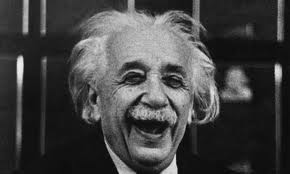
Albert Einstein is of course well-known for his theory of relativity, and E = mc and other cool phy sics stuff. Max Born,  giant of 20th century physics, called his theory of relativity “the greatest feat of human thinking about nature.” But there is a lot more than that to Albert.

Einstein published hundreds of books and articles on all kinds of topics. He thought widely. But perhaps the books, the theories, and the smart reputation as a genius, all the intellectually fancy stuff, has kept us from the man.

Einstein, the man, is worth knowing. He was not just smart; he was fun. He was not just brilliant; Albert was very human. In fact at the very time that he was publishing his theory of relativity, he was in conflict with his estranged wife and wrestling to find a meaningful way to relate to his children. But for all his serious family problems and serious scientific theories he was not just serious, he was droll and naughty in a schoolboy kind of way.

He wrote: “Common sense is the collection of prejudices acquired by age eighteen.”  

I like it!  I’m still trying to recover from common sense,  to finally think at least something uncommon.

Einstein also iconclastically quipped, “Education is what remains after one has forgotten what one has learned in school.”

Touche, even if it wasn’t entirely true! Curiosity and imagination and research lead him far beyond the classroom.

He said that “The only source of knowledge is experience,” and he practiced that, except of course for all the math and physics he learned in the classroom! He never lost his “holy curiousity.”

It’s the bit of rogue in him that I like, the maverick, the unconventional thinker, his,”Imagination is more important than knowledge.”

He advised against reading too much. “Any man who reads too much and uses his own brain too little falls into lazy habits of thinking.” I like it; I read too much, and if I can take Albert’s wry advice, there may be hope for me yet.

Einstein came at God this way, sideways, obliquely, interestingly. He said, “Coincidence is God’s way of remaining anonymous.” He also said, “I am a deeply religious non believer.” His “God doesn’t play dice with the world” has been widely repeated and widely misunderstood.

There is also the down to earth, kind of pure, in-the-moment Einstein. “I never think of the future. It comes soon enough.” It did for him — relatively.

And there is the Einstein who saw all the evils that could come from stupid national loyalties and from war.  I like his passion for peace, his love of our race, his desire to protect, his anger. He roared,  “Nationalism is an infantile disease. It is the measles of mankind.

He also said, “Heroism on command, senseless violence, and all the loathsome nonsense that goes by the name of patriotism – how passionately I hate them!”

Albert was a complicated man, with some complicated family relationships and some complicated math in his head,  and yet he wrote,”Make everything as simple as possible, but not simpler,” and “If you can’t explain it simply, you don’t understand it well enough.”

Before World War II, Einstein was so well-known in America that he it was said that he would be stopped on the street by people wanting him to explain “that theory.” He finally figured out a way to handle the question. He told the people who stopped him, “Pardon me, sorry! Always I am mistaken for Professor Einstein.”

He was practicing his belief: “Creativity is intelligence having fun.”  The wild man with the wild hair and the wild brain — it would have been fun to trade a few quips with him.