Archive for the ‘beautiful’ Category

We missed the gorgeous streak of jalousied light on the texturized white wall in the front room, just above the couch,  blazing with glory from the roiling, radiant sun because we were thinking about how he had “umhed” and “rrrhed” two years ago, backstabbing us in full daylight with people watching apathetically.

And so right there, in full sight of the devine, we dispossessed the present with the raging despotism of the past. If not that, something else is always getting in, between us and beauty.

We are, and I do not hesitate to say this anymore, aesthetically marginalized by our own myopic distortions of present tense reality,  lost in the gap that exists between our pathetic squints and blinks and the blazing, glancing, whipping spiritualized light of shockingly full-tint, full-throttle reality.

We are tyrannized by our habitual, paranoic, self-limiting, psychic-poor, observationless ways. We gunk and sputter to a stop, short of it and late, epistemic hat in hand stuttering excuses.

Enough has been wasted. Enough reality has been squandered. It is time to slow time, to dawdle with the second-hand and to fiddle and twiddle and muddle with duration and intensity and lengthification.

Today I sat out in the backyard with two young friends and talked about their upcoming marriage. Beautiful!  They, the approaching night, the cool ocean breeze, the nasturtiums lurking slyly along the sidelines — all breath-stopping gorgeous. Then the evening tiptoed in on our words,  drop-dead, wow-you-down, baptized in splendor gorgeous. The water fall in the pond fell glancing behind our thoughts and danced into the lovely idea of a more focused future.

We sipped strawberry lemonade on ice, sucking the sugary red nectar inside our mouths, sucking up the symbiotic ambrosia of the together-now.

We poked and prodded several and various globes of seeing and imagining and believing.

I enjoyed it, the ambience of my friends; I relaxed into it, the extruded presence of my spiritual children — our fully mutualized sentience,  the rise and fall of our texturized voices,  the splashing water, the yellow flowers beyond her hair, the shade tree arching above his dark eyebrows, the possibility of a different future flowing into the air and swirling in the breeze around our cheeks.

The question is more obvious to me lately. What does it mean to live wisely, fully, meaningfully?

I  always feel a little cheated, a little out of it, a bit of a distance between myself and what is, and what is beautiful and what is perfect and pure and falling down softly day-to-day on the walls and heads and minds of the righteous and the evil ones too.

I haven’t got it, but I am beginning to grab a few broken bits and pieces of it.

I want to fully embrace the now. I need to acutely and astutely and even savagely engage the present, activate the awareness of the flow of life that is immediate to the moment, to the space close and at hand and nearer than even that, the only spaces that actually exist and that I can touch with my heat-prints in the ever and  now, the water and flowers and air and presence of my people.

I’m telling you and myself now, that I need and want to look into people’s eyes longer than I am accustomed to. To look, to see, to love, to love again because I haven’t looked, and we haven’t and we don’t really see each other, but we can and must and can again as we age and become a million years old in the seeing experience by the power of him who made the blind eyes to see and the seeing eyes to see again.

I confess it; I desperately need to savor my food and drink longer in my mouth than I have before. It is good! It is better than I have given it credit for. It is the gift, of life, the bread of life, and I love it,  stawberry life, lemon life, hazelnut life waterfalling down my tongue and into my throat.

And I need so much, and may I be so bold as to say to you too that you need so much to pick up the child reaching up to us for a hug. I need that child and that child needs me and I need to carry her and take him by the hand and pat his head and affirm the reality and value of the presence person,  of that little, fragile, precious being.

I must and do and want to  reel up that thought again, each thought again, each and every brilliantly-faced thought,  and hold it like a diamond and stare at it and ruminate over it, and polish itwith my mind, like a stone tumbling across the fast flowing stream of my hypothalamic electrifications.

And I need, need, need God, and I now know that I want, want, want the divine, more than anything. I must get clear on this, everything is from him and to him and for him forever, and I will, to thrive, wrap everything up in the him of the him of him.

And I need my dear ones, my family and my friends, and I must pull them around me and have that time and that talk and that presence in the room even when there is no talk. I cannot and will not, I absolutely refuse, to be alone for very long, because this is wise and there is no wise away from my precious ones that have been given to me.

Listen, I don’t have it, but I’m crudely gesturing toward it; I’m psycholingustically guessing about it; I am sociolinguistically posturing it its direction. I’m spirituologically sponsoring, for you and for me, its very essence.

I command you now, in the name of all that is good and holy, run after ontological joy that looks something like what I have tried to show you here.

This is what the proverb makers and the psalm mongers have always meant by being the wisdom-sage scholar.

I went to San Francisco last week to see as much as I could see.

I had that crazy good feeling, that so many of us feel, that makes us want to get up and go out and see it! So I did.

Standing in a narrow alley in Chinatown by the “Delicious Dim Sum” restaurant, I heard the noisy Mahjong tiles in the apartment above.

It was a moment of awareness, just as I had experienced shortly before, when I had seen the Chinese men in the park, talking over the newspaper together, gesturing and commenting and laughing. I saw them, and they seemed so perfectly typical to me, old men hanging out together in the morning, but I didn’t know what they were saying, or thinking or reading.

And standing in the alley, I couldn’t see the Mahjong game above, the players, the stories of the players, their lives and loves and their wins and losses, but I saw the alley, and the underware drying just outside of one window, and I heard the slap of the tiles on the table above.

I saw it, and I didn’t. It’s always this way, for all of us, but the thing is to keep on looking, and to take a second look.

Earlier, we had riden up Hyde Street in a cable car,  clanking and vibrating along up the hill. It felt good. The view of the street and bay out of the back of the old wood and metal was a perfect San Francisco scene, bright, and watery and sloped and lovely and charming. But when we rode the Powell line down to Market Street, and I stopped a moment and talked to the operator as I got off, the view changed.

“They’re screwing us!” he said. “We get no respect from the people who own the company. The police and firemen are treated better than us. But they just keep cutting us. We’re probably going to go on strike. It isn’t right.”

He was angry, frustrated,  embittered. His losses surfaced, and I saw them. The view from his car was different from the view from mine.

Interesting, reality, changes, according to the point of view.

One day in the city, we rode the ferry out to Alcatraz island. Everyone says to do this, so we did. They were right. Interesting, again. Here we saw another reality — prison life. I was particularly engaged by men that we met from the peeks we got between the bars.

The men’s stories, on the audio tour, brought the prison back to life. We heard from the prisoners themselves,  how dark the cell block was at night, but also how the sun would come in one end of the cell block in the early evening, and light the place with life and warmth and beauty in an ugly place, and  how at Christmas, the children of the guards would come sing Christmas carols to the prisoners that they never saw, and how on a summer evening, the prisoners could hear the sounds drifting across the bay from the city, a woman’s laugh, a snatch of music. 

The life they had before, for them, was out of reach here, but it was so very close. This is a  feeling that I too have known, close but so far too.

I was particularly struck by one snatch of story we heard on the audio tour of Alcatraz, how one prisoner was released from the prison, but free and on the street, he said he was lost because,  “the world was moving differently than I was used to, and I didn’t know how to move with it, and everyone had some place to go, but I didn’t have any place to go.”

He saw a different San Francisco that a tourist with a map and a friend and a destination and a place to go home to when the sites had been seen and enjoyed and marked off the must-see list. He had no map, and no list and no home to go to.

In the San Francisco Museum of Modern art, we stood and stared at Matisse’s Woman with a Hat. It is wildly colored picture, although we were told that the model, his wife, was dressed in black when she posed for the painting. Matisse saw it differently. When Woman with a Hat was exhibited at the 1905 Salon d’Automne in Paris, it caused and uproar and gave rise to the avant-garde movement Fauvism, from the French  fauves or “wild beasts.”

Matisse saw it differently, than he had before, life, wildly splashed and staring right at you with emotions bared.

I want to see, like Matisse, like the prisoners, like the cable car operators, like the Chinese families, see it all, know it all,  the stories within the stories, to really see and understand the world.

On Sunday, after we had returned from San Francisco to San Diego, I got to pray with Ishmael. He had never prayed before, never. He wasn’t sure if he wanted to, because he didn’t know how, but then he said he did want to. I prayed a short prayer, to help him, and he repeated it after me.  He wanted to do this, to know this, to have this experience, of God, of life, of all of life.

When we looked up, I asked Ishmael, who’s name means, “God hears,” how he felt. He said he felt good. Just an hour later, he was baptized. His choice, ten years old, his choice and no one elses, to stand up in front of the church and admit to being a God follower.

Stepping up half way out of the baptistery, he paused, and then he flipped his head down under the water again, one more time, a second look around, I guess.

He was learning, how to move, with the movements around and within him, and to pause, and to see, and to make the choice to take a second look around.

And this, I think,  is how it is done, and how one begins to begin to see more.

“Have you even lived on your own?” I asked.

“Not really,” she replied. “Even last year, when I moved out, I kept going back over to his house, even though I knew he didn’t really love me. He said he did, but I know he didn’t.”

I turned her words over in my mind, like stones, looking at each side of each of them.”

“Perhaps it would be good,” I suggested, “for you to figure out your core, to become a strong independent woman, with known boundaries,” before you go back into any close relationships.”

“I think it would,” she said.

                                                                                          *****

I pushed the camera down in tall grass, pointed it up into the sunlit blades, and snapped a shot, blind.

Then I extracted the camera from the grassy mess, flipped on the LCD screen and peered into the shiny glass.  

Thatched, crossed, beautifully sunlit blades — captured in detail was a pure ribbed and vaulted glory.

                                                                                          *****

I pulled off the cover and glanced down at the tops of the valves, damp and webby and spidery. The manifold linked the valves together and then sent three-quarter inch pipes plunging into the ground. It didn’t make complete sence. I sat down on the low wall and looked harder. The one inch pipe was the supply line, the three-quarter inch  pipes fed each zone. Looking more closely, I could see that some of the pipes on the manifold were threaded. Then I knew. This beast could be screwed apart and another valve easily added.  By means of a few intricacies, I could yet turn my backyard into Eden.

                                                                                           ******

I’ve noticed of late that both the beauty and the way forward are often found right in front of us, within the peculiarity of the details.

 “We’re all just trash waiting to be thrown away! That’s all a toy is!” screams Lotso, the stuffed bear,  in  in Toy Story 3.

“You’re terrific as far as I am concerned,” Charlotte tells Wilber the pig in Charlotte’s Web.

Talking toys, spiders, and pigs —  fun, fascinating and entertaining.

How?

How do toys and spiders come by parts, lines, and fame, in fact more fame than most humans. How do such characters enter and dominate the thinking, talking and emoting world of humans?

By means of imagination, the happy(although not always) fun-loving gift given to humans. 

Imagine it, and it lives. Imagine it and it is real, at least in our minds, and maybe in the next reality that we construct.

Perhaps, many of us have played it way to safe, mentally. Perhaps we have thought that we have had to remain safely within the boundaries of our previous thoughts, but we don’t, have to, retain such constrictions.  

We can jump, mentally, and run around the rooms of our brains and find a door and break out. We can stride, gallop, and break into a flat-out mental romp.

Through imagination can come a new invention, solution and creation. Through the imagined image we can bring a new story, poem, play, song and artwork. Clever, cute, fun, sad, touching, entertaining, fascinating, shocking, disturbing — this is the power of the imagination.

Think it out, flesh it out, and give it away. And this is not merely the privilege of writers, musicians and actors. Imagination is the gift of the scientist. And it is the gift of the mom, the housewife, the plumber and the office manager. It is the gift of anyone who wants it, who will risk it.

We all have an imagination.  We all can think of a possibility not yet thought of. We can all take off the mental restraints and fly into unthought realms to solve any problem, to animate any thought, to explore any question.

So.

Think freely. Fly faster. See further.

 If you were to imagine something better, more fun, more healing, more constructive than you have yesterday, what would it be today?

I want it. I want to snorkel it, I want to telescope it, I want to drive in it, I want to plant it in my backyard, I want to eat it, I want to look at paintings of it, I want to see buildings that revel in it;  I want to put it on the top shelf of my brain every night and sleep on it.  I want to happen upon it unawares on the ground or on a wall or on a face and be startled again by the drop-dead gorgeousness of the gorgeousness of the gorgeous.
Last week, I saw a man hand a woman a bag of free food – beautiful.

I saw a cat peak with yellow eyes, black face and white whiskers through a hole in a box—beautiful.

I saw the shadow of a tree on a wall, shadow art, lacey and intricate grey drawings,  caved paintings, duplications of the ideal forms of things. I was Platonic again in that moment.

I saw a baby crawling, sitting, clapping, bright eyed, expectant, insatiably curious – absolutely beautiful.

We live in a God-kissed world; his lipstick is all over the place.  This is why sunsets and Indian Paint Bush are red.

I couldn’t resist the charms of a pack of rosy colored Impatiens at Lowes last week. I brought six plants home, all blooming with best shade of red ever and planted them in my back yard along with some new bright green sod. I planted the flowers in front of my repainted, white, stucco terrace wall. I really like the rough surface of stucco; flowers and trees and grass look knock-you-out beautiful posing up against stucco. It never stops —  the divine smouching,  the physical evidence, the outrageous beauty.

On August 1, 2010 the sun flared, an arcing pillar of hot, white light rising up and flaring out from roiling surface. Recorded by NASA’s Solar Dynamics Observatory at extreme-ultraviolet wavelengths, the photographs show a massive white, orange and yellow pillar of fire rising up off the sun.

Nice! Beautiful! We needed that, the flare, the flicker from the sun, the color in our eyes. Yellow fire, we’ve seen it before — the candles on Christmas Eve, flickering over the communion, highlighting the wine in the cup. The pure golden fire, lying on the beach as the sun sets, a glitter path of golden light running from the falling sun, across the waves and onto the sand.  

It’s good for us. On August 1 we  soaked in the flare, literally, the rays, as they flew on the solar wind to earth. One day a larger solar storm may stike us and destroy the electrical grid and wean us from TV and the Internet and managing our money online.  If that happens, it will be okay, really; it will give us more time to look around,  at the beauty.

I see that Lunt Solar Systems is now offering an affordable, compact hydrogen-alpha solar telescope that features a 35-mm etalon, with a bandpass narrower than 0.75 angstrom. It can show the Sun’s prominences and delicate surface detail. I want one. We all should have one. Iccarus should have left off with the wings and just sprung for one.  A solar flare, seen from afar, can make a day.

But the deal it that there are a lot of things to distract us from seeing the good stuff, to interfer. Too much, we miss it.

Today, more than a solar telescope, I felt like I needed some protein, and so in the morning, I engulfed my soymilk, wheat checks and coffee. The brown, latticed squares crunched hard and fast, as well as the second bowl and the second slurped cup of coffee went down smooth. As the protein, carbs and caffeine weighed in, I began to near humanhood again.  The first grumble at our house is sometimes, “Just give me the coffee, and no one will get hurt.” Eating and drinking is good habit, a good habit, but good habits  can keep us from seeing better stuff — flares.

Last night, I  wanted sleep more than star light or meteors or other bright visual stuff. I know that because I closed my eyes at 8:30 pm. with the light still on for my wife’s reading, and went to sleep.  Running my reciprocating saw all morning cutting metal bolts and flanges in the backyard had dramatically depleted my stored energy. These bits and pieces of rusted metal were remnants of someone plan for a patio cover — never realized. We dream, of the sun and of shade, but sometimes, like Jonah by his withered plant,  we fail at it.

This afternoon, I wanted safety, not beauty. I know that because I slowed on the turn around the lake in my SUV, coming back from Lowe’s, negotiating the SUV lean, wishing I was driving the MGB that I owned in college, but being careful in what I was in – a living room on wheels, not much more negotiable in a turn than a book mobile. But speed will have to wait,  perhaps until the Infiniti G-35 sport coupe that I occasionally lust after and may some day fall for. I checked the intersection at H Street and Eastlake Drive before entering to avoid any Mr. Toad’s driving furiously by.  And last night, for more safety, I avoided watching the evening news. What I don’t know isn’t in my mind, to scare me. Safety is overrated. It too often wastes the use of our eyes.

And this evening, I felt like I needed a real kiss, not a solar kiss. I know that because when my wife came home from work, I was really happy to see her and gave her a big hug, and we ate Mexican food together on the patio and talked over the day’s trivial events, as good wives and husbands do all over the world, making sense of the day, calming the little things we did and said that day down, telling them in a story, settling them in for the night. We were Mrs. Darling in Peter Pan, folding and stacking the mental mess, putting the good on top, packing the undesirable at the bottom of our minds.  The Mexican food helped because Mexican food makes for good talk because it is multi-colored and beautiful  — green, red, yellow – and it can inspire multi-level thinking, and with a Corona to wash it down, it can inspire colorful conversations – sometimes.

But protein, sleep, safety and kisses are not enough. Something is still missing. We also need beauty. This is one thing I have sometimes forgotten but keep coming back to strong now. I need beauty, a cup full, a bowl ful, a world full, a sky full, everyday. So does everyone else,  but we all tend to forget it in all the pursuit of the other pursuits that pursue us.

During my recent garden project that resulted in a nice layer of sod in my backyard, I glued a lot of schedule 40 PVC irrigation pipe. To stick it together, I used Christy’s “Red Hot Blue Glue.” I love Christy’s glue. It’s beautiful with the lid off, ropy, as deep blue in color as my grade school girlfriend’s Teresa’s eyes and it makes me dizzy in the same way she did. To avoid Christy’s seduction on my recent project, I wore my snorkel and mask when gluing the pipe together in the trench. It’s the same breathing tackle I used in Maui on our last trip to the islands. But when you wear your mask and snorkel in the backyard while carrying a can of blue glue and some white pipe around, you risk the neighbors avoiding you forever hence forth. But it can’t be gotten around. The pipe must be laid. A beautiful lawn is really all about what’s underneath, schedule 40, some male and female connectors, some risers and Christy’s hot blue glue. One night I wore my mask and snorkel to bed, putting it on while my wife was in the bathroom. When she came out,  I was ready, looking out over the sheets through my silicon mask, breathing noisily. Her, not so much. 

It’s universal, the lunge toward beauty, the beauty projects, the willingness to lay pipe to create lawn.  Some of our greatest minds have been chronically in need of a daily dose of the gorgeous – obviously. Consider Xie He,  the Chinese art critic known of his six elements that define a painting,  Johannes Vermeer, the Dutch master of painted light, Carl Linnaeus, the Swiss father of taxonomy,  Antoni Gaudi,  the Spanish architect of biomorphic buildings, Coco Chanel, the French fashion designer, Satyajit Ray, the great Indian filmmaker, Auguste Escoffier, the French emperor of chefs, Leonardo da Vinci the Italian genius, Shakespeare, the English bard – all clearly ached for beauty.  All their art and art criticism and science and architecture, clothing, movies, culinary delight, intricate machinery, fine literature and a lot more stuff in our world bears witness to our wildly aesthetic bent, Shakespeare’s Hamlet, da Vinci’s flying machines, Coco’s little black dress – “Wow!” 

And we don’t merely need one beauty; we long for and crave many  beauties, one of them being that shapely thing we call size. We humans are wildly attracted to things cubic, things with circumference, with volume. When I was in college a friend and I shared rides to school. She was taking beginning Astronomy and loaned me one of her text books, The Stars by H. A. Rey. It is a children’s book and so it is very helpful to everyone.

There I first learned about the stars. Stars have circumference, a lot of it. They have pull, gravity, and an appetite; they eat and are eaten by each other. I was smitten by the huge, round, hot, white, blue and red orbs and their groupings in space.

Using her big blue book, I identified the constellations for the first time in my life. I thrilled over discovering Orion, as if I were the first discoverer, the belt, the sword, the nebulae therein.  I bought my own copy of Rey’s book. I went on a trip with her class and wandering innocently up to a telescope I bent down and saw the faded butterscotch orb and brilliant arching rings of Saturn.

“Incredible! It doesn’t look real. I didn’t know you could see the rings of Saturn in a little telescope. That’s the Cassini Division in the rings?  Wow! Superwow!”

I gushed. I grinned. This was it. This struck a chord in me; the ring was for me a beautiful F# minor 7th, a combination of harmonious notes to play again, to come back to whenever playing an E, an A2, a B2 and a C# minor 7th.  It fit, it belonged, it seemed to me that it wanted to belong in this measure of song, in this movement, of this piece, in this given universe. And perhaps it was more even than that, and indicated something fishy going on here, something behind the scenes, something weirdly wonderful in the physics of the stuff we live close to.   

The split between the A and B rings is one of the most beautiful splits in the universe to look into, much like the Grand Canyon or the split between the left and right brain. The rings on each side of the Cassini are flying flocks of rocks, shepherded by moons. How cool is that?  

“Gorgeous!  Amazing! Wow. Wow. Wow!”

I read in H. A. Rey that if you placed Saturn between the moon and the earth the rings would almost touch reach the moon on one side, the earth on the other. I celebrated that and still do, inside and out. That night I also saw the moons of Jupiter and its cloud belt. I was astonished, ripped, wrought. I went back home and bought a four inch reflector. I pointed it up and was astonished.  But it wasn’t big enough for my appetite. More light was needed.

I bought an eight inch Celestron — beautiful, in itself, in fact, so much so that  by it I was distracted from the stars for a moment  much in the way that cars distracted me from math in high school. What a gorgeous work of art is the Schmidt Cassegrain telescope —  the central opening in its primary mirror, the folded light path, the sleek and shiny corrector plate.  And the views it gave up, they were something to “ooh” and “ah” over — Saturn’s belts, Jupiter’s red spot, Venus’s crescent, Mar’s white polar cap against its dusky orange sphere, the perceptible disks of Uranus and Neptune.  

I went crazy for aperture. I found a used 13.1 inch Coulter Optical Dobsonian in the paper, bought it and refurbished it. It was a light bucket. I fell in love with the mirror. I cleaned it, stroked its silver skin, polished its gentle curve. I now owned an observatory. I could find and gawk at hundreds of fuzzy galaxies with 100 million stars in them, more, more, more, the hunt for the mystery, the look, through the eye piece at the wonders.  I couldn’t get enough celestial beauty; I still can’t. I adore the Orion Nebulae, the Ring Nebulae, the Veil Nebulae, the great globular cluster M-13, the Whirlpool galaxy. They never stop thrilling me. Anyone who has missed them should do nothing else at all until they have seen them. One should not exit earth wthout seeing what is beyond earth.

The other night I looked up. The moon was huge and far and white. I put it in my eye, and I washed a little bit of the difficult day out with it. This is it, the beauty washes us, it cleans us, it restores the orderly in us again; the beauty is Mrs. Darling, bent over our disturbing dreams, straightening the covers, kissing us on the foreheads and saying “Goodnight, my little sweethearts.”

We must go places where we can see further. It should be mandated that we frequent viewpoints and lookouts. This last spring, I went out to the Anza Borrego desert east of San Diego. From highway 79 just south of the town of Julian I stopped at the desert outlook. I squeezed through the sun roof of my SUV and sat on top. Thousands of feet below and miles away, were the beautiful, sandy desert and beyond the blue Salton Sea. I soaked my psyche in the far off.

But what is the beauty of distance, of size of volume, without the beauty of color. Color is fuel, drugs, the palate of the mind. I love color. This spring my wife and I hiked the trail from the top of Torrey Pines, south of Del Mar, down to the beach. Stopping half way down, the color palate was stunning, yellow Sea Dahlias, red Paint Bush, blue heliotrope, purple and white Black Sage and the red sand cliffs and the aqua marine ocean with the black dolphins riding on it, swimming south in the sea in lyrical, synchronized movements.

I needed this because I had worked too much in confined spaces, too close to sheet rock and neutral wall paint for too long. I went home cured, temporarily.

I love the watery beach with the same love that I have for the desert. They wear similar makeup. One year when we went out to hike the Palm Canyon in the Anza Borrego desert, just east of San Diego, it rained. There we were, hiking up the canyon, ogling the flaming red tips of the Ocotillo, the yellow clumps of brittle bush, the magenta explosions shooting out the tops of the beaver tails. Then it rained, and the canyon was transformed into a cathedral, the wet walls became stained glass windows, rich in reds and blacks and gleaming browns and yellows.

A few years back my wife and I toured Italy,  an art circle tour. In Assisi we visited the basilica of Saint Francis. We were struck by the frescoes in the lower church, said to be painted by Giotto in his revolutionary naturalistic style. The life of Christ was depicted in blue and red and green and brown, simple shapes, elemental colors, archetypal stories.  Linda cried. I asked her why.

“They are so beautiful,” she said.

She is on to it. Everywhere we go we should be weeping, over the beauty, everywhere, in nature, in art, in each other, in faces. Just consider the glorious beauty of faces. I recently looked into the face of a woman with cancer and then into the face of her mother who had just prayed for her, thanking God for giving her, her little girl so long ago, a very old woman praying for her aging daughter and all the beauty she was at the beginning and is now, perhaps near the end.  I looked in their faces as they looked in each other’s familiar faces and there was pure, love-drenched beauty..

A few Sundays back, I saw a little girl walk to the front of the church by herself, standing in line, only eight and yet making her own decisions to take the sacrament, making her own choices to put herself in the moment of holiness. 

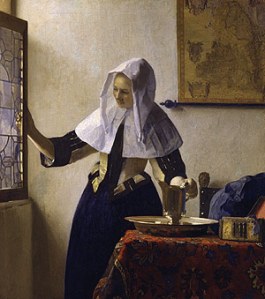
She stood expectant before the woman serving her, like Vermeer’s girl at the window, caught in the light, reaching to open the glass to something beautiful.  The little communicant held the bread, her short black hair cropped straight along the bottom of her chin, her head tilted as in the painting, angled slightly down and yet opening to something outside of herself.

Then she took the cup, and held this too, perhaps too long, certainly longer than the adults before and after her, either not sure what to do or simply savoring the moment, maybe a little embarrassed, always looking down at the hem of her dress, sipping the blood of Jesus so carefully, half emptying the cup and handing it over, as if it were too special to drink it all. Vermeer would have been frozen, stunned silent and motionless by the beauty.

We need such beauty, often, close, experienced, savored. We would do well to know that more and to make the conscious aesthetic choice to really see it when it is in front of us and to go find it when it is not,  to know it, to treasure it, to soak in it, and to let it inside of us to fill us up again.

I paused under a tree recently and to notice the little bright circles on the ground. It was the sun, shining through the leaves, reproduced, the solar pinhole effect, 386 billion billion megawatts of energy, in a tiny, me-sized, accessible image! I was reminded; we are here to pause, to Sabbath, to enjoy! This is it — the pause; we need to pause; we must pause.

I striped my church’s parking lot recently, laying down new white parking lines on the black asphalt. When I was finished, I paused, it was the divine pause; I enjoyed my work. This is how God must have felt after making the zebra. Stripes! It’s good. My striped parking lot is of the divine order of things.

I like the Hebrew Psalm, number 148. It’s a hymn of creation, the writer exulting in the galaxies, angels, sun, moon, rain – everything up there praising, the writer exulting in everything down here, including little creatures, praising. ”Praise the LORD …  “small creatures,” the Psalmist writes. I guess that includes ants and fleas. The Psalm presents a world-view that reveals a vast, universal hymn going up from the earth, from flea to galaxy, creation — all praising the maker of the beauty. It makes me think, hard.

It is a privileged to see the living Vermeers, and yet,  while we do our best to pile up beauty around us, art on the walls, food plated and presented perfectly, the faces we love captured and framed, the pet fur that we love kept near us in a box or a cage or a yard, our chromey and zoomy cars in the garage, our flowers on the table, much of the beauty of life isn’t in our hands to give and take. We go looking with our telescopes, but the event isn’t within our grasp. It’s cloudy or not; it’s given, or not.

On a recent warm, San Diego afternoon my wife and I paddled out into San Diego Bay from J Street Marina over arched by a steeply angling sun. We had come out to gape at the wonders. Sitting off-shore from the Chula Vista power plant, we turned in the kayak and looked west toward the Pacific Ocean. The roar of cars on Freeway 5 at our backs, we could see the Silver Strand running north from Imperial Beach to the almost-island town of Coronado,  a beautiful narrow strip of sand crowned with red tiled roofs and glowing palms. Condos, big houses, boat slips, the famous Hotel Del Coronado, upscale retail – more contrast to the industrial shore line behind us. 

We luxuriated in this watery commons, we soaked in the distances, we beheld the reflective plane, the flat lines as beautiful as those in a John Marin seascape, and then we turned back toward the power plant. My eyes traced the long line of one of the earthen dikes built to create its intake and discharge channels. What a contrast to Coronado’s strand. Chula Vista’s thin strips of fill material are as ugly as a ransacked room, narrow lines of eroding fill dirt and pieces of broken concrete. As we sat in our quiet watery moment, the beauty of the bay broke through like a shy smile.  The departing sun glittered across the ocean, over the strand, down the bay and onto our faces. The breeze became gentle, the water smoothed and then suddenly, very near, we saw what we had come to see.

A large curious head and curving protective shell broke the surface of the water. We aren’t alone. Swimming very near was a giant, green sea turtle, one from the group turtles that have made their residence in the warm waters of the power plant. One doesn’t have to go far in Chula Vista to see the marine treasures.  In 2009, Forbes magazine rated Chula Vista as one of the most boring cities in America. That’s interesting. Are there boring places? Or are there only bored people in uninvestigated, beautiful places?

We watched transfixed as the turtle broke the surface, opened its mouth, and then slipped back into the depths. It was a sighting of a wonder. It fell into the neural folder in my mind that held all the other sea turtles I have ever encountered. It found space beside the turtle I swam with two years ago on a gorgeous California summer day in La Jolla. That day, my marine buddy and I paddled together from Jolla Shores to the La Jolla Cove through glitteringly clear water, moving in tandem through the sparkling blue Pacific.

It landed in the same neurological row as the baby turtle I discovered while snorkeling off the west coast of Maui last summer. I found this little one on the bottom, sleeping under a rock shelf, then coming up to breathe with me and descending again in a slow arc to safer quarters.

Sea turtles, something given, offered  —  they are part of the beauty that we paddle through life with.

Last week on a bike ride with my wife, I saw a Snowy Egret fishing in a mud flat along the strand in Coronado — beautiful.

Today I say a large white bloom crowning the top of a dark green, glossy-leafed Magnolia tree on the main street running to my house — gorgeous.

And today I watched water cascade over the rock waterfall that I built in my backyard pond, glistening silver in  the sunlight and splashing happily onto the green lily pads that I have planted and carefully nurtured there — spectacular. Monet would approve.

It’s given, non-stop, everyday, offered, to us, out of love, for us — the beautiful!
Don’t it always seem to go

That you don’t know what you got ’til it’s gone.

They paved paradise, and put up a parking lot.

Big pop rock hit; cool lyrics; “Counting Crows,” Joni Mitchell — ongoing issue. How do we live on our earth? Do we pave it with asphalt or plant it with flowers? Do we save it or use it up?  But it’s not as simple as  that, a parking lot or a paradise. And rhetoric dominated by one-sided presentations doesn’t help. Our choice isn’t simply to eat organic, “go green”  and hog tie offending businesses, or “go business,” skip the regulations, cut the forest and protect the jobs.

Take the ants — we share paradise with them. How is that going for you? I personally kill the heck out of them. When they come to my house for dinner, I spray them with Raid or if I’m out of Raid, I nuke them with 409. A while back ants got in my kitchen sink. I washed them down the drain and turn on the garbage disposal. It didn’t bother me.  I grew up in a mid-western gun and fishing-rod culture. If it moved, we shot it.

I’ve moved beyond that now, I don’t go find things to kill. I only kill things if they come to my house uninvited, in a web or in a nest —  spiders and wasps. I hate spiders. I’m death to spiders. And while I’m confessing, I’m a serial flea-killer. I repeatedly put Advantage on my cats. .

And when it comes to pavement, I love asphalt, because I love cars, fast cars, rear-wheel driven, asphalt-ripping cars. Let’s see, a paradise or a parking lot? Most of us think it’s paradise when we find parking. I do.

But there is another side to me, and you. Most of us will be happy to drive cars that run on natural gas, electricity or solar power. And we all hate what is happening in the gulf; the BP oil disaster makes us sick. All that gooey brown oil flowing into our beautiful blue-green ocean, the flopping, dying creatures at the shore, the fisherman’s lost jobs. We love our earth. And we love our shrimp, with cocktail sauce on it. And we don’t like petroleum on our shrimp. We hate seeing the ocean ruined. Paradise for most of us includes asphalt, and sea food, but it isn’t an ocean full of oil.

And I’ll man up. I contributed to the BP disaster. I helped create BP. If you drive, you did too. Our love affair with the American auto, our toleration of the internal combustion engine is ruining the earth.

We didn’t rush the BP job; we didn’t violate the safety regulations; we didn’t fail to have a backup plan, but nonetheless, we don’t have a clear conscience. Steven Wright once said,  “A clear conscience is usually the sign of a bad memory.”  I have helped pollute the earth by wasteful living. I want to be different.

I like the Hebrew Psalm,  number 148. It’s a hymn of creation, the writer exulting in the galaxies, angels, sun, moon, rain – everything up there praising, the writer exulting in everything down here, including little creatures, praising. “Praise the LORD …  “small creatures,” the Psalmist writes. I guess that includes ants and fleas. The Psalm presents a world-view that reveals a vast, universal hymn going up from the earth, from flea to galaxy, creation — all  praising. It makes me think. We should be very careful when destroying what is praising. When we fill the ocean with oil we drowned some of the plankton praise.

But, Psalm 148 doesn’t cancel the food chain. The day the writer wrote Psalm 148, he probably had a quail egg for breakfast and a steak for lunch. The cattle and flying birds, while praising, flew into his mouth, no longer praising.

“Praise you!–  oooh no!”  Silence.

This is our world: some who praise kill others who praise and then package and sell the silenced praise.

But the truth is that the praising creation cannot live without consuming. Wendell Berry, the great environmentalist, wrote, “We cannot live without another dying.” “We depend upon other creatures and survive by their deaths. To live, we must daily break the body and shed the blood of Creation.”

The oats die so we can keep blowing in the wind. The chicken gives its life so we can keep squawking. We wash with the water, so we can be clean but then the water is dirty. We cut down a tree to build a house or a church, and we make a safe place from the tree in which to worship. 

We will consume, but how, that’s the issue. Wendell Berry: “When we do it ignorantly, greedily, clumsily, destructively, it is a desecration.”

It is not okay to pillage and rape anything. The Deep Horizon, BP oil disaster, the rushing of this job, the carelessness, the lack of a backup plan —  these are reminders of the damaging possibilities in such living. The destruction of the ozone layer, the loss of glaciers throughout the world, the cutting of the rain forests, the pollution of rivers, lakes oceans, the loss of evergreens throughout the western United States and Canada – the evidence is overwhelming, we are killing the planet that God gave us to nurture.

We must use to survive, but we must also steward, shepherd, nurture, pamper and sustain to  survive.

What to do?

Take care of yourself.. One of the best ways we can love and steward creation is taking care of our own bodies. We are the crown of creation, the greatest sacrament, and we must steward our bodies  and our minds

I bought a happy meal recently from Mc Donalds as an experiment. It didn’t make me happy. I took it apart  and was left with a small pile of food and a huge pile of wrappings. There were 14 surfaces of paper and plastic to present two, small greasy pieces of food, an egg in a bun and a fried potato paddy. It took me about eleven minutes to drive to McDonald’s, wait in line, and receive my meal.

The morning before I cooked my own breakfast at home.  I cooked up two eggs and added in fresh green onions, chives, fresh organic tomatoes and cheese. I toasted a slice of multi-grain bread and I made a smoothie from strawberries, blue berries and soy milk.  The eggs took 7 minutes to prepare and cook, the smoothie took 4 minutes. The whole process took me eleven minutes.

So what’s fast food? Home was as fast as McDonald’s. Most of us will confess that we are addicted to convenience, or is it just what we think is convenience?

We are aghast at what BP has done to the ocean, but many of us will dump oil in the form of saturated fats into our own little ocean, our bodies, without a qualm. It isn’t right, it doesn’t steward creation well, it’s hypocritical.  

What else?  We may not solve the BP disaster today, but we can nurture our own tattered cusp of Eden, the bay or river or stream near us, the town or city we live in by not driving too much, the community we live in by sharing our resources with neighbors, by giving a tithe of what we have to charities that renew and help the environment and people in need.  

Recently a sparrow flew in a classroom when I was teaching.  I got down on the floor and took it in my hands. The little creature was afraid,  warm, beautiful. I could feel its heart beating in my hands.  I thought about avian flu, but children were watching. So I took it out to the balcony and tossed it into the air. It flew, banging its wings against the air with praise.

I felt like Saint Francis of Assisi. But I washed my hands, just in case. 

I like myself when I act like this — nurturing the surrounding praise.

first communion

Posted: June 18, 2010 in beautiful
Tags: , , , , ,

She walked down  to the front of the church by herself, standing in line, only eight and yet making her own decisions to take the sacrament, making her own choices to put herself  in the moment of holiness. 
She stood expectant before the woman serving her, like Vermeer’s girl at the window, caught in the light, reaching to open the glass to something beautiful.  The little communicant held the bread, her short black hair cropped straight along the bottom of her chin , her head tilted as  in the painting, angled slightly down and yet opening to something outside of herself.

Then she took the cup, and held this too, perhaps too long, certainly longer than the adults before and after her, either not sure what to do or simply savoring the moment, maybe a little embarrassed, always looking down at the hem of her dress, sipping the blood of Jesus so carefully,  half emptying the cup and handing it over,  as if it were too special to drink it all. 

It was her first communion, but then firsts were now coming fast  for her. Only a few weeks before she prayed for Christ to live out his life in her. Shortly after that she was baptized, by her own choice.

The server took her cup from her, still half full, and she went back to her seat with her head still down.  The adults moved more quickly through the line after her. 

Not long after this,  a young boy came to the front. He had been served the sacrament already that morning, but now he was back for seconds.

“I’m hungry,” he said, looking up to the woman holding the bowl of bread.  “May I have some more?” She looked down at him and said softly,  “Certainly you can.” So he took another piece of the fresh, soft torn bread and stood there, before her, and ate it. Then looking up he said, “I’m still hungry. May I  have some more?” 

“Yes, you may have some more,” replied the woman with the bowl.  And so he ate again, standing at the altar hungry,  taking communion for a third time, eating the body of Christ again and again.

Then he returned to his  his seat.

It isn’t in the way things are usually done.

We adults take the bread and the wine by the book, as if by prescription, as if by mandate passed down from some ancient Pharmacopoeia Sacra, with the sacred liturgy and the defining rules for the administrations of the holy medicines. We know the drill; we hurry through, we get it done.

We nervously drain the cup; we never think to savor the bread; we don’t like to wait; we don’t know how hungry we are; we don’t go back for more.

And yet, what Jesus said about the little ones somehow comes to mind, “I tell you the truth, unless you change and become like little children, you will never enter the kingdom of heaven.” 

To stand expectantly in church as if in a Vermeer, by the window with our arm extended, the warm light  falling softly on our skin,  to keep our heads tilted down a little longer, waiting, savoring, opening to something, beautiful, to hold the fresh bread between our fingers a little longer, to drink the glossy, purple cup as if it were to precious to use all up.

To eat and drink and yet know that we have not had enough, to come again to the front to stand in the holy place hungry, to ask for more of what we are starving to death for but can’t get enough of — this we might learn from a child.  

Perhaps if we could only — and yet in time —  as we grow younger — perhaps we can do just these things.

Your brain is amazing! Although it weighs only about three pounds, it may well be the most complex structure in the universe. It’s been noted that there are as many neurons in your brain as there are stars in the Milky Way galaxy. You are a galaxy of brain activity. A typical neuron in your cortex receives input from some 10,000 other neurons.

As a baby you were able to process sounds spaced at a millisecond apart. You totally mastered a language with a vocabulary of 50,000 to 60,000 active words. Some of you learned several.

It has been estimated that you have from 25,000 to 50,000 thoughts a day. You are really busy, even just inside your head.

Busy at what? I’ve been watching your brain work. You think about what is going on around you. When TV or conversation or action engages your attention, then your mind is on that. You focus on what is right in front of you, on work, people, food. But when you are alone, even when you are with people, you sometimes seemed to fall into using your own personal galaxy to reflect, to interpret what is or what has been happening to you. At this point you rehearse the past or evaluate the moment and give your life meaning.

You use your amazing memory to replay trips, events, conversations and to stamp them with value.  And sometimes thinking about the past, launches  you into wondering about what’s ahead. You forecast and interpret the future based on the past, on past success, future danger, imagined solutions, growing problems.

The deal is, your brain jumps all over the place in a given day, moving around between the past, present and future.  Are you in control? Are you in control of your mental movements, of your focus, of your thoughts, of your 16,000 words a day? Let’s be honest. Sometimes you are and sometimes you aren’t.

Could you be more in control? A lot of experts now say you could. It’s a strong part of our human mindset. We tend to believe we can be in control of everything. And when we see that we aren’t, we tend to believe we can be if we just try harder.

You’ll find tons of support for this point of view. One school of such thinking is called cognitive therapy.  This way of thinking says that it is possible to control your mind. This approach encourages the exchange of negative thoughts for positive thoughts. There is something to this.

But not always. I’ve been watching you think, my friend, and I know that you aren’t always in control of your thoughts nor will you be nor can you be. Your mind is an ocean of activity. It will storm and it will calm, and you won’t always be in charge of that. Let’s have some humility here.

When life gets you, when you lose someone close, when you suffer things you don’t want, your mind will wander, and jump, and break away like wild horses. And then as time passes, and it tires of its flight, it will calm, and come again to you, returning home, returning to a safe place within you.  You will have positive thoughts, and you will have negative thoughts, but you won’t always be in control of your neurons. That flies in the face of what many people will tell you, what you may want to believe, but this, my friend, is true. We all fail when it comes to herding all the stars in the galaxy in perfect harmony.

That said, some control is possible, essential to good living.  You do have some control. It is good to have some control. I recommend you consider  using you mind, when you have control of it, like this:

Think about other people. This is one of the most extraordinary things you can do with your amazing brain. “Love your neighbor as yourself.” This isn’t natural. But this is supreme. The people who have lived best, and who have taken pain out of the world, put their incredible minds on others. Do so. You won’t regret this. The best use of a mind is to help someone else.

Use your brain to take action. Please don’t sit and think and reflect to such a degree that you become passive and fail to take needed action. Don’t over-think your life. Your amazing galaxy of neurons is built for doing. Activity increases brain function. I urge you, balance thinking with acting. 

Take time to reflect on your life. Acting without wise thinking can be tragic. Take time to think deeply. Think about life. Think about God. Consider your successes and what you have learned from them. When you are hurt and when you lose take time to grieve. Rehearse what you will say before you go into a difficult conversation. A return to positive thinking will take time. It won’t help to be dishonest about your thoughts and feelings. Sit and think. Be. Life isn’t just doing. Life is being, being an authentic mind.

Hope is the thing with feathers
That perches in the soul,
And sings the tune–without the words,
And never stops at all…

Emily Dickinson understood it,  hope, the feathered thing that sings on — most of the time.

When I woke up early this morning, reasons not hope came to mind — the news of the continuing BP Deep Horizon oil spill and other ugly bits and pieces of life like that, the disasters in some of  my friend’s lives, feathered things, flopping in the goo, sick or dying.  

Hope is challenged by the craziness out there, lives lost,  ocean creatures yet to perish, all that thick brown crude oil gushing into our clear, life-rich, beautiful, blue sea this morning and probably tomorrow morning too.

The brown oil swirled early today, a thick, gooey mess near the surface of my waking thoughts. But then, this morning, fortunately, sweet, brilliant Emily Dickinson also came to mind — and hope. I”ll put that in my head, all day, and not stop at all.

I say, hope on and sing on too.

Wipe off the ugly oil from your wings you fine feathered friends of mine and sing on. There is other news online today.

Sing on over the space shuttle Atlantis that landed safely this morning, having traveled over 120 million miles in its life.

Sing  on over Crystal Bowersox. A single mom with a fresh sound and a tune in her honest, open, loving heart didn’t win American Idol but she won the hearts of so many young Americans.

Sing on over hybrid automobiles and electric cars and natural gas-powered cars. A new era is coming when we will abandon the oil gulping, earth-trashing days of the past and take care to nurture the fragile earth we spin gentle on.

Sing on over new homes. Housing starts rose to an annual rate of 672000 in April, the fastest pace since October 2008.

Sing over recovery, success, change, newness. I know that this is not all there is in the news today.

But I say,  sing on my feathered friends and don’t stop at all.

 Hope deferred makes the heart sick, but a longing fulfilled is a tree of life. 

 Pr. 13.12


I snapped a photo of the gleaming white concrete steps and glanced upward into the narrowly ascending tile stairs.

How many people had come down those since they were made, stepping slowly so as not to slip, hearts pounding, anticipating the bottom, the backwards fall, the sudden sucked-in breath, the deadly shock?

Only a few hours earlier I had kneeled in the bottom of the pit, the tank, the concrete coffin and pounded away on the floor with a power bar. Paint chips flew everywhere, green paint, yellow paint, white paint. Dropping the bar, I grabbed my paint scraper and pushed it down hard, dragging it across the accumulated crud on the top of the paint and concrete. It screeched along the cold surface like fingers on a chalk board.

What was it? I wasn’t sure? Sediments from the water? Oils from people’s skin? The thin greasy yuck of ten or more generations of yellowing anger, lust, hatred, selfishness and pride? I sanded it, I TSP’ed it, I pounded it again, and it slowly yielded to the onslaught, as it is want to do.

I rose up from my knees thinking, “Jesus may have died for your sins, but somebody eventually will have to clean them off of the bottom of the baptistery.”

The whole experience had been rather unique from the beginning. I thought it would be simple, repaint the old baptistery. It wasn’t.

 Even the trips to the paint store, three trips, had an interesting aura about them. “This paint isn’t really meant to be submerged,” the clerk said, turning the gallon can in his hands.  ”It’s water proof, but … maybe you should go to a pool store.”

At the pool store Mark, the pool expert, added another wrinkle. “You need to bring in a paint chip. I’ll test it to see what kind of paint was on there. Then we can pick a paint that is compatible. Otherwise, it will just peel off.”

But when we pooled the paint chips I brought back, dunking them in three different kinds of solvents, nothing happened. The thick, adamantine pieces stubbornly resisted dissolving in anything. “I think the paint is from the 17th Century,” I quipped. Mark looked nonplussed. But we still didn’t know what we were painting over, just that it was really old, really hard and resistant to solvents. It looked a lot like the peculiar texture of human corruption to me.

Mark wanted to sell me two cans of paint at $90 a gallon and a cleaning kit for $37. I settled for the $59 per gallon epoxy paint after he said that it would probably stick just about as well as the other. I had some TSP and an acid based concrete cleaner  back at the church, down in the basement,  in the old supply room where you can pretty much find anything if you look long enough.

Mark took a long time. He was really slow.  His every movement was in slow motion. He had all day. I didn’t; I fidgeted. Murderous thoughts surfaced in the back of my brain, not compatible with my mission. I chipped away at him in my mind. Why did Mark push the more expensive products? After all and with all due respect, it was for the baptistery! You’d think he’d offer a discount to try to score some points for himself on the side.

Maybe he did. At the register he took 15% off, but I think it was because there was a sale going on. Earlier he had told me he didn’t go to church and that they didn’t give discounts to churches. Other thoughts came to mind. His name is Mark, and his story isn’t over. 

Back at the church, I kneeled again in the baptistery, paint roller in hand, the thick white paint dripping off the cover, onto the floor. The moment was sacred. It was an honor to be in this place. The concrete enclosure had a unique, historical, purposeful presence, like the ancient baptismal tank at the Baptistère Saint-Jean in Poitiers, like San Giovanni in Fonte, the Lateran baptistery built by Constantine in Rome.

But this baptistery is no museum. People will not come to look just to look. This baptistery will receive the devoted ones on this very upcoming Sunday.

They will step down into the rippling water, shining brilliant white, reflecting its new paint. They will stand in the water before their friends, families and God, and they will make their professions of faith in Christ.

They will dive backwards into the water in the name of the Father, Son and Holy Spirit like people have for thousands of years, and they will lie still below the surface, dead to their crud, dead to their old selves, dead to their sin, and they will be lifted up from the watery grave with faces shinning white – new ones, redeemed ones, fresh ones, life-splashed, righteously strong and beautiful ones.

I hope the paint is dry. Otherwise the saints looking on may see an ethereal, white glow on each baptized face and mistake it for a miracle.

No matter, paint in the water or not, this moment will be a miracle, new life springing up in an old baptistery.