Archive for June, 2010

Recently, on a Thursday afternoon, I stopped by the farmer’s market near my work.  It’s on Center Street, between Third Ave. and Church Street in Chula Vista, California. A soft, cooling afternoon breeze was coming in off the San Diego bay.

Ray’s Shoe Repair is here. A red neon sign says “Nails” at the place on the corner.  Fat, short lemon trees and bins of lemons are painted on the side of the wall between the two.  The First Southern Baptist Church of Chula Vista sits at the far corner. Smooth, white Greek pillars pose in front of red brick facing.

As I crossed Third and approached the farmer’s market, walking with a couple of friends, the famers market gently emanated that one-day-outdoor event feel, a kind of  pseudo-gypsy mana,  a small, Euro-market ambience with canopies covering fresh fruit, flowers in plastic cans and hand-crafted jewelry. It was a temporary, civic improvement to the area.  

The hand-written signs (black marker on cardboard) behind the fresh produce proclaimed proudly,   “Grown in Carlsbad.”  Carlsbad is a beach resort city north of San Diego, known for expensive homes and its eastern edge of commercial flower fields. There aren’t so many cardboard signs there.

I did what we all do at the produce market; I picked carefully, rejecting the fruit and vegetables with cuts and scars and culling the ripe, unbattered pieces from the bins. I picked out some nice white squash and some fat, ripe tomatoes.

At the end of the produce stands was the food court. The “Indian Fusion” cuisine caught my attention. The owner was giving away samples, yogurt dips on Indian bread and hot and spicy chicken. It was all a curious and fascinating blend of Indian, Afghani and Chinese food.  It was exotic, tasty, spicy, and I found myself suddenly longing for a large cold Coke – fusion.  

It’s somewhat exciting, really, to meet people selling Indian fusion food, to dialogue, to eat experimentally. On Center Street there are opportunities.

I brought my veggies and went home thinking about culling. We all do it. We cull Main Street and Church Street for the best. And we reject the worst, or what we think of as the worst. It’s normal; it can get weird.

I ran into a guy the other day who was doing some serious culling. He said to me, “The country is going downhill,” he proclaimed to me. “The Muslims are building mosques all over the place.”

“Really? “ I said.

“Yes,” he said. “They hate us. They are trying to kill us.”

I paused. These kinds of conversations require an occasional pause.

“Have you even read the United States Constitution?” I asked.

He looked up at me from his bench.

“It seems to me,” I said, “That there is something in there about the free exercise of religion.”

He sputtered, but I didn’t let him get up a head of verbal steam again.

“Do you remember what Jesus said about people who we think are our enemies?” I asked him smiling.

“Oh, you mean that we are supposed to…”

I went for his spiritual throat with another smile. “I think he mentioned something about loving them.”

I reached down to his bench, shook his hand, wished him a good day and walked off. He was still frothing a bit, but I felt that at least I had taken the moment to throw a brick under his mental front tire. We were on Fifth Ave and E Street, not far from Center and Church. If you go down Fifth and take a left on G you run over to Third Ave and from there you can walk to Center.  It’s not that hard to get to Center Street.

There are actually a million ways to get to where we want to go. One basic way is to say what we are against; the other is to say what we are for.

It’s okay to say what we are against, but I’m for saying more of what we are for. I’m pretty burned out on the narrow, negative, judgmental verbal ordnance that gets launched as conventional wisdom in the nail painting shops, churches and internet chat sessions just off Main Street in downtown America. There is a lot of such railing in America, liberals railing against conservatives, Republicans railing against Democrats, the poor railing against the rich, the Christians railing against the gays, Muslims railing aginst Christians and back and forth, stereotypes and overgeneralizations galore.

I suppose it’s  okay to cull your fruit, that’s what we do everywhere, and to it’s okay to  say whatever you think. Well, we all will no matter what anyone else says.  But the fruit we like isn’t necessarily the best fruit, and the fruit we don’t take home somebody else probably will. And really,  does the rind and surface color we judge  tell all. I’ve picked fruit that looked good in the store and found it rotten at home – and church.

In the last few years I’ve had the opportunity to make the aquaintance of some Muslims. Some of them have been brilliantly educated, enlightened and more than accepting of me and my differing beliefs. And, I have had the opportunity to make friends with some brave young women who are gay. I’ve listen to their stories, and I’ve felt their pain. And, I have made friends with friends who are not homed, and some who don’t want to be. 

I have friends who don’t know what they think, but that they are sure they don’t think what they have been told to think. I have friends who are stoned drunk most of the time but who believe more deeply in God that some people who go to Church Street every Sunday.

I have friends in South Africa, in Brazil, in England and in America.  Many of them think differently than I do. That is why I like to go see them. But often I find that they think the same as I do. I like that too.  I’m interested in how we see things the same. There is a lot there.

And, I’m for getting out on the street here at home more, more farmer’s markets, more locally grown foods, more relationships with local growers, and locally owned eateries, less Von’s and Albertson’s. They are great stores, but the chance to mix, on the street, to discover Indian fusion food, to meet someone outside of your comfort zone – it’s appealing.

And I’m for listening more. And I’m for feeling more. I’m good and sick of people who can’t feel, who won’t feel what they feel and who won’t let themselves feel what other people who are not like them feel, who refuse to feel other people’s disasters. It is not enough simply not to attack.   I like W. H. Auden’s poem, Musee des Beaux Arts.

             About suffering they were never wrong,

            The Old Masters: how well, they understood

            Its human position; how it takes place

            While someone else is eating or opening a window or just walking dully along …

 It’s not new that we don’t identify with other people’s joy and pain. Auden makes his insight come alive with the infusion of an artistic allusion.

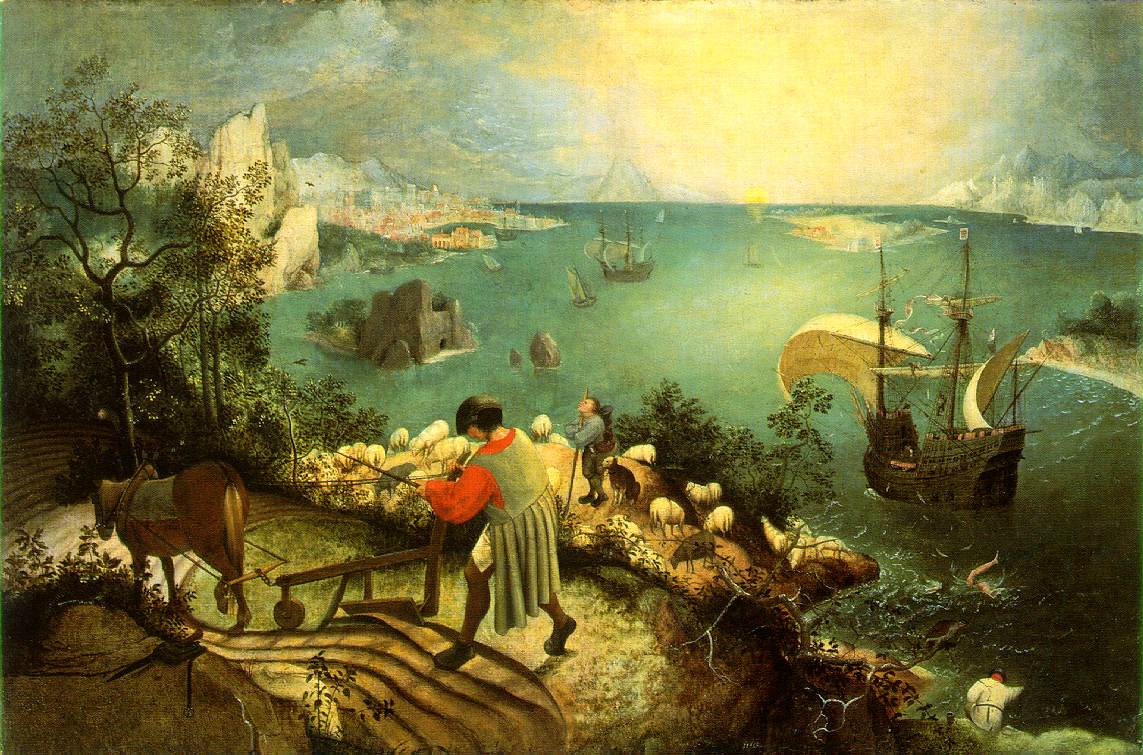
              In Brueghel’s Icarus, for instance: how everything turns away from

              Quite leisurely from the disaster …

              A boy falling out of the sky.

It is true; we all sail blissfully on; we plough our fields; we cull or vegetable, while Icarus falls unnoticed out of the sky. But, I wonder, if we were looking around more, might we not notice such things, and choose to go to the rescue, of  foreign legs disappearing into distant seas?

I’ll say it straight up. I think that it would be best if we were more in touch with people who are different than we are, and if we made more effort to understand their flights and their disasters.

I think we should replace blame with understanding and that we should substitute forgiveness for judgment. Life isn’t simply us and them, it’s more  just  — us.

You can shop where, you want – it’s a free country – and you can cull your fruit as you like, but this much is true: The fruit you select isn’t necessarily better than the battered pieces you reject.

first communion

Posted: June 18, 2010 in beautiful
Tags: , , , , ,

She walked down  to the front of the church by herself, standing in line, only eight and yet making her own decisions to take the sacrament, making her own choices to put herself  in the moment of holiness. 

She stood expectant before the woman serving her, like Vermeer’s girl at the window, caught in the light, reaching to open the glass to something beautiful.  The little communicant held the bread, her short black hair cropped straight along the bottom of her chin , her head tilted as  in the painting, angled slightly down and yet opening to something outside of herself.

Then she took the cup, and held this too, perhaps too long, certainly longer than the adults before and after her, either not sure what to do or simply savoring the moment, maybe a little embarrassed, always looking down at the hem of her dress, sipping the blood of Jesus so carefully,  half emptying the cup and handing it over,  as if it were too special to drink it all. 

It was her first communion, but then firsts were now coming fast  for her. Only a few weeks before she prayed for Christ to live out his life in her. Shortly after that she was baptized, by her own choice.

The server took her cup from her, still half full, and she went back to her seat with her head still down.  The adults moved more quickly through the line after her. 

Not long after this,  a young boy came to the front. He had been served the sacrament already that morning, but now he was back for seconds.

“I’m hungry,” he said, looking up to the woman holding the bowl of bread.  “May I have some more?” She looked down at him and said softly,  “Certainly you can.” So he took another piece of the fresh, soft torn bread and stood there, before her, and ate it. Then looking up he said, “I’m still hungry. May I  have some more?” 

“Yes, you may have some more,” replied the woman with the bowl.  And so he ate again, standing at the altar hungry,  taking communion for a third time, eating the body of Christ again and again.

Then he returned to his  his seat.

It isn’t in the way things are usually done.

We adults take the bread and the wine by the book, as if by prescription, as if by mandate passed down from some ancient Pharmacopoeia Sacra, with the sacred liturgy and the defining rules for the administrations of the holy medicines. We know the drill; we hurry through, we get it done.

We nervously drain the cup; we never think to savor the bread; we don’t like to wait; we don’t know how hungry we are; we don’t go back for more.

And yet, what Jesus said about the little ones somehow comes to mind, “I tell you the truth, unless you change and become like little children, you will never enter the kingdom of heaven.” 

To stand expectantly in church as if in a Vermeer, by the window with our arm extended, the warm light  falling softly on our skin,  to keep our heads tilted down a little longer, waiting, savoring, opening to something, beautiful, to hold the fresh bread between our fingers a little longer, to drink the glossy, purple cup as if it were to precious to use all up.

To eat and drink and yet know that we have not had enough, to come again to the front to stand in the holy place hungry, to ask for more of what we are starving to death for but can’t get enough of — this we might learn from a child.  

Perhaps if we could only — and yet in time —  as we grow younger — perhaps we can do just these things.

The boys were throwing rocks.

One thrown rock ricocheted off the nearby trash can with  a clang and spun out over the road.

A flickering thought came to me, “This could be dangerous.’

I kept walking, and then I heard the cry, turned my head and saw the little girl crumpling into the dirt. I ran to her, and  picked her up.  Down her face ran a rivulet of blood, streaming from the gash in her forehead.

As I carried her down the road, looking for her parents, raw emotion ran over through me, “Why hadn’t I stopped the boys?’

I”m wasn’t exactly sure. “They weren’t my boys?”

Lame.

Here is the way I am feeling lately; there isn’t enough leadership on the planet.

Think about it: Think about the Gaza.

Think of the number of homes being foreclosed in the US.

Think about the  BP oil disaster, BP’s response, the goverment’s response.

Think children, think the childification of poverty, the feminization of poverty.

Think about the needs in your work place, your church, your home, your community.

Think about the pain in your own family.

Most people I meet tell me, “I’m not a leader.”

I don’t buy it. It’s a con. It’s a ruse. It’s a dodge. 

A leader is anyone who sees what needs to be done and does it, who sees what needs to be said and says it, who knows what they failed to do and resolves never to do that again.

You’re not a leader?  Really now; give me a break!  Every time you open your mouth you lead! You are a model to someone.

Every time  you take action you are a leader, and every time you do not take action you are a leader too. You prevent or fail to prevent things, and you are an example.

I helped a homeless woman recently by giving her a safe place to nap, a phone to use to call for help. But I didn’t go to the second level and find her a place to live. I was leading, deciding how much I would lead, give, do, what I wouldn’t do.

I think that I am watching too much TV without doing anything about what I see on TV.

I think I am sitting too much at home when I should be over at my neighbor’s house helping.

I think I am sitting in church too much singing when the baby in the community is wailing!

Enough.

I’m sick of it.

Rocks are flying.

Children are walking nearby.

Somebody lead.

“The conflict with the inspector  happened because she couldn’t read the social cues,” I said, “It’s part of her disability.”

“Oh, I totally get that,” she said, standing behind the food counter. “It’s just that other people don’t.”

“I know,” I replied, “and then it’s like they think she’s just making a choice to be difficult, but she’s not. It’s because of her brain damage.”

I could feel a bit of extra humidity in the corner of my eyes. I could see it in hers too. We looked straight at each other in a way people just don’t do across a public counter.  In this instant we bonded over our understanding of the pain resident in the complications of relationships compounded by disabilities. Our eyes seemed to reach out and touch.

I wonder lately, are there really any other kinds of human relationships, ones without disabilities complicating them? And do we often stop to look at the many shades of emotion resident in our failed attempts to communicate with each other?

A day earlier I sat a lunch in a restaurant on the other side of town.  

“Fear isn’t a disease,” he said. “It’s normal. Everybody has it.”

I sat there not eating, just looking at the astonishment on his face. It was fascinating, his knowing smile. It had taken 30 years  of brilliant psychiatrists getting it wrong for him to realize that inside  he knew the truth all along.

“Everybody is afraid,”  he said, ” not just the people who did drugs in high school”.

“Etiology is tricky,”  I thought to myself; the professionals made a muck of this. They blamed his fears on him.

I nodded to him, flashing back to a few of my own seasons of terrible anxiety. And I thought about how I keep running into this —  learning embedded in feeling. How being human is about some kind of rich affectivity realized and accepted.

I will always remember kicking my fins along the coral wall in Kauai,  excitedly pushing myself toward a large school of Achilles tangs. I still remember the joy of  their dark purple bodies, their bright orange tear drops and their blazing white highlights, the sudden and odd thrill of the unexpected combination of vibrant colors swimming together like some kind of underwater mobile home painted by a madman.

I think that emotions are like this. You turn a corner, kick a couple of times and there — a new school of them, unexpectedly colored, swimming with you. Then, as you approach, off they dart  together into the deep, you in mad pursuit of something amazing.

I like this. It reminds me of Charles Burchfield’s painting, “Oncomming Spring,” where the cold, white snow is melting into the ground and the trees are all ablur with  motion, everything moving in the storm, all of nature alive to the wind and the bright yellow warmth that will bring life to the dry, brown trunks.  I like how the windows open between the tree frames to blue skies. Life is found in such movements toward things not yet fully realized.

Older, I’m more aware of the storms within. Now I find it increasingly odd, how relational Achilles heels and all the emotions schooling with them are so much rejected in the public sphere — those places where we too much see the tight lips, the polyurethane expressions, the harsh judgments and the keratitis sicca.

I feel.

 I am.

 I am open to feel.

I grieve over the emotional damage that has been done by people who refuse to acknowledge the validity of feelings, those who have said to others, after causing extreme pain to them, “I’d advise you not to talk about how you feel. That’s not going to help here.”  Cause a reaction, and stifle the reactor?

I grieve over those who only say to their children, “Don’t be afraid.” Better it be sometimes said, “I too have been afraid. I know how you feel.”

I grieve over how those who have caused extreme emotional hurt to others have then turned and said, “I’m not hurt,” as if it is possible  to damage others and for that not to damage ourselves.

It’s storming. And I will be a Charles Burchfield and  go out and paint it. This is reality.  I see windows opening up upon our emotional realities.

This is reality, beautiful, heart wrenching emotional reality, to go out into the tossing ocean and swim with the purple and orange tangs again.

my little sister

Posted: June 5, 2010 in nature
Tags:

i woke last night at 2 am

breathing audibly

heart pounding inside me

it’s my beautifully wild little sister

she’s punctured somewhere far from me

bleeding hard and i can’t reach her

if you only knew how i love her

she wears her blue green and silver dresses tight and shimmery

filling the room at every crazy bluesy party she puts on

fast and fun until she rises from her couch late and scares the hell out of all her guests

i love the things she loves

her white flyers skimming

her black and white giants leaping

her vibrantly hued darters schooling 

her long brown tresses waving

her radiant edges glowing

but now

in the night

i am angry and lonely over those who have attacked and left her there

she bleeds internally

fouling brown blood squirting into her clean pure blue

the goopy flopping things at the edges dying with her

my little sister if I could only reach you and hold you

i would heal you if I could

i’m punctured too

Failure

Posted: June 2, 2010 in difficulty
Tags: , , , ,

We deal with failure differently.

Some failures we laugh off.  An older lady told me yesterday. “I was trying to read in a group recently, and I couldn’t seem to read the page I was on, then I figured out I had my glasses on upside down!”   We both laughed.

Some failures can’t be laughed off.  A person told me with great pain recently, “I never thought I’d be divorced.” No humor in this moment.

It’s interesting how we process failure. There is actually controversy about this. Some people take an aggressive, positive approach. They fight against things; they pray against things; they refuse to accept defeat. They may say things like, “There aren’t any failures; there are only learning experiences.” They give examples of those who have been healed, who have risen above loss, who have made a come back, who have reinvented themselves. They are believers in power. They speak of post-traumatic growth.  

This response has value in that it is positive, it sometimes wins the day, it works well to motivate reform; it preserves self-esteem; it uses failure as nuclear fuel to energize a  new  future. At its best it is a plucky, hopeful, can-do approach to life. At its worst it is an arrogant triumphalism, fostering a sense of superiority and the over-expectation of ultimate triumph.

Some, on the other hand, take a more accepting, honest-about-loss, humanized approach. They say things like, “It’s important to face the reality of loss. To do that we need to grieve. We need to feel.”  This approach embraces loss and failure as deep learning experiences  that help us gentlize, become more human, more relational. The interest isn’t in winning something, defeating something or healing something.  The response isn’t interested in becoming a dynamo of success fueled by a devastated past.

The interest is in becoming an authentic person, an emotionally intelligent person, a more aware person. This person leans into failure, learns to listen to the rumblings within. This perspective is good in that it clearly identifies a legitimate failure. It often leads to appropriate expressions of grief, to deeper empathy, even perhaps to a few much-needed apologies. It is good; it is emotionally healthy, but taken too far it may become defeatist, overly emotional, giving up on reversing declines, not tapping into the power to heal or reform, not pushing ahead and winning victories that could yet be won.

To see these approaches in action, consider how persons with these two perspectives might respond to terminal illness. The upside-of-life, assertive, go-for-it person says, “We can still beat this,” or prays, “God, we ask you to heal this.” But the more emotionally focused, reality-accepting person might say at a death bed, “It is time to let her go. We have to now accept this.” And then this person prays, “God, comfort us as we grieve this.”  It’s problematic spiritually; both responses can be seen as spiritual. To look to God for healing shows great faith, but to accept reality when it isn’t what you want also shows great faith. 

Such responses are a choice in each situation of life, and we many of us probably go back and forth between these. But some of us have one of these two reactions as a default setting. We tend toward either a triumphalist or a more humanize response to failure and loss. Where this is true this may become problematic for us. Being stuck in one kind of response to every situation many keep us from bringing wisdom to the subtlety and complication of life.

For example, being overly optimistic in some situations can stifle legitimate grief. It can also sabotage a needed apology. It can also run over the top of other people involved in the same incident who need time to process and recover. A downright Pollyannaish outlook can even deny reality.

But being overly “in touch” with emotions, and the past and human frailty also has a downside. Self-confidence can be destroyed if in a time of failure as a person turns upon themselves too much, wallowing in feelings, perhaps over-analyzing themselves for what they think they did wrong.  Too much introspection can stifle action, prevent us from going on, keep us from believing that with God’s help situations can be reversed, dramatically changed, people healed.

What to do?

Do both. Engage in both the “I’m looking forward” and the “I’m looking inward” approaches. Reality is complex; so must our responses be, nuanced, intricate, bi-functional.

True, we must move beyond failure, but we while doing so we must not deny the losses in the past. It is good to see the best in things, but not to deny the worst. Praying for healing is good. And when it doesn’t happen it is also good to accept that God had something else in mind.

In short, to be wise we must be human, and more than that.

In failure, we must  grieve and then move on and finally know when to do one and then the other.