Posts Tagged ‘thrive’

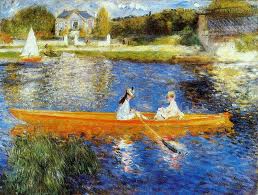
In the National Gallery in London Pierre-August Renoir’s “The Skiff” lights up the room. I am falling in love with it a little more every minute, and I can’t understand why someone  put it in a small corner.

It overwhelms the space it is in. The green grass jumping up out of the lake in the foreground, the sparkling blues blue water grabbing the sunshine out of the sky, the women in the white dresses calm in the middle of the burning orange skiff.

It is the orange that gets to me, the orange, very, very orange skiff, I can’t get over the orange skiff – all that warmth absolutely dominating the blue lake, leaking off the canvass and banishing the picture frame, the museum wall, the museum floor, and the whole of the room we sit in. I can’t see anything but orange. I am totally smitten by incandescent orange paint. I can’t stop ogling it.

The women in the painting are so calm. One is reading, the other is sitting and rowing so casually. They seem so un-startled, so undisturbed,  much like the people around me in the museum, shockingly respectful and settled.

But I am not so calm!  I don’t know what to do. Perhaps I should stay right here on this bench for a long time looking and pulsating. I will; I am deciding  right now to eat here tonight, and then sleep here. Now I am deciding not to. It won’t work; this Renoir won’t stop glowing, like a fire, and it won’t go down, like the sun. If I stay, it will be too bright to get any rest at all.

I won’t stay, but I will stare. At the bottom edge of the skiff I can see that the orange is coming off of the wood, and it is getting in the blue water. Renoir let it can away from him. The orange paint is jumping around in the ripples of the water that are coming off of the boat. The orange paint is getting all over the blue paint, taking over the gap between the boat and the lake. I can’t stop smiling. I like it that the orange has taken this step, has crossed over, has created an interface, has made this transition.

We leave the National Gallery. We get on the tube to ride through London to our refuge in West Finchley, our suburban home away from home that is housing our stay. We stand in the isle of the train because there isn’t enough room to sit down. A bell rings. The electric doors whoosh closed, and off we whir into the tunnel, rushing madly beneath the streets of London. We come to another station, we slow, then stop. The train doors open, and a woman’s voice, very British, says, “Mind the gap between the train and the platform.” We get off.

We mind the gap.

We always do, or not, depending on how well we are doing.

I love the gap. I love the people in the gap. I love young people crossing the gap between their immaturity and their maturity. I love me, crossing the gap into the next stage of life.

The spaces that exist between are always the most interesting, where the boat meets the water, where the blue meets the orange, where the train meets the platform – interesting, disturbing, transitional, difficult, formative, painfully beautiful.

Take the gap between childhood and adulthood — wow and superwow! This transition shapes the rest of life.  To get out of the boat, to step across gap, to bring one’s babyhood, ones adolescence, ones teenafication, one’s “becoming” into ones “I have become, “  to splash the colors from one place into another, this is at the core of the very core of every rippling and  transforming identity.

What is this thing,  this growing up? What are the paint strokes that get us across the gap? How do we paint the immature past into the mature present?

I’m not always sure, but here are a few of the brush stokes that may need to be mastered to paint across the gap:

We must overcome the fear that makes us not want move our brushes beyond what we have known before, or beyond what others like us have done.

We must come to  relate to the people in the boat, wisely, and not sit when they are sitting if standing is what we really want to do, or we must just jump, out of the boat, and into the orange water if really that is the only thing to be done when we are  so ready for change that sitting doesn’t work for us anymore.

We must learn, must we not, when not to judge but still to discern what is right and what is flat-out, dead wrong for us, even if not for everyone else.

We must try, and test and test again, our limits, when one more, or one is less,  or one is one too many, or too few or just right, if you know what I mean.

We must grow in confidence, to splash paint, from the boat to the water and on to the sky.

And what else?

What else must we do to get across the gap?

Tell me, so at the very least it is out here, on the canvass, to deal with, to face, to enjoy, to revel in.

We need protection — from voices.

Two potentially harmful voices come to mind.

The first one is our own.

When I finished my first year of professional teaching, I said to myself, “I hate this! I feel like a failure. I want to quit.” My own voice didn’t  offer good guidance. Fortunately my father, in a phone conversation about this,  said to me,  “Now you know how your students feel. Many of them  feel like failures. Now you know.”

That was a good voice, and I went on from there, following the leading of that voice to teach, until now, and I like it. When I finally do quit teaching, I think I’d like keep teaching,  part-time  —  for fun!

My own voice was suspect. This is hardly rare. Most of us have experienced bad feedback,  from ourselves, concerning ourselves.

Beware your own whining and sulking and quitting-talk.

The second kind of voice to avoid is the voice of the unwise family member or friend.  Family members — they don’t always get us right. Over time they tend to stereotype us.  “Well she always has been a bit edgy, or sad or dominant or shy,” or whatever they come to label us. Others in the family, may concur, and the label may stick, when it shouldn’t.

Friends are often also unwise voices in our lives. In giving feedback, friends tend to simply project their own reactive, unresolved feelings onto our situations. We need to face this; most people aren’t great counselors.  If they hate men, they hate our man. If they hate women, they hate our women. If they don’t resolve their own conflicts well, they won’t resolve ours well either.

What to do?

Pick mentors carefully.

Find people who have life experience, good and bad, people who have been able to resolve conflicts, who have learned something about healthy boundaries, who have had some long-lasting relationships, who have raised some kids (and the kids still love them), who have been successful in their careers but who have also gone through some career-hell and come out still feeling like life is some kind of heaven, who know something about God, something along the lines that God loves us and will never, ever stop loving us.

There are many voices. The world is full of talk. The deal is to learn which voices are safe and which ones aren’t, which voices to tune out, and which ones to listen to when we are losing our way a bit.

This is one of those things to figure out, to get right, to get a handle on, to give some time to.

The right voice, the right answer, the wise counsel — it’s beautiful!

It’s protection.

Age.

Disability.

Ethnicity.

Gender.

Marital status.

National origin.

Race.

Religion.

Sexual orientation.

These are sometime the basis for unlawful, socially harmful discrimination.

I’ve been discriminated against. When I was a teacher,  I remember one of my students looking me in the eye, glaring and saying, “You’re not capable of understanding.” Then I knew what it felt like to be on the receiving end of racism.

For me and for most of us, discrimination is something we think of  other people doing.  They are racists, bigots, fanatics, the unjust. But it is a symptom of the disease of unlawful or harmful discrimination not to see it in ourselves. With our “they” we  poke out our own eyes.

To actually experience condescension in our own voices, say when speaking to a sixteen-year-old or an eighty-seven year old or a disabled person, is harder.

We may also experience it in our silence. I noticed at one point that I spoke less to my daughter’s friend who can’t speak, than to her other friends. Why? He can’t speak back, so I felt awkward. I decided to change. Why shouldn’t he receive my attention as much as any of her other friends. It’s been a nice change for me. I have my own “way” with him now. We laugh a lot, together.

I know a young woman who in her twenties looks ten years younger. When she asks for help while shopping for clothes, store clerks sometimes ask her where her mom is or direct her to the “younger department.” She knows what it’s like to experience age discrimination, and while one might easily defend the clerks as having no way of knowing, such situations bring to light how easily we slight others and don’t  know it.

It’s subtle. I have felt a distancing going on in my mind as certain people have approached me. An observation of size or disability or age has  sometimes shot a small dose of fear or repulsion into me. I hate having to admit this, but my first impressions have sometimes been based  completely on superficial and  automatic distinctions.  And I don’t always catch on to the fact that I have done this.

Sometimes our racial or social distinctions seem to us to be  wise notations of  differences. We think of ourselves as understanding. We make a capability clarification or a  role clarification; we see our discrimination  as a necessity that reflects physical reality.  “There are differences between men and women.” As such, our discrimination begin disguised as enlightenment.

I remember in my younger days thinking that I wouldn’t go to a church that was pastored by a woman. I based this on an interpretation of scripture. I based it on no experience. I had none. I based this on my own insecurity. I based this on what other men and women that I knew said they believed.  Now I would gladly go to a church pastored by a woman, and now I can present a strong scriptural basis for this and now I am surrounded by other people who affirm this. It is so important to be able to change, to be able to shed former boxes of constricted and harmful thinking.

I have had to grow into the realization that different should not be disallowed. I have had to flight past social taboo and come out free to accept as women as equals and their contribution as enriching.

The truth is that we too often hide our “put downs”  in religious mandates, governmental programs, institutional values and herd mentalities.  “They can’t” or we “must not” or “God doesn’t want'” can be simply disguises for insecurity, fear and selfishness.

Discrimination often functions within social expectations and rules.  It is better to hear than to sign. It is better to see than to be blind. It is better to be light-skinned than dark. It is better to be rich than poor. It is better to be educated than not.

What is needed is a definition of what it means to not discriminate.

To not discriminate is to experience someone different from you and to not see them as less than you.

To not discriminate is to hire a person who is in some way the opposite of you,  and not compete with or intimidate that person. It is when an extroverted leader hires an introverted leader to enrich the emotional depth and quality of the organization.

To not discriminate is for a man to see a woman as his equal, fully empowered, taking her place in the family or the organization and being treated as in no way inferior or lesser or weaker or more emotional. It is for her not to be dominated and controlled or put in a limiting box.

To not discriminate is to treat the school smart daughter the same as the daughter who is in special education and to affirm them both, equally and to see that smart is not better it is just different and kind is not better either it is just a quality that some have more than others.

To not discriminate is to see a court case where the one charged is Hispanic and the one dead is black and to not see this as a brown versus black issue but a right or wrong issue that must be given a process that has as its goal the truth and justice and love.

The truth is that it is always a fight for the truth.

And the truth is that it is hard not to discriminate, that we all tend towards it, and that maturity and personal growth always involve movement toward loving other people more.

The beginning of the end of discrimination?

Think of it as something that you, not just “they” struggle with.

The other day, when I went to  the zoo, I noticed a lot of clumping, swarming and clustering.

The Harpy Eagle was happily hanging out at the entrance with his trainer and a whole crowd of gawkers, the Flamingos were squawking it up together around the pool, the fish in the  snapping turtle pool seemed to be clumping together for safety and the gorillas were all clustered up within 15 feet of each other, despite their huge, grassy, multi-storied, multi-waterfalled home.

What is that about?

A few nights ago when I went to bed, the same kind of  swarming together and hanging-out-close seemed to be going on,  so  I closed and latched my bedroom door so I might get some sleep.

It was a good thing. At 1 am they tried to break in and then again at 3 am I heard them banging on the door. But I held my ground, and as a result got some sleep. I know why they wanted in. They wanted my body, it’s warmth. because they are little and thermophilic and cold at night.

When I got up they were still by the door — my two cats, hungry for company, heat and love and … cat chow.

The creatures seem to not to want to be too much alone.

More and more people are living alone these days, however, partiularly in urban areas. Eric Klinenberg, in his new book,  Going Solo: The Extraordinary Rise and Surprising Appeal of Living Alone, reports that in recent years, particularly since the 1950’s, solo living has grown, and it has grown most  in countries with booming economies: China, India, and Brazil. The US is lagging in this going-it-alone stuff,  but more people live alone in the United States than ever before, 28 per cent of all households, about 31 million people.

Studies on living alone have found that women, in contrast to men,  are more likely to have strong social networks, and that this enables them to live alone without being alone. Men, living alone, are more at risk of withdrawing into isolation that, in the extreme, can make them very unhappy and that can even be dangerous for them.

According to a Finnish study, “Living alone is associated with an increased risk of alcohol-related mortality — from alcohol-related diseases and accidents.”

It can be fine to live alone, but I think that for most of us, it is not fine to be too much alone. Household practices are changing, but not our core need for clumping.

This is particularly true when we move from our family of orgin to whatever we design next.

I remember in my college years, driving places alone, talking to myself in the car and  saying stuff like, “I need more than me, here…” The loneliness in the front of the car was palpable. It felt like cold, dark  water running through the bottom of a deep cave.

I find the desire for human warmth to be quite universal.

I spoke to a homeless man a while back, “What is hardest about being homeless?” I asked.

“The loneliness,” he said.  “I just need someone to talk to.”

It seems like, no matter how we choose to live, we can’t get away from it — the need for clumping and swarming. It’s weird, almost like we were wired for this, like God himself wired a social port into us. Perhaps it feels like that because …  that’s the way it is.

In the beginning of the beginning of the very beginning it was said, “It is not good … to be alone.”

I’ve been thinking a bit about that, and I think that perhaps it is one of the vast accomplishments of life to understand what exists that will never not exist and then to act accordingly.

We are inveterately, undeniably, intrincically social.

So what’s next?


I clearly remember the moment I first  took responsibility for the earth.

It was the day I found big Red. He was a mangy male on the plus side of the scale, lots of ginger hair with some facial scars that belied his kick-back personality.

When I found Red, wandering, I drug him home with me, his forelegs hanging over both my arms, his stiff ears brushing the underside of my chin,  his back legs and tail bumping along on the ground behind.

My mom let me keep him, but he was pretty much confined to outside, where he wanted to be anyway, just in case there was a chance to mix it up with the feline cuties flirting in the neighborhood.

To get a sense of Red, you must understand something: He was so large and prowlish that when he was out and about, mothers pulled their small children back inside the house.

I was very, very proud of Red; his homecoming put me in a God-like category.

Genesis 1:26 states rather underwhelmingly that in the amazing and astonishing beginning of the very beginning of us, God said, “Let us make human beings in our image, make them reflecting our nature so they can be responsible … “

And then, in perhaps the greatest omission in world literature, the text goes on to say, “for the fish in the sea, the birds in the air, the cattle, and, yes, earth itself, and every animal that moves on the face of Earth.” In other words, for Red.

The author, seemingly unawares, blithely glosses over the emotional reaction — an unbelievable ellipses! Upon creation of beings like himself, God must have jumped up and down, waved his arms and  hooted! Adam and Eve must have screamed with pure delight. The animals must have jumped into a celebration chorus so raucous and joyful that it forever upstaged any and all imitative, animated, Disney-movie hit tunes!

What? The emotional response to creation was not mentioned? Perhaps, it was shockingly lost in the Hebrew oral tradition, or perhaps Moses thought he couldn’t do it linguistic justice.

But the effect wasn’t lost. According to the record, Adam and Eve jumped right into the forray and started happily naming things. With all the acumen of a Carl Linnaeus they classified the marvelous creatures they were  now wonderfully “responsible” for.

Cool! They acted out the DNA of God. They named, they brought home, they cared for — Red!

To care for the creation, to name it, feed it, pet it and bring it home with us– this is the image of God in us. The image of God is reflected in human responsibility for creatures. The sacred text itself says, God made us like him, so we could be responsible.

And in a damaged world and a broken creation, it is certainly the most God-like thing we can do to find lost creatures and to bring them home and care for them.

Want to be God-like?

Feed the dog.

Bring home a lost  humanoid too.

Around him sat at least 15 open paint cans, a half-dozen paint trays half-full of paint and a good 20 rollers and brushes with paint hardening at the edges.

He looked up at me from the mess, smiled wryly and said, “It would have been a lot easier to do it myself with a paint gun and one helper.

This was what the end of a church painting project at a campground in Mexico.  About 20 people had been recruited, transported, armed with paint “weapons” and turned loose on a couple of now shinning buildings. It worked — kind of.

It’s typical. The  end of most attempts to order the earth have a behind-the-scenes disorder to them.  It’s called clean-up.

Last week, I got out the ladder, and took down the Christmas lights. There was a pile on the lawn, then a pile in the box, then Christmas was again on the top shelf of the garage.

Life is a lot about the clean up, about ordering the disorder created in our attempts to bring about order.

I talked to someone yesterday who is in need of redoing their taxes, in a better way, a more orderly, honest way. They told me that they  have a sense of an era closing. They simply aren’t going to cut corners they used to cut. A new definition of what’s orderly has inspired them and a mess is going to be cleaned up, as best it can be cleaned up.

Paint rollers, taxes, Christmas decorations, the kitchen sink, our minds, our hearts — all need attention, ordering. To leave them as they are is to complicate the future. To order them is to bring about the next thing, to provide an opportunity for something new to happen.

I just cleaned out my clothes closet in my bedroom. Some of the shirts and pants that I had not that long ago bought, placed in my closet, wore, washed and returned to the closet  were now tossed in a box to be donated, in order to restore order to my closet. Some of them, I just wasn’t wearing anymore and they were complicating and hiding the clothes I am wearing.

When I finished, I felt ready, for this year and I felt something else. I felt calm.

Isaiah the Jewish  prophet,  claimed that the effect of being right and doing the right thing is peace.

Order equals calm. I like it,  calm, a sense that for the moment things are okay.

What’s next? We decide, what to do with disorder in our lives.

A good plan for any chaos or mess  might look like the following:

First an ordering of the disorder, then calm.

The garage.

The closet.

The past.

A broken relationship.

A mental confusion.

The inner-most closet of the heart  — think cleanup.


I like to hang around people in their twenties. They are in college, or in the beginnings of careers, or in love or not, but perhaps they want to be.

I love them. I see myself in them. They are dreaming and hoping for bread.

Yesterday, a large, black crow landed on the street in front of me, square in the middle of an intersection. He carried in his mouth a large, dry piece of bread. He threw it down hard on the pavement; it broke; he started his meal.

The light changed, a line of cars came at him from both sides. He took up the main of his  bread and flew.

We protect, our bread, the large piece of it at least.

When we are young, or old, our dreams of what we might yet get  take up our focus — and while large things intruded such as the rise and fall of the economy —  the flapping and gliding of our career paths, the loft and reach of our personal relationships, the competitive spirits of other people keep us moving, mostly.

A BMW ran fast in front of me last night on a freeway on ramp, cutting the line, forcing me behind its shiny, silver flank.

I have a sense of my right place in the line. I fumed a bit.

Nobody likes cutters. Such things cause fuming. For those who tend to take an  interest in getting bread, and keeping it, and in getting some place, cutters aren’t fun.

I hope for a great hope, for something wonderful, in the future. I hope hard for something full of beauty and refinement for all of the young people I know, and even yet for the surge and flap of my own dreams.

Dreams keep me going. I  hope for so much good for myself and my young friends.  I love dreams of good, of bread, of water, of love, of finding a good place in the line, and of finding out what was meant to be.

But one thing stands out today, and it isn’t that pushing forward, or line cutting or bread protecting.

Often, what is needed, on the way to somewhere else, in the flap and drive and hope of something better, in the middle of ambition is something found in Psalm 131.

1 My heart is not proud, LORD,
my eyes are not haughty;
I do not concern myself with great matters
or things too wonderful for me.
2 But I have calmed and quieted myself,
I am like a weaned child with its mother;
like a weaned child I am content.

David, perhaps on his way to being a powerful leader and a great success, calmed down his feelings. He settled his own emotions, he leaned into being weaned. In other words, he told himself that he no longer required the comfort he had before, perhaps from the family he came from, and that it was not his business, in the moment, to determine his place in the line forming up outside.

This is the task of the anxious twenty-something, and perhaps for many of the rest of us, to lean into the calm found in the present moment, to take charge of the tendency to be troubled by the not-yet-achieved future, and to choose to be content with the bread God has given us to throw down in our own intersection.

Contentment, self-imposed, on the way to being king, is good!

Many people, you know, have been  radiated.

But  maybe you don’t know that, because mostly, when you see someone, it’s not the first thing you notice.

I ran into a friend in the grocery store today. We caught up. The first thing I noticed was her unique face and her smile. We all have the same pieces, eyes, mouth, nose, ears — but “wow” and “superwow” again; those smiles are each perfectly special.

She mentioned getting forced out of her last job. That  came up because she was telling me she was looking for new work.

“I think it was a personality thing,” she said. Then I could see that she had been radiated. A “personality thing” — that’s code for someone decided they didn’t want her at her workplace, and a few conversations were had behind the scenes, and then, she was history.

“I know,” I said, “It’s something I’ve experienced too.”

We chatted a bit more. I said, “Hey, I’ll pray for you.” I did, as I walked away, and later too, because, “I know.”

It’s common, to get nuked, by someone else’s personality, or their agenda, or their insecurity. At work, church, among friends and in the family, if you live long enough, you will be blasted by someone else’s poor management of  their own issues, and yours.

I know another person who used to work for the same organization as the girl I met in the grocery store. She recently told me she had gotten a new job. Why? She too was radiated a few years back. It was so bad, she lost her opportunity to even work in that field anymore, despite her good credentials, and she had to go back to school and retrain for a different career. Fortunately, that worked! I’m glad for her, but she still isn’t “okay” with what happened to her.

Why all the radiated employees? Many CEO’s, supervisors, “bosses,” and just plain people aren’t good at conflict resolution; they bring to their conflict win-lose solutions. They win, the underling loses. Why?  These human resource brokers tend to see the world as black and white; one person is wrong, someone else is right, and so they “do what they have to do” by making the party at fault (in their minds),  the loser. This is interesting, painful, maddening, hurtful, harmful, crazy, radiating!  And yet, often,  the core issue, is the power broker’s own personality and problem solving weaknesses, which have created, at least a part,  the problems.

And so, radiation happens.

But here it the really fine news! For those of us who  have gotten up close to  personalities that are leaking nuclear power plants,  we  have choices, afterwards, which  can successfully mitigate the negative and harmful effects.

To help you thrive, after being radiated, here is what you can do, as I’ve learned it from my own experience.

Never stop moving forward into the next thing God has for you. God, the God who sent  his son Jesus to die for a sin-radiated world, is the God of radiation recovery. God, as he exists in his absolutely crazy-good-loving-redemptive personality is always trying to help you move into a healthy, radiation free future. Retrain, retool, rethink the future, try again, go back at it, when you fail again, get up and try again, never stop moving, except to rest and eat. The enemy — it’s quitting!

Forgive everything! Christ forgave you; forgive everyone else. Yourself, your boss, the organization, the people who don’t apologize,  the people who apologize except that it’s for the wrong thing because they still don’t get it, their friends who helped them hurt you, your friends who abandoned you, every-freaking-body on the planet, forgive them,  if that is necessary. Forgive and then, when the memories come back, forgive again and forgive for the rest of your life, if that is how long it takes. That doesn’t mean you quit saying what happened was wrong; it doesn’t mean you forget it; it means something like you do all you can to make it right and then you leave it in God’s hands.

Why? If you don’t forgive, you’ll radiate yourself.

And lastly, learn from what happened. Nothing is simple. “They” did something wrong, you can hold on to that if it is true, but so might you have made mistakes in  what happened and in how you have handled what went down or in how you will handle it in the future.  You have a personality too, and it can radiate people too, especially if you have been hurt. It’s been said that hurt people hurt people. It’s true, and so be careful, because you don’t want to become a hurt person who hurts other people. Don’t do what was done to you in any way, shape or otherwise twisted form.  That will make you similar to the people who hurt you, and you don’t, trust me, want to be like them.

Take your hurt and learn to be compassionate towards others. Having been radiated, “You know,” and your knowing is a powerful force inside of you to understand and to be compassionate, and to be gentle and to take some pain out of the world, instead of smashing more pain back into the world.

The best radiation therapy in the universe is found in understanding and in compassion, which we all know by its more noble name — love.

Figure it out; people need you to work this out. You’ll meet them tomorrow in the grocery store. They will have just been radiated, and you will do best with them if you can say, without any residual toxic resentment inside of you, “I know.”

“I think you think that you can’t  hurt me when you say stuff. But when you say stuff it does hurt me. I know in the past I acted all tough and hard-headed but I’m not like that now.”

He sat on the couch in front of her and put his fist on his chest and coughed.

“I don’t know,” she said. “You used to say that nothing could hurt you, and I guess I thought that was true.”

“Well, it’s not anymore,” he replied. “You see how I’ve been lately, all emotional with the kids and with you. I see that what I’ve done has hurt a lot of other people and I’m sorry about that and I’ve been apologizing for that.”

I turned to her and asked, “Can you see that he’s been different lately?”

“I can,” she replied. “It’s like he is becoming more human.”

It’s interesting, the degrees of things, the way things change.  We are all becoming, everyday, perhaps more or less human.

What does that mean? I’m not entirely sure, except to say that part of it can be explained by the progress or regress we make emotionally. To be human is to feel —  pain, love, depression, happiness, guilt, tranquility.

To petrify emotionally is to lose our humanity. To turn to stone regarding other human’s feelings is to lose the human quality of our relationships. To grow numb, to fail to understand or care when our behaviors bring pain to others — this all is part of a process whereby we grow inhuman and inhumane.

This matters.

We must not lose the affective domain or we lose our humanity.

To be human is to be emotionally rich. To break, to soar, to break down, to take courage, to pick ourselves up and explain to someone else how we really feel — this is what it means to be an integrated person, a complete personality, a fully human being.

As long as we can be hurt then we  retain the ability to understand someone elses’ hurt.

To the extent that we can accept and honor our own emotions, then we will be able to accept and honor other people’s emotions.

Feelings feel feelings.

Feel.

Be human.

Thrive.