Posts Tagged ‘thrive’

When Adam first saw Eve, he said … “Wow! Check you out, baby!  Nice work, God.  Hey, Eve …  want to go for a coffee … or something…”

And Eve said, “Yes! And then she turned aside and said, “That is the best looking guy I’ve ever seen! He is so hot!”

Then Adam said, “Hey Eve, Should we get dressed up tonight… our just go out …  au natural?”

And Eve said, “I don’t care what people think … wait … there are no other people. Hey, were alone …  hey baby… !”

Adam and Eve’s beautiful physicality, it was all God’s idea and Adam and Eve must have been thrilled with each other.

God made them for each other, and he made their puzzle pieces, fit together, and God called his work “good.”

What do we take from this? We do not need to be ashamed of our bodies, our skin, our muscles, our jiggly parts, our flab, what Paul calls our “weaker parts,” our vulnerabilities, our sexuality. We should never be ashamed of God’s body work.

The body is amazing.

Sneezes regularly exceed 100 miles per hour. Feet have 500 sweat glands.  You know that when you remove your socks. Your nose can remember 50,000 scents.  You use 200 muscles to take a step.

Everyday we produce 300 billion new cells.

Women are born with one to two million immature eggs.

We can make copies of ourselves! How fun is that?

We are miracles!

We have a little studied book, the Song of Songs, where we find the writer healthily enchanted with his lover’s physicality. Solomon writes in the Song:

The sweet, fragrant curves of your body,
the soft, spiced contours of your flesh
Invite me …

You’re beautiful from head to toe, my dear love,
beautiful beyond compare, absolutely flawless. 

(Message Version)

This is scripture. Holy scripture is comfortable with flesh, with bodies, with “spiced contours.”

There is an old stereotype of the religious person who is puritanical, Gnostic, self-rejecting, who hates the body, who is afraid to hug, to dance. But this is not what God wants.

Truly spiritual people are self-accepting, not self-shaming. They make friends with their flesh, with their gender, they are thrilled with their mates bodies, and they dance at their weddings, and they enjoy sex afterwards.

But, now let’s be honest, transparent, real —  not everyone, is comfortable with other bodies or their own. Some people actually hate their bodies.

How does that happen?

How have we gotten so far away from what God began with?

  1. The Barbie and GI Joe standard dominate us. Our sense of body image is bombarded on TV, movies, and internet media with  ideal bodies —  toned, muscular, skinny, tall and amazing bodies.

2. Past physical and sexual abuse —  too many shaming experiences have made some of us hate our bodies. This has sometimes come from the mean comments  or harmful abuses of others —  parents, peers, even ourselves.

3. Lastly life, surgeries, diseases, disabilities, weight gain, aging, such uncontrollables may have taken away our sense of a whole self, an acceptable self.

But our bodies, old or young, symmetrical, dysmorphic, attractive or unattractive are places where honoring, where kindness should occur. This is scriptural.

 Do you not know that your bodies [imperfect bodies] are temples of the Holy Spirit, who is in you, whom you have received from God? You are not your own; you were bought at a price. Therefore honor God with your bodies.

Question: How can we then honor God with our bodies?  We can love them, feed them, rest them and accept them.

Last weekend I went to a Jamaican restaurant with about 20 other friends. Jerk chicken, tasty veggies, chocolate cake — yum!  Different ages, races, backgrounds – all accepted, all fed.  One person came and took a nap on a chair in the back, then came and sat in my lap and at the end of the meal had to be carried out the door. It was four-year old Loki. We honored, his little body.

We should so honor all bodies. We would do best to treat our body as if were four. We should hug it when it cries, feed it when it is hungry, carry it home when it has had too much to eat and drink.

How else can we honor God with our bodies? We can use our bodies to respect and nurture other bodies.

Jesus is a good model of this. “Jerusalem, Jerusalem, you who kill the prophets and stone those sent to you, how often I have longed to gather your children together, as a hen gathers her chicks under her wings, and you were not willing.

It takes a pretty secure man to say I long like a “hen”  to gather my children.  But to hen chicks, to nurture children, is a good thing, a godly trait, a human trait and not a trait just reserved for women.

I like Jesus in this regard. Jesus handled his maleness well. He had close female friends and followers, but there is no evidence that he was ever anything but appropriate with them. None of them became girlfriends or wives.

As Christ-like people, we can nurture the opposite gender in really fun, uplifting and beautiful ways. We can make friends with each other, and we can respect each other’s bodies.

On Friday I heard laughing downstairs at the church. Later, I found out that the food distribution team was laughing about some pasta they had to give out. The brand name was “Allegra,” but someone thought it was, “Viagra.”  Wow! If word got out, that the  church gave away Allegra Viagra — that would bring some new converts.

“Hey, you should try this church. They give out this pasta, that helps with … you know. My husband has been eating it, and he is a changed man!”

Also on Friday, one of the distribution leaders was so excited about the church’s underwear!  She told me, “Wow, in our clothing room, we were given some new underwear to give out!”

Cool! That should go on the church website. “FB Church, a place with you can get great Bible studies, cool worship and new underwear.” A good church is okay with human. It gives away underware. It cares for real bodies!

Bodies, gender, good; male and female, made and loved by God and useful in honoring him and helping others, all good.

But, we know too, that bodies, can make bad choices.

Being sexual beings is beautiful, and can lead to fun, to children, to nurturing, but … our sexuality can also bring pain and harm to our lives.

San Diego was rocked recently by the charges against the mayor for sexual inappropriateness. Life carries within it a challenging handling of sexuality.

King David, the towering hero of the Old Testament, made some mistakes, sexually. King David committed adultery with Bathsheba, one of his soldier’s wives, and then to cover it up, when Bathsheba became pregnant, David had her husband murdered.

Our sexual desires, while good, made by God, can derail us. David suffered some grievous consequences and losses for his behavior, the loss of a child, the rebellion of his sons. In fact, David set a model of sexual inappropriateness that his sons followed, and that was tragic.

But it is not David’s mistakes, but his recovery that is worth noting. God, the creator of our sexuality, is also the redeemer of our sexuality! How gracious, even in the area of sexual mistakes, God is!

David fails, but God is full of understanding for David’s humanness, of his weaknesses.

After David fails, after David mucks things up, David rushed to God. God still loved David, and God forgave him, and even amazingly redeemed the situation.

Psalm 51:7 records David’s prayer, after his affair.

Soak me in your laundry and I’ll come out clean,
scrub me and I’ll have a snow-white life.
Tune me in to foot-tapping songs,
set these once-broken bones to dancing.

David trusts in and asks for a scrubbing, to be made clean, to be given the ability, after failure and loss and pain, to sing and dance again. How can he do that? He can do that because he knows a God who understands human imperfection and forgives.
Psalm 51:8-9 gives us more of David’s model prayer:

Don’t look too close for blemishes,
give me a clean bill of health.

God, make a fresh start in me,
shape a Genesis week from the chaos of my life.

God can take our mess and clean it up. He can start us again. After we have suffered from our sexual mistakes, what we need to know and grab on to is a God who can and will forgive us. We do well, after failure, to rush to God and ask to be forgiven and renewed.

What is so amazing in the story of David, is that after David makes a horrible choice, and lots of evil comes from it, God brings some good out of the situation anyway! Bathsheba and David marry after the mess, and Bathsheba gives birth to four sons. One of the sons was Solomon, who became the next King after David.

This history, this real story, shows us that God is so redemptive when it comes to our bodies, even our sexual mistakes.

What to take from all this?

  1. Love your body! God does! Be at peace with yourself as Adam and Eve were with each other. Take care of your body, feed it healthy food, exercise it, work it, rest it and steward your gender. Buy it new underwear!

2. Use your body to love other bodies, and yet be aware of the power of sexuality. It’s good stuff, but strong stuff. Control your body. And follow Jesus in being appropriate with the opposite gender.

3. If you fail with your body, and we all do in some way — if you feed it too much, over work it, are immoral with it — then stop doing that, and rush to God to ask for forgiveness and help, just as David did.

And then God, who love bodies, who made your body, and the fragile person’s inside of it, will scrub you clean, and redeem your life.

Then I asked, “Why do you like the trees?” speaking loudly to be sure she heard me.

“They make me feel calm and peaceful,” Elizabeth said.

“I like the trees that grow over the walk,” she went on, pointing to the ones that met and formed a canopy ahead over the sidewalk. “I like the birds in them, and I like the clouds that look like angels.”

I looked up as we walk along together, slowly, to accommodate her cane. There were some patchy white cumulus clouds overhead, but I couldn’t see the angels.

“The birds sing in the trees,” she said.

We walked under the leafy canopy, I luxuriated in time with her, ambling along beside her, passing now through this wonder and that, and suddenly the world felt magical to me, seeing it from her angle, through her eyes.

“I have a lot of memories of this community,” she said. “My mom and I pushed a shopping cart up the hill from Target with our Christmas tree in it.”

“How long have you lived here?” I asked.

“I lived here with my mom for twenty-one years,” she said.

When we reached her apartment, I felt like I was entering a sanctuary. Right away, our focus went to the cat, sleeping on a paper bag under the old TV. Cinderella got up, and came over for some love, rubbing against her leg.

“She likes me to pet her,” she said, “and rub her ears. What color do you think she is?” She paused and then answered herself, “She’s white, and black, and gray around her head.” Then she asked uncertainly, “Isn’t she?”

“That’s right,” I said. “Those marks around her eye are gray. She is a sweet kitty. She’s perfect for you.”

“She’s skinnier than when I got her from the animal shelter,” she said,”I think she lost some weight. Probably needs to lose more.”

The cat was overweight. It was also deaf. It had formerly been abandoned, but it now it had bonded with her, in only two weeks.

She looked up at the wall above her, covered with photographs, clippings and paintings.”My mom liked Indians,” she said. She paused, then said, “It’s really hard sometimes, with all her stuff here around me.”

“You’re doing really good,” I said, “With Cinderella and your therapist, your recovery groups and your church family.”

“I guess,” she said. “I’m trying. I’m trying.”

We talked a bit more. I left with a hug. Her hearing aid screeched.

Walking back though the old neighborhood, under the canopy of bird-filled trees, underneath the unseen angels in the clouds, I thought about her life.

Fifty years, side-by-side with her mom, fifty years of being completely taken care of, and then suddenly, boom, her mom is gone, and she is alone, deaf, caned, uncertain, grieving desperately, struggling like all of us, for sanity, and yet ever so bravely, taking the first, small, courageous steps forward into a new world.

I’m so glad I know her.

Elizabeth is taking care of her cat.

Elizabeth is taking care of herself.

She is taking care of me too.

I expected skilled and seasoned men.

I got little girls.

They were fine, better than fine. They were more fun than the tough guys; they took orders well, and more than that, they took the job by the throat and finished it off!

I asked the nine year old if she had ever pushed a wheel barrow. She said that she hadn’t, but she was ready to try, and off she went with the handles, plants swaying wildly but getting to their destination nonetheless.

The five year old, she could dig, and stand in the hole up to her waist, and roll a Raphiolepis into it and cover it up with a bag of garden soil.

When the job was done, we high-fived, and I was happy. It was a good workday at the church. My people came out.

Earlier that week, I’d had a similar experience. “Where did you get your skills?” I asked the guy who was kneeling in the doorway, hammering in a new threshold in our new worship leaders office.

“I learned a bit of everything when I was incarcerated,” he replied.

I needed him. We needed him. He was the perfect man for the job, the job of restoring fifty rooms at the church.

I drove him home. We were both happy.

The day after that, it happened again.

I was sitting in my office, with some of my church leaders ” We are a motley crew,” I said and laughed. We all laughed. A quiet artist, a retired school principal, a young Navy instructor, a former media repairmen, and me, the pastor, with an MA in literature from a secular university rather than an MDiv from a seminary — we are the ones driving forward a successful renewal at the church.

It’s Biblical. Jesus gathered a ragtag group of people around him. They got a shot at leading. They did good.

Recently I met with the leader of our food ministry. When she came to us she was a silent figure in the line — now she runs the place.

The transformation is stunning. She talks!

I look at her. One day she was a quiet follower, the next she was an empowered leader. We laugh thinking about it. “I know you can do this,” I say. “With your help I know I can too,” she replies.

Joaquin called me on the phone today. “Yeah I got your text. $1,800 is fine,” he tells me. We discuss capping the sewer, running the new water line.

We are unlikely partners, moving houses, building a big, beautiful new courtyard at the church. I prayed for the safety of his workers the other day after Joaquin and I finished lunch together.

“That was different,” he said, “I’ve prayed for myself, but I’ve never had anyone pray for me.”

Our church is undergoing a fairly dramatic renewal.

It’s being led by children, felons, and introverts, even by those just on the edge of the inside of belief.

A motley crew of successful leaders, bringing about astonishing changes — that’s different. That is so God!

20130302-135133.jpg

The ScreamNow the world is outraged! It is 2103. We  think of ourselves as a modern, civilized people, but a 23-year-old woman has died of injuries sustained during a brutal gang rape on a bus in India.

We are aghast! But not enough.

It is noted in the popular press that India is a country with the world’s oldest religion, the largest democracy, and one of the fastest growing economies, as if old religion or large democracies or strong economies don’t tolerate rape. We know otherwise.

The religious, the democratic and the prosperous — they rape.

Certainly the way things are done or not done in India is part of the problem and should be addressed. Indian law doesn’t recognize rape committed within a marriage. It doesn’t count acts of oral sex as criminal rape. And it doesn’t allow for rape of men. India is slow to prosecute rape cases. Indian law enforcement does not do enough to protect its women from being harassed on its own public busses and streets.

We are offended! We should be. We focus our offence: India has a problem. It does. Indian laws, perspectives and protective measures need to change. But the problem is not isolated to India and it extends beyond rape.

Rape is an act of violence, and we Homo sapiens are a violent species – world-wide. We want to point the finger concerning sexual brutality at India. The statistics point everywhere. I live in the United States. My country is no exception.

The American Association of University Women reports that up to one in four American women experience unwanted sexual intercourse while attending college.

According to Stephen Donaldson, president of Stop Prison Rape, in the United States, more than 290,000 male prisoners are assaulted each year. Prison rape, says Donaldson in a New York Times opinion piece, “is an entrenched tradition.”

Studies indicate that people in the United States with developmental disabilities are four to ten times more likely to have acts of violence committed against them. Other studies also suggest that up to 68% of girls with developmental disabilities and 30% of boys with developmental disabilities will be sexually abused before their eighteenth birthday. Research suggests that 97% to 99% of abusers are known and trusted by the victim who has the developmental disability.

That’s shocking! That’s not. That is who we are, and that is what we are doing.

Everywhere, in India, and in the United States of America, in our wars, our prisons, our hospitals, our schools and even in our homes, we are systemically violent people, and everywhere sexual violence is semi-tolerated. We are habitually violent. We use force to get what we want – sex, money, revenge and control. And we are calm about that too much.

What we have world-wide is a crisis of violence against persons. Let it be talked about. We humans are habitually, systematically, consistently and brutally assaulting each other! We have a problem — all of us! We have governmentalized, commercialized, sexualized, and sanctified violence. We are violence machines; we know it, and we go with it, on and on and on.

Over 60 million lives were snuffed out in World War II. Over 60 million human beings! In our time, in our father’s generation, in our grandfather’s generation, we trashed and dumped 60 million bodies.

Of course, there were the causes, and the forces that had to be stopped, and the rationale and the reasons and the explanations and the conclusions, and yet 60 million lives, young lives were abused, shot, blown up, diseased, hacked up, experimented on and even incinerated alive.

We can’t dodge this reality! We are a violent species. We have been massively violent, recently — and not only at the level of Indian females.

We are aghast! We are not enough so. We are offended! We should be. World outrage does not match the depth of the affront or drive to the core of the problem. A more appropriate aghast-response is needed.

We should be much, much more offended than we are offended. We are under-offended!

Our aghast-reaction is underwhelming! There is not enough marching, standing up, protesting, lobbying, arguing, researching, understanding, confronting, problem solving and reforming our world’s life-style of violence.

We are under-responding to the insult against women and against bodies worldwide. We are not protecting bodies, everywhere. We must face reality: We have a planetary tradition of insulting bodies.

Aghast, the aghast must not stop, the sense of horror must not be dulled by the neat explanations and the nicely organized war museums and the moving on of popular culture and the unimpassioned explanations in history books and the under-reaction of the news media with their quiet sentences and civilized, standardized reporting and their pointless end-stop punctuation.

We should begin to change this, all of us, now, yesterday! We are too quiet on rape! We need more crying out! We should go into violence-correction mode, with no end stops. We should not stop shouting that the current world-wide violation of bodies is totally unacceptable to all of us.

A world-wide movement protest against rape is needed. A world-wide protest against all forms of violence is needed. The violence we are allowing is simply not acceptable for human beings.

Our very bodies need to cry out for themselves, “Respect us! Honor us. Do not touch us without our permission. Our skin is a boundary that all of you must honor! Leave our women alone! We require that our developmentally disabled live without being sexually assaulted!”

All bodies, sick, well, male, female, disabled, not disabled, foreign, family, friend, near, far, small, large, gay, not gay, religious, not religious, foe, enemy, different, the same — they should be given nurture and care and love and protection – always!

Bodies of the world, unite.

Randy HasperI didn’t see Carlos hit the old man, but he did, hard, right up side of the head, with his fist, and the old man bled just above his right eye.

When I went over to check things out, Carlos was looking dour. I could see that the world had gone down hard for him. Larry, who knows Carlos, told me that Carlos is homeless, living in his car and scrounging for every bite.

Carlos denied hitting anyone.  Then my friend John spoke up and said, “I saw you hit him,” and pointed to the old man.  But Carlos wasn’t to be pinned down, and seeing that his lie didn’t work, he said to all of us menacingly, “What I do in my family is none of your business!”

Tiffany, standing on the sidelines, spoke up, “I know about abuse, and it isn’t okay.”

I took my cue her. “We’re not okay with abuse and with violence at the church,” I said. I wasn’t sure what Carlos would do next, but whatever the outcome, I was acutely aware that the whole thing was brutal and sad, for the whole lot of us, standing there.

Then I told Carlos, “I don’t mean to disrespect you, but you need to leave,” and he did. I then turned to the old guy who got hit. “It’s nothing he said.”

“No, it’s not nothing,” I said. “It was wrong for him to hit you like that? Why did he do it?”

“He’s just like that,” he said.

I went and got some medical supplies and I wiped the guy’s cut, and I  put a bandage on him. It was only then that I noticed that he was shaking. He had played in cool, out of fear, at first, but now that the threat was gone I could see how horribly upset he was. He too was homeless. He told me that he was afraid that now Carlos would come get him. I suggested he move his camp. Then we fed him dinner, in the basement of the church, along with the hundreds of others who came for the meal.

Three times the guy who was hit came back to me before he left, and he thanked me for caring for him for standing up for him.

Then I got a plate of hot mashed potatoes and gravy and sat down with some older Hispanic ladies who lived near by in the Congregational Towers. They were super cute, and friendly with my daughter, who tried out some of her Spanish on them.

The food was exquisite, and the company too, except for Carlos, but he just needed a boundary drawn, and maybe he needed that more than a meal.

A grandma told me that recently when her granddaughter was at her house, and the little girl was jumping on the couch. she told her, “Please don’t do that.”

The granddaughter said, “No.”

So grandma said back to her, “I’m not asking you, I’m telling you.” That settled that. Another boundary drawn, and so we civilize the world, protect our couches and our heads.

A little while later, the granddaughter asked for something and the grandma said, “No.”

The little one, two or three looked at her grandma, thought a moment, and said, “I not asking you; I telling you.” Grandma told me that she really had to try hard then, to keep from laughing.

We all need more, more boundaries, and more love too. Maybe no one told Carlos “No” enough when he was little. Maybe they told him too much.

On Sunday, Angelina came up to me. She put out her arms and gave me a hug.  She’s five.  Pretty soon she was back for another hug. I picked her up and gave her a big squeeze. I love Angelina. She looks like a little fire plug. Last year I sponsored her for Christmas and bought her a polka-dotted dress and a sketch a doodle. We’re good together.  She came back for a final hug before the morning was over.

Alex also came up to see me after church.  Alex is in his twenties. He has a learning disability.  “I’m getting baptized,” he told me proudly. Alex  has found a place, and some people, in our church, to make a little bit of a family out of, and be loved.

At the end of the morning Elizabeth came by. She too wanted a hug, and took three. Elizabeth is about fifty and learning how to make it on her own for the first time in life. She handed me a letter. “I just need to tell you how I’ m feeling she said, “I’m doing much better.”

We need more, more protection, more acceptance, more of a sense of belonging, more affirmation, someone to hug us, someone to read our letters, more love.

I wonder how Carlos is doing today?  What does he need? What put all that hate in him? What could take it out?  Not punishment. Not prison. Not rejection? Not religion.

I think that he just might need what we all need, more love.

“Don’t do anything for your kids,” he said with a mischievous look in his eyes, “and then they won’t expect anything from you.”

Pat laughed, as he did after so many things he said, then I laughed too. His personality filled the space between us, like an air bag, as it did often, and not just with me. He was easy to be with, and safe. He often quipped about his profession, the noble art of house painting, by saying, “Women like a man in uniform.”

Personality can be hard to define, but when you are up close to a unique one, you know it. With Pat there was this casual, relaxed honesty that included a keen wit, a self-effacing humor and a willingness to let the “somebody slot” be filled by somebody besides him. The “somebody slot” is that opening which occurs when people talk,  an opening for one of the parties to be important. Pat gave other people room to be the star around him — he even invited it. This invitation, this ease, this opportunity —  it rubbed off on you, like fresh paint, a kind of fluid sociality, with no rules.

I told Pat once, “I’m my worst self around you.” We laughed. It was a compliment.

Everybody has one, a personality,  but not everyone lets it out to play. It would be nice if they did, and not just the extroverts. Personality is fun to experience, in ourselves and others. Shy is good, when we to see it peek out, a subtle, beautiful demeanor, lovely in the same way as deer.  And loud is good too. Loud is like a sunflower shouting its bright yellow.  And there are so many fun personalities! I  love gentle, sincere, kind selves.  I especially like droll, sarcastic or wry personalities.

I also like sass, sometimes. “If you don’t like me, there is something wrong with you,” one of my young friends quipped to me recently. I like her.

What is personality? Personality is the tuxedo of the soul.

Personality is our inner self showing up in our outer clothing. Personality dresses itself in gestures, postures, animations, idiosyncrasies and vocalizations. My cat, Shanaynay, has more personality that most three people combined. She yowls, huffs, purrs, begs, greets and deftly inserts herself into any possible opportunity given to play, eat, snuggle or snooze with anyone!

Personality is the expression of the unique self that arrises out of the distinctive core — like magna oozing from the earth. When we encounter it in others, it leaves us with a whiff of them, their cachet, their mark, their social signature. This is deep; it is spiritual; it is residue of the image of God in us.

When I left one of my older friends recently I could still smell her social perfume in the air after she was gone. It was the  fragrance “graciousness,” with sweet, woody notes of gentleness and non-judgment.

But in any one person, we must be careful not to constrain or warp their personality by labels and categories. Personality is a complex kind of thing, made up out of traits and states that swirl together and separate again like the Northern lights. Traits in us persist, but states (as in “I’m in such a state”) come and go. This morning, for a moment, I was grouchy. It left me shortly. The moment of grouch is normal for all of us, and so is the moment of temporary insanity, but these moments do not and should not define us.

But say they do, the dark moods, begin to define us. It’s possible. Something caustic, cynical, critical, mean and dark may overtake us. Then we should get help, and change, as a form of mercy, for the rest of the living, or if we cannot, we should at least remain at home — and not post on Facebook.

Personality can change, heal as it were. Mine has. Thirty years ago, “cautiously reserved” might have fit me. Now, at times, ” wild and crazy” might be much more suitable.  The wall flower may one day climb the wall. I have a friend who is basically shy, but she is getting good at speech making. Out of her shy person she is learning to bring a new, public persona of confidence.

But whether it morphs or not, personality, in all its diverse forms, is something to savor, like a good wine, in ourselves and others. It is also something to learn to give, as a gift, to ourselves and others.

If I could do anything for the many fearful people whom I know, it would be to set them free to be all that God originally designed them to be — unique personalities. Their personalities might yet be the secret sauces of their success.

Everybody begs.

But not everybody is good at it.

The cats beg in the kitchen for food; children beg in the store for candy, husbands beg for favors, wives beg to be listened to. Singles beg God for good mates — or wisely thank God that they don’t have them — less begging.

And people beg for money.  A lot these days.

The other day a man came to me begging for some cash I told him, “No, I’m not going to give you any.” He left, mad.

A younger person looking on asked me why I didn’t give him anything. She said to me, “He said that his wife is pregnant and stranded on the freeway with no gas.’

“I don’t believe it,” I said. “He lied.”

“How can you tell?”she asked.

“When he began by telling me that at one time he was in the NFL I got a clue. When he rolled out the ‘pregant wife stranded on the freeway’  my suspicions geared up, but when he pretty much demanded I help him, then I figured thatI was up against a seasoned manipulator, who really wasn’t that good at begging.”

What if I was wrong?

Then maybe I’ll burn in hell for not helping him — or maybe not. I’m much not afraid because of what I know about God.  God is a God of mercy, and of truth, and He’s not that much into begging.

Well, you might ask: What about the parable of the  persistent widow? Wasn’t she rewarded for persistent begging.

Yes, but what about the man Jesus told to take up his mat and walk? He had to do something himself, for himself, before God helped him. And in the Old Testament, the Jewish people certainly didn’t gain much from begging. The were exiled when they proved to be unfaithful to God.

I do believe that God is into answering requests — and responsibility.

The other day a woman came to my office with one eye socket empty. That was interesting. She looked me full in the face and asked for money. I didn’t giver her any.

I have to confess that it crossed my mind that she had her glass eye in her backpack, and that she took it out just before she came into see me. Maybe I was wrong. Maybe I’ve read too much Flannery O’Connor, but I couldn’t help but feel that I was being manipulated.

In the current Presidential election this very  issue is at stake. Do we give people stuff, or do we expect them to step up and take care of themselves?

I know the right answer.

Both.

I felt good the other day when my wife again mailed off our monthly check to pay the fees of four children attending schoool in Tijuana. I like myself when I put other people’s kids through a school they otherwise could not afford. This is a good thing to do.

Foster children, the aged, the oppressed, the abused, the sick — we have lost all heart, all touch with reality and all Christian compassion if we think that everybody can and must take care themselves. They can’t. We must.

But, despite that, next week I’ll probably tell some person who comes to my office begging, “No.”  I do not believe that generosity makes a good partnersship with  stupidity, and I think that the good cease being good when they begin to take their marching orders from liars snd manipulators.

I’ll say “no’ and be okay with that if it seems to me that the missing glass eyeball is in the sack that they brought into the office with them.

When Africa crashed into Europe, the Alps jutted up from the earth

When India crashed into Asia, 40 to 50 million years ago, the Himalayas thrust into the sky. Marine fossils came to rest on the top of Mt. Everest, at over 29,000 feet! A crash put limestone sea beds on the roof of the world.

Modern geology has discovered powerful interior forces that have shaped the earth.

Yellowstone National Park, the unique steaming, hissing spouting world like-no-other is the result of an ancient super-volcano. Looking at the current landscape, ones sees nothing left poking up that resembles a volcano. Only the bubbling remains of Old Faithful tell of the tremendous heat that once blew this landscape apart.

4,000 years worth of supercomputer simulations of weather are now revealing an association between periodic changes in stratospheric wind patterns (the polar vortex) and similar rhythmic changes in deep-sea circulation.

The sky controls the sea!

Wow and superwow!

Interestingly, it is the same inside of our souls. We are beginning to understand how the psyche is formed. Superforces have been at work.

When one human, with its massive continent of thought and emotion, collides with another individuated mass of articulated humanification, a unique personality is thrust up. We are a product of the crash with our parents. The seabed of their lives ends up in the top of our heads. We discover their fossils at our highest altitudes.

And when hot human emotions collect beneath the surface, they eventually volcano, explode, and wipe the emotional landscape flat. The geography of human personality bubbles and hisses for years after.

And that’s not all folks. When the polar vortex of culture and tradition swirl above the people, the deep sea of human behavior circulates in a similar pattern below.

Life, inside and out, is shaped by hidden forces.

Interiority expresses itself in exteriority. This is the divine, the geological and the human order of things.

What to do? Search! Putter around, check out the clues, eyeball the landscape, ask the questions no one has dared ask, observe the revealing patterns.

Do you want to understand yourself? Then you must become a scientist of your own soul. Look at the framework under your own bridge.

Only discovers, seekers, microscope carrying hikers, hungry-to-know-what-happened rock-smashers and peak climbers, may read the clues left of the surface of exterior things and figure out what happened as a result of interior things.

A small tip for all psyche searchers looking to understand themselves and others.

Interiority often explains exteriority.

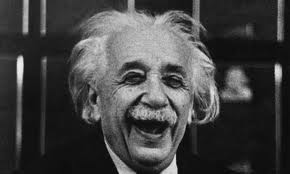
Albert Einstein is of course well-known for his theory of relativity, and E = mc and other cool phy sics stuff. Max Born,  giant of 20th century physics, called his theory of relativity “the greatest feat of human thinking about nature.” But there is a lot more than that to Albert.

Einstein published hundreds of books and articles on all kinds of topics. He thought widely. But perhaps the books, the theories, and the smart reputation as a genius, all the intellectually fancy stuff, has kept us from the man.

Einstein, the man, is worth knowing. He was not just smart; he was fun. He was not just brilliant; Albert was very human. In fact at the very time that he was publishing his theory of relativity, he was in conflict with his estranged wife and wrestling to find a meaningful way to relate to his children. But for all his serious family problems and serious scientific theories he was not just serious, he was droll and naughty in a schoolboy kind of way.

He wrote: “Common sense is the collection of prejudices acquired by age eighteen.”  

I like it!  I’m still trying to recover from common sense,  to finally think at least something uncommon.

Einstein also iconclastically quipped, “Education is what remains after one has forgotten what one has learned in school.”

Touche, even if it wasn’t entirely true! Curiosity and imagination and research lead him far beyond the classroom.

He said that “The only source of knowledge is experience,” and he practiced that, except of course for all the math and physics he learned in the classroom! He never lost his “holy curiousity.”

It’s the bit of rogue in him that I like, the maverick, the unconventional thinker, his,”Imagination is more important than knowledge.”

He advised against reading too much. “Any man who reads too much and uses his own brain too little falls into lazy habits of thinking.” I like it; I read too much, and if I can take Albert’s wry advice, there may be hope for me yet.

Einstein came at God this way, sideways, obliquely, interestingly. He said, “Coincidence is God’s way of remaining anonymous.” He also said, “I am a deeply religious non believer.” His “God doesn’t play dice with the world” has been widely repeated and widely misunderstood.

There is also the down to earth, kind of pure, in-the-moment Einstein. “I never think of the future. It comes soon enough.” It did for him — relatively.

And there is the Einstein who saw all the evils that could come from stupid national loyalties and from war.  I like his passion for peace, his love of our race, his desire to protect, his anger. He roared,  “Nationalism is an infantile disease. It is the measles of mankind.

He also said, “Heroism on command, senseless violence, and all the loathsome nonsense that goes by the name of patriotism – how passionately I hate them!”

Albert was a complicated man, with some complicated family relationships and some complicated math in his head,  and yet he wrote,”Make everything as simple as possible, but not simpler,” and “If you can’t explain it simply, you don’t understand it well enough.”

Before World War II, Einstein was so well-known in America that he it was said that he would be stopped on the street by people wanting him to explain “that theory.” He finally figured out a way to handle the question. He told the people who stopped him, “Pardon me, sorry! Always I am mistaken for Professor Einstein.”

He was practicing his belief: “Creativity is intelligence having fun.”  The wild man with the wild hair and the wild brain — it would have been fun to trade a few quips with him.

“A strong man who has known power all his life may lose respect for that power, but a weak man knows the value of strength and knows, compassion.”

So says Dr. Abraham Erskines, the German defector who injects stength serum in the anemic, weakling Steve Rogers who is about to become Captain America. Steve is the right guy to get strength serum. He has the character to handle it.  Strong, he goes out saves America by sacrficing himself. Steve’s a good guy.

In Shakespeare’s “Measure For Measure,” on the day before Claudio’s scheduled execution, Isabella pleads with Angelo to spare her brother, but Angelo refuses mercy. Frustrated by his heavy-handedness, Isabella cries out:

O, it is excellent to have a giant’s strength, but it is tyrannous to use it like a giant.

Isabella could have used a Captain America before America but not, of course, not before captains or tyranny. She needed a gentle giant, an enlightened tyrannt, a man tempered by fire. She needed the man who had been weak so that he knew how to use a giants strength, not as a tyrannt.

Weak and strong, everyone of us knows some of both, and it is one of the neat tricks of life to know how to balance the two. Paul Tournier, the brilliant Swiss therapist and writer got at this quite nicely in his book The Weak and The Strong. Tournier points out that really, depite the way we present ourselves in public, all of us are both weak and strong, and that we need to stay informed by these two parts of us in order to live sensitively and wisely.

Strong and weak, we need to get used to both becauses both are on life’s docket for all of us, and getting this right could make the world a lot easier for those who have to live with us.

This morning I spoke to a friend whos was saying that his mom had deteriorated, mentally. She could remember some things perfectly from years ago but couldn’t remember something he had said to her only a few minutes before. Another friend, listening in said that she had visited a retirement home recently, checking on a place for her parents, and that it was a bit shocking to see professors, doctors and writers in the fascility who could barely function anymore. Their brains had worn out.

No shame in that.

It happens.

The strong will one day become the weak, and some who are weak today may well be strong tomorrow.

What to do?

Well, all of us might do well to work at staying humble, because we certainly are not, nor will we ever be, in control of all that comes to us. If weakness comes then we would do well to use that as portal through which we might gain a beautifully gentle perspective on the world. And we might stay hopeful too, that we will have an opportunity to use power for good, learning and doing good whether weak or strong.

Perhaps it would be healthy for many of us to allow ourselves to admit and experience our weaknesses more, particularly if we plan to go out and play at being Captain America tomorrow. Say that happens, say we become a kind of Captain America in the future.  If we stay in touch with our intrinsic weaknesses, then we will have the best chance to avoid becoming  tyrannts.

Another Paul, centuries ago, commenting on this weak and strong thing, got right to the issue.

“When I am weak then I am strong.”

Bingo!