Favor

Posted: June 10, 2012 in thriving
Tags: , , , ,

As the boat rounded the thin edge of the island, all manner of hell broke lose along the bank.

The Jacana were running on the tops of the water lily pads.

We yelled and the guy running the outboard motor cut the throttle.

There were two of them in front of us. One went airborne; the other ran. Across the lilies in long, skipping, gliding motion — lily ballet.

It was a moment of favor for me. To see the Northern Jacana, long-legged-red-and-yellow run on the bright green pads floating in Lake Nicaragua. In seconds they were gone. So was I — too cool.

On the fight from Managua to Bluefields the views from the 12 passenger plane were nice — jungle, brown water, snaking rivers.

In the evening, walking back to our house we noticed Scorpio and the northern cross blazing on the horizon to the south.

We ogled; it had been a long time since I had seen the southern sky. A firefly flashed. The stars flashed. More favor.

We went to bed in a sticky, muggy cloud of heat. It was much too tropical hot to sleep. Eventually I did anyway. I awoke at midnight to a mad rush of wind. I thought that Daniel had turned the fan up to high.

Then I felt the rain on my face. It was cool, fresh and clean, blowing through the screen. Favor. It seemed to wash out of me some of my insanity, some of the toxic thoughts I had gone to sleep with.

When I had been teaching earlier that evening I made the comment that life is difficult. Everyone agreed It is. Lots of unwanted thinking.

When we arrived in Bluefields my luggage was missing. All my clothes, all my bathroom stuff — gone.

Life is full of stuff gone, stuff broken, stuff taken. Life is full of thoughts in the night that we would rather not have.

And life is full of favor.

This morning we sat on the veranda and let the cool and wet wind blow on our faces.

I like the favor. It so refreshing.

It’s bright like the stars.

t’s cool like the rain.

Favor runs on the water lillies like the Jacana.

It’s light on its feet.

When I pulled into the parking lot of the church a young man in a suit and tie rushed up to the window of my car and said, “Sir I have a twenty-four month old and my wife and I need to get back to New Mexico and I am begging for money. The man over there just gave me some.”

It was fascinating to me, the suit and tie, the stock narrative, the assumption about church, the he-did-so-you-should logic, the questions this raises. I wasn’t sure what to think.

I didn’t give him anything and felt right about that.

He drove off quickly in a nice minivan.

I went out front and began pulling dead leaves off of a plant I had recently replanted. A few leaves had survived the transplant.

A young man and girl walked by. After he passed, he looked back over his shoulder at me and called out, ” Hallelujah!” I wasn’t sure how to take it. Sarcastic? Not? Sincere?

It gets me thinking. What’s spiritual?

Later in the day a friend called me. “She’s yelling,” he said. “This is ridiculous. I can’t stay here.”

“You can’t not,” I replied. I was ticked. Maybe it was the guy in the suit. He had kind of set me off.

“It’s insane here,” he said.

“Yeah but you made it that way when you had all those kids,” I said back.

He said more stuff

So did I.

“Go apologize to your wife,” I said.

He did.

That’s spiritual.

What’s spiritual?

Not “Hallelujah.”

Not begging from the church.

I think spiritual has something to do with taking responsibility for your mouth and the people you live with.

I think that really spiritual is an apology and the peace after.

It’s like a transplant. A few leaves survive.

When we launched our canoes into the Little Niangua River, we had to paddle to scooch across the first pond below the bridge, but fairly soon the paddling quit.

Looking ahead we could see the water sloping downward. Like a flat table, tipped, like a slide sloped, the water angled down from us and around a bend.

The front of the canoe was now lower than the back, and we sped down the river  quickly now, with little effort, silently and smoothly slipping along the surface.

It was a soft, slippery,  smooth run down through the green trees along both banks. We quit paddling; we ran fast.

Then the river turned and in the corner we sped up even more. The smooth water ran rough here; the canoe suddenly scraped the bottom, aluminum grinding on pebbles, and then we wacked the paddles into the water hard  to scoot on through the turn and avoid smacking into the bank.

Out onto another smooth pond we glided, and we there we returned to dipping our paddles gently into the water again to propel the canoes along.

Slop, slide, slop, slide — with a familiar and constant rhythm we made our way through forested turns, past old, dead logs, along grassy, green banks shaded over with drooping bows.

Paddle, float, paddle, float, paddle float —  life has a pattern running through it, a smooth and rough, a smooth and rough, smooth and rough, float and paddle, float and paddle, float and paddle.

I am noticing something. I think that maybe many of us tend toward paddling too much.

We tend to push. We fixate on the rush. We power forward. We compete. We seemed to have an anxious, urgent need to get there.

But …  I think that perhaps getting there is over-rated, especially when we don’t really know where “there”  is.

Perhaps enjoying the paddle is the main thing, and floating,  down the so very nicely prepared slopes, the main thing.

At that moment, the main thing I felt was fear, but I also knew I wanted to do it anyway. Something inside of me was pushing me, hard.  “Step up now,” a voice inside of me said fiercely to me, “and say it.”

I raised my hand, and then I spoke for maybe 17.4 quivering, stammering, but nicely contributing seconds. I was aware of each tenth of a second. When I got done, I was all shaky inside.

That night, after the group ended, someone told me that they liked what I had said. Nice. I hope so; it cost me.

It’s stressful when the impulse to be quiet is fighting with the impulse to speak. It’s stressful being immature, plus shy to the fourth power, especially if you also want to be heard so much that you are willing to be scared shaky and yet still try. Between the ages of 18 and 28 shaky was common for me. On my way to getting to know myself, I experienced a lot of rattled. Many of us do.

During our figuring-it–out years, the years between child and adult, between immature and mature, between amateur and professional, many of us suffer from a significant and debilitating lack of confidence.

I remember that in high school I was afraid of girls. I adored girls, but from afar. I had no confidence around them. They had grown into something too beautiful, and I was unused to that. When they were little, we could play games together. I had some grade school friends who were girls, but when they and their kind got all perfect, I didn’t know how to reply to their amazingness. It took me quite a while to recover from their awesomeness.

The transitional years are often defined by insecurity with the gender we are not. We are trying to figure out how to relate to other newly remodeled creatures, to know what’s acceptable, when we are with them, what crosses the line, the line that is invisibly drawn in some unknown place that we don’t  know how to find. And we massively struggle with what to do with our infatuations, crushes and  transient moments of pure and true ephemeral love.

In high school I loved Linda, a cheerleader, but I didn’t know how to tell her. I smiled at her across the room, and I enjoyed the electrical shock therapy I received from her, but I couldn’t walk up to her and have a normal conversation. In the college years I think I  was for a brief moment adored by Valerie, a tall, leggy beauty,  but I was never quite sure, and I think she didn’t quite know how to alert me to the possibility of us. The not being sure if they love you, it can torture you — playground to grave.

It was the same with academia. Early in my education, I knew I wanted to be a writer, to say stuff, in the classroom and to the rest of the leaders of the world,  but I wasn’t sure I had it in me. After all, I had no manuscripts, and I had no adoring readers. I wrote a poem in grade school. I still have it. At the university, I wanted to step up and to enter the conversation, the centuries old discussion about the great ideas, but I didn’t because Shakespeare, Hegel, Plato and my literature and history professors were over-wowing me everyday.

Those of us who want to be included in the conversation, those of us who even want to go to the front of the room  before we know what it feels like up there or what a leader is, we suffer. The want-a-be-contributors take it on their aspiring chins. Those of us who feel like we can be more but have never proven it — we eat it until we become the more within the less of the very us.

Hard — this was hard. There was no small amount of  awkwardness and a truck load of social pain in my years of low confidence, and that pain lasted a good ten years, even, to some degree, ten more.

Why?  Why do we suffer in the becoming years?

For one, it’s all the new stuff. New stuff makes newbies feel incompetent, and a bit of aloneness can pile in on us during those years. We keep graduating, into new levels,  new roles, new kinds of relationships. We are  incompetent transitioners because we are semi-incompetent in each new place, and also because sometimes we are too much alone when working out all the new stuff.

Between 18 and 28 or 35 or 43, or somewhere down the road, most everything turns into something new and perhaps a bit isolating for most all of us   At 18, I moved out of my family home. It was new to go it on my own, to make dinner, to pay the bills, to not have a family to hang out with in the evening. I was lonely and couldn’t even admit that. There was no new safe place once my parents stopped parenting me. They wanted to stop, and I wanted them to stop, but that meant that I was navigating the new while newly alone.

Neo-solo isn’t confidence building.

I went off to college to study literature, philosophy, psychology,  history and linguistics. There were suddenly new concepts, new world views, new ways of thinking which resulted in new excitement for learning and some new confusions.  I found a new form of lostness, in ideas.

Plato’s Republic got me to questioning the Biblical world view that I grew up with. What was the ideal society made out of? I didn’t know, but now I knew there were options to the monolithic view I was handed as a child.

In my becoming years, I took new jobs. Every new job put me in the role of the fumbling beginner. I became a janitor. That didn’t turn out well. My boss fired me for not having a good attitude. I didn’t have a good attitude.  A good attitude while vacuuming was new to me.  I hadn’t always done my chores at home with a good attitude.  I also worked building a freeway. I didn’t get fired from doing that. That job paid my first year’s college tuition, but it had some sucky working conditions, like moving every time we finished a new stretch of road.

Really, that’s what the transition years are all about, moving.  We keep moving, while we build the highway that we will  spend the rest of our lives driving on.

During the schooling years, I worked as a grocery store box boy, I shelved books in a library. Every job, every new social part to play brought its own social challenges. I  became a part of  a church; I met a bunch of cute girls; I survived them telling me that they liked me when I didn’t like them the way they liked me, That was awkward.

I found the right cute one that I liked,  but she liked someone else. That was awkward, but after a bunch of drama I got past her awesomeness and saw her personhood, and we fell in love so hard that we got married.

Wow! My transition years didn’t flow; they bumped along,  they pounded down the road, they careened into the ditch and they bounced back on to the highway, spun around and set me headed in the opposite direction. I brutally pounded and spun my way toward maturity.

Right when I got married, I began a career  as a teacher, the front-of-the-room guy who I always kind of wanted to be. It threw me into a total nervous disarray. To stand in front of five classes everyday, to have a conversation with a whole room full of people, all day, it made my stomach hurt.

What can we do, to grow into our own skin, to become more confident, to grow into a professional status? I have some ideas, from my experiences.

I am no longer new or in the grip of the new as much as before. In fact, I am in a second career now, and my daughters themselves are in the transition zone. I have learned just a few things, and they make me want to help a little, because I know what it is like to move toward maturity,  and move again while experiencing low self-confidence.

Here it is. Do this, my young friends, to get through it. I urge you to rush down the pipe, and kick down the door. Knock the steel door off its hinges and jump head-long into the sea of things that are in your hearts to do. Do this. Do the very things that make you feel incompetent. Try to be the thing you want and need to be even when you won’t immediately be successful at being it.

And if you can’t do that, if what you try is not your thing, if it is not within where you are going or really can go, then you will find that out by trying. If you do learn that something good is not your good something, then you must have the courage to drop it and move on to the next good thing.

I always wanted to be a musician. I practiced and practiced the guitar. It was not my thing, and I learned from playing the guitar, to put it down. I still play, for fun, on the side, very minor, so that I can major in the major things that I do much better than playing the guitar.

That’s the thing, finding what you it feels like you were meant to do. And then,  if it is in your heart, and within your reaching grasp too, and it is going to be your thing, then you must rush it. You must raise your hand and speak to the group even while you are shaking inside with insecurity.

If it is in your DNA of aspiration and ability, then you must walk to the front of the room, and stand and play the part of the teacher or leader while all the time thinking that you are perhaps a total fake and that everyone watching knows it, but of course they really don’t, and of course you really aren’t. I know. I did it.  Pretending to be something is the first step toward becoming it.

And about the girl-boy thing, there you must learn to be brave and to tell awesome girls and totally cool boys that you love them when you do, or  to sometimes tell them not. You must sometimes tell them not when you can discern that they don’t and won’t reciprocate. Then you will protect yourselves from that completely unnerving experience of  unrequited love.  You must learn when and when not, and when “when” is the most important unknown factor in the when-and-when-not social equation.

It comes down ro this regarding the confidence factor and confidence-building-type-things.

Do what you need to do today and you will become more confident tomorrow. Experience is the fastest road to get to the that very cool place that we called confidence. Your personal insecurity is bested when you are willing to be insecure in order to become more secure.

And one warning. Doing nothing for too long may lead to being nothing for a long time.

If you are afraid to become what you want to become then I urge you to do the opposite of what your fear is telling you to do.

Go for it, because I wish you, my lovelies, my beautifully insecure and shaky road makers — more confidence.

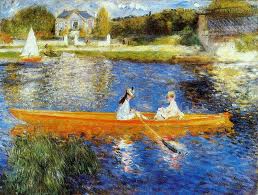
In the National Gallery in London Pierre-August Renoir’s “The Skiff” lights up the room. I am falling in love with it a little more every minute, and I can’t understand why someone  put it in a small corner.

It overwhelms the space it is in. The green grass jumping up out of the lake in the foreground, the sparkling blues blue water grabbing the sunshine out of the sky, the women in the white dresses calm in the middle of the burning orange skiff.

It is the orange that gets to me, the orange, very, very orange skiff, I can’t get over the orange skiff – all that warmth absolutely dominating the blue lake, leaking off the canvass and banishing the picture frame, the museum wall, the museum floor, and the whole of the room we sit in. I can’t see anything but orange. I am totally smitten by incandescent orange paint. I can’t stop ogling it.

The women in the painting are so calm. One is reading, the other is sitting and rowing so casually. They seem so un-startled, so undisturbed,  much like the people around me in the museum, shockingly respectful and settled.

But I am not so calm!  I don’t know what to do. Perhaps I should stay right here on this bench for a long time looking and pulsating. I will; I am deciding  right now to eat here tonight, and then sleep here. Now I am deciding not to. It won’t work; this Renoir won’t stop glowing, like a fire, and it won’t go down, like the sun. If I stay, it will be too bright to get any rest at all.

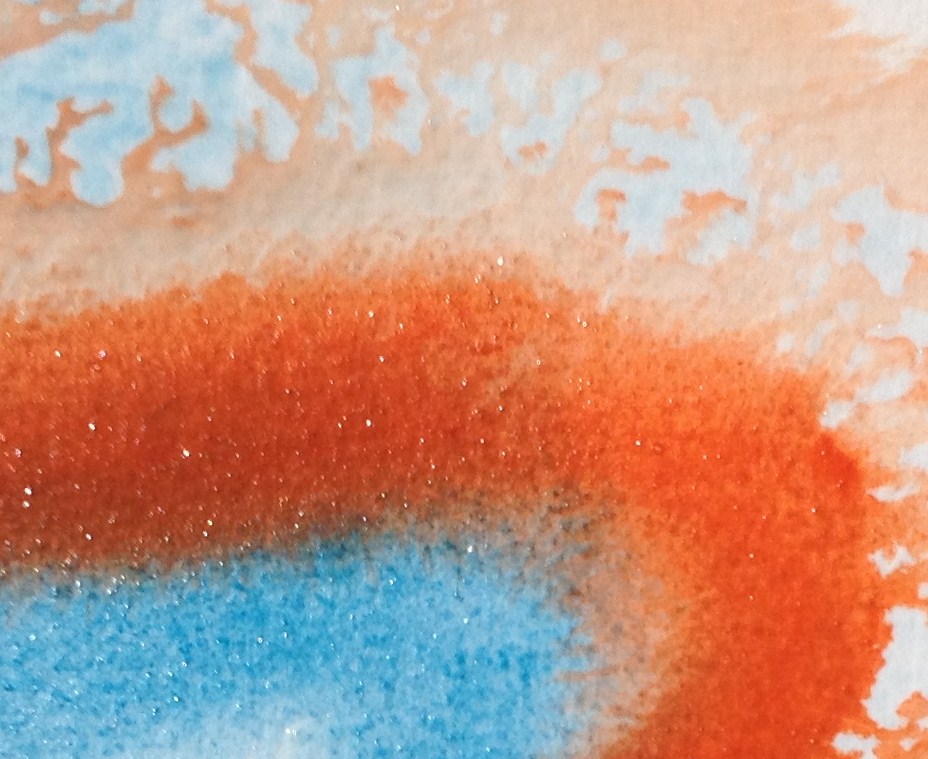
I won’t stay, but I will stare. At the bottom edge of the skiff I can see that the orange is coming off of the wood, and it is getting in the blue water. Renoir let it can away from him. The orange paint is jumping around in the ripples of the water that are coming off of the boat. The orange paint is getting all over the blue paint, taking over the gap between the boat and the lake. I can’t stop smiling. I like it that the orange has taken this step, has crossed over, has created an interface, has made this transition.

We leave the National Gallery. We get on the tube to ride through London to our refuge in West Finchley, our suburban home away from home that is housing our stay. We stand in the isle of the train because there isn’t enough room to sit down. A bell rings. The electric doors whoosh closed, and off we whir into the tunnel, rushing madly beneath the streets of London. We come to another station, we slow, then stop. The train doors open, and a woman’s voice, very British, says, “Mind the gap between the train and the platform.” We get off.

We mind the gap.

We always do, or not, depending on how well we are doing.

I love the gap. I love the people in the gap. I love young people crossing the gap between their immaturity and their maturity. I love me, crossing the gap into the next stage of life.

The spaces that exist between are always the most interesting, where the boat meets the water, where the blue meets the orange, where the train meets the platform – interesting, disturbing, transitional, difficult, formative, painfully beautiful.

Take the gap between childhood and adulthood — wow and superwow! This transition shapes the rest of life.  To get out of the boat, to step across gap, to bring one’s babyhood, ones adolescence, ones teenafication, one’s “becoming” into ones “I have become, “  to splash the colors from one place into another, this is at the core of the very core of every rippling and  transforming identity.

What is this thing,  this growing up? What are the paint strokes that get us across the gap? How do we paint the immature past into the mature present?

I’m not always sure, but here are a few of the brush stokes that may need to be mastered to paint across the gap:

We must overcome the fear that makes us not want move our brushes beyond what we have known before, or beyond what others like us have done.

We must come to  relate to the people in the boat, wisely, and not sit when they are sitting if standing is what we really want to do, or we must just jump, out of the boat, and into the orange water if really that is the only thing to be done when we are  so ready for change that sitting doesn’t work for us anymore.

We must learn, must we not, when not to judge but still to discern what is right and what is flat-out, dead wrong for us, even if not for everyone else.

We must try, and test and test again, our limits, when one more, or one is less,  or one is one too many, or too few or just right, if you know what I mean.

We must grow in confidence, to splash paint, from the boat to the water and on to the sky.

And what else?

What else must we do to get across the gap?

Tell me, so at the very least it is out here, on the canvass, to deal with, to face, to enjoy, to revel in.

We need protection — from voices.

Two potentially harmful voices come to mind.

The first one is our own.

When I finished my first year of professional teaching, I said to myself, “I hate this! I feel like a failure. I want to quit.” My own voice didn’t  offer good guidance. Fortunately my father, in a phone conversation about this,  said to me,  “Now you know how your students feel. Many of them  feel like failures. Now you know.”

That was a good voice, and I went on from there, following the leading of that voice to teach, until now, and I like it. When I finally do quit teaching, I think I’d like keep teaching,  part-time  —  for fun!

My own voice was suspect. This is hardly rare. Most of us have experienced bad feedback,  from ourselves, concerning ourselves.

Beware your own whining and sulking and quitting-talk.

The second kind of voice to avoid is the voice of the unwise family member or friend.  Family members — they don’t always get us right. Over time they tend to stereotype us.  “Well she always has been a bit edgy, or sad or dominant or shy,” or whatever they come to label us. Others in the family, may concur, and the label may stick, when it shouldn’t.

Friends are often also unwise voices in our lives. In giving feedback, friends tend to simply project their own reactive, unresolved feelings onto our situations. We need to face this; most people aren’t great counselors.  If they hate men, they hate our man. If they hate women, they hate our women. If they don’t resolve their own conflicts well, they won’t resolve ours well either.

What to do?

Pick mentors carefully.

Find people who have life experience, good and bad, people who have been able to resolve conflicts, who have learned something about healthy boundaries, who have had some long-lasting relationships, who have raised some kids (and the kids still love them), who have been successful in their careers but who have also gone through some career-hell and come out still feeling like life is some kind of heaven, who know something about God, something along the lines that God loves us and will never, ever stop loving us.

There are many voices. The world is full of talk. The deal is to learn which voices are safe and which ones aren’t, which voices to tune out, and which ones to listen to when we are losing our way a bit.

This is one of those things to figure out, to get right, to get a handle on, to give some time to.

The right voice, the right answer, the wise counsel — it’s beautiful!

It’s protection.

I’m smack down, knock-you-out, beyond-the-stratosphere  impressed.

I’m astonished beyond the extreme edge of sheer, blacked-out and totally demolishing astonishment.

I’m flat-out,  heels over head, shot-into-space-to-the-edge-of-the-sun smitten.

There is no one anywhere, anytime or in any way like God!

There never has been nor ever will be anyone ever with such a flat-out, full-0n, incomparable graciousness. You and I and the rest of the universe will never meet anyone with such an over-the-top and completely loving intelligence.

God is beyond the ultimate expression of the beyond inside of the beyond of the very beyond.

God is crazy attractive. God has such a floor-you-and-pick-you-back-up charm, such a drop-dead-and-then-raise-you-from-the-dead beauty, such an ultra-extreme elegance beyond the silken edge of the finest elegance that I just cannot stop staring.

I saw this when I saw him best. It was at the moment that he approached me at my worst. I was kicked in, smashed up, beaten down and washed out. I was done. I was gone. I was finished.

And then God, the incredible God,  scooped me up, held me close. God soothed and restored me, fueled and refreshed me and set me on my feet and gave me a gentle push back into the perfect opportunity he had prepared for me.

No one will take this away from me. Not my detractors, not my enemies and not the unseeing.

God, my God, rescued me, and I can’t get over it; I won’t get over it; and nothing in the future will get me over it.

God was, is and ever will be the first-place, top drawer, premium, upscale, top-of-the-line savior of the world.

God rescued me!

I love God!

“I feel like I’ve wasted the last year,” she said, as she looked at me through the camera on her laptop.

“Perhaps not,” I said back.” She and I were miles apart, but it felt like we were close together. We had screen faces and screen smiles and screen delivered nuances of expression that helped us to speak freely.

“We learn from everything we go through,” I said. It sounded cliched.  “Now you know more about yourself and about the kind of relationship you want in the future. If you hadn’t gone through this then you wouldn’t understand yourself or other people as well as you do now.” That sounded better.

It was really not much me telling her that.  My wife said something like that to me recently, and  I was paraphrasing  her, as I so often do. There is a significant advantage in being married to a smart women. Not long ago, I had bemoaned to my wife my regret over the emotionally difficult experience that I went through in switching jobs in 2008.

My wife had listened, and then responded. “It’s made you who you are.”

She got it right, as she usually does, and I liked it as I tried it on,  for me, for my friends and everyone else.

“Hmm.” We may not like what we’ve been through and it may seem a loss, a waste, an unwanted detour, but that is not the only way to view our experience.

Every hard thing we go through has the potential to shape us, make us.

When someone has been hurtful to us, this might at first bury us, but then  we might learn that we really don’t want to do something like that to anyone else. When someone has dominated us,  we may learn something mean from this, how to dominate others, or we may learn a much better lesson — to not dominate others. When someone has not honored our emotions, we might learn that only some people are safely entrusted  with our deepest emotions. When we have made a mistake, we may know not to make it again, maybe.

Jesus said, “The truth will set you free.

The past is a form of truth, so “the  past will set you free too,” if you can  see the truth extruding out of it.

I am learning to make friends with my past. The past is my best friend. It has given me everything I now have. It has been my teacher. It has been my lover.  The past has humbled me, and it has honored me.  It has left me angry; it has also taken anger out of me. The past has shaped me into the me of the very me inside the core of the very me.

And lately, I am realizing that the past has turned me into the me that I am learning to treasure.

Age.

Disability.

Ethnicity.

Gender.

Marital status.

National origin.

Race.

Religion.

Sexual orientation.

These are sometime the basis for unlawful, socially harmful discrimination.

I’ve been discriminated against. When I was a teacher,  I remember one of my students looking me in the eye, glaring and saying, “You’re not capable of understanding.” Then I knew what it felt like to be on the receiving end of racism.

For me and for most of us, discrimination is something we think of  other people doing.  They are racists, bigots, fanatics, the unjust. But it is a symptom of the disease of unlawful or harmful discrimination not to see it in ourselves. With our “they” we  poke out our own eyes.

To actually experience condescension in our own voices, say when speaking to a sixteen-year-old or an eighty-seven year old or a disabled person, is harder.

We may also experience it in our silence. I noticed at one point that I spoke less to my daughter’s friend who can’t speak, than to her other friends. Why? He can’t speak back, so I felt awkward. I decided to change. Why shouldn’t he receive my attention as much as any of her other friends. It’s been a nice change for me. I have my own “way” with him now. We laugh a lot, together.

I know a young woman who in her twenties looks ten years younger. When she asks for help while shopping for clothes, store clerks sometimes ask her where her mom is or direct her to the “younger department.” She knows what it’s like to experience age discrimination, and while one might easily defend the clerks as having no way of knowing, such situations bring to light how easily we slight others and don’t  know it.

It’s subtle. I have felt a distancing going on in my mind as certain people have approached me. An observation of size or disability or age has  sometimes shot a small dose of fear or repulsion into me. I hate having to admit this, but my first impressions have sometimes been based  completely on superficial and  automatic distinctions.  And I don’t always catch on to the fact that I have done this.

Sometimes our racial or social distinctions seem to us to be  wise notations of  differences. We think of ourselves as understanding. We make a capability clarification or a  role clarification; we see our discrimination  as a necessity that reflects physical reality.  “There are differences between men and women.” As such, our discrimination begin disguised as enlightenment.

I remember in my younger days thinking that I wouldn’t go to a church that was pastored by a woman. I based this on an interpretation of scripture. I based it on no experience. I had none. I based this on my own insecurity. I based this on what other men and women that I knew said they believed.  Now I would gladly go to a church pastored by a woman, and now I can present a strong scriptural basis for this and now I am surrounded by other people who affirm this. It is so important to be able to change, to be able to shed former boxes of constricted and harmful thinking.

I have had to grow into the realization that different should not be disallowed. I have had to flight past social taboo and come out free to accept as women as equals and their contribution as enriching.

The truth is that we too often hide our “put downs”  in religious mandates, governmental programs, institutional values and herd mentalities.  “They can’t” or we “must not” or “God doesn’t want'” can be simply disguises for insecurity, fear and selfishness.

Discrimination often functions within social expectations and rules.  It is better to hear than to sign. It is better to see than to be blind. It is better to be light-skinned than dark. It is better to be rich than poor. It is better to be educated than not.

What is needed is a definition of what it means to not discriminate.

To not discriminate is to experience someone different from you and to not see them as less than you.

To not discriminate is to hire a person who is in some way the opposite of you,  and not compete with or intimidate that person. It is when an extroverted leader hires an introverted leader to enrich the emotional depth and quality of the organization.

To not discriminate is for a man to see a woman as his equal, fully empowered, taking her place in the family or the organization and being treated as in no way inferior or lesser or weaker or more emotional. It is for her not to be dominated and controlled or put in a limiting box.

To not discriminate is to treat the school smart daughter the same as the daughter who is in special education and to affirm them both, equally and to see that smart is not better it is just different and kind is not better either it is just a quality that some have more than others.

To not discriminate is to see a court case where the one charged is Hispanic and the one dead is black and to not see this as a brown versus black issue but a right or wrong issue that must be given a process that has as its goal the truth and justice and love.

The truth is that it is always a fight for the truth.

And the truth is that it is hard not to discriminate, that we all tend towards it, and that maturity and personal growth always involve movement toward loving other people more.

The beginning of the end of discrimination?

Think of it as something that you, not just “they” struggle with.

I slid the hammer under the nail in the cross and pulled. The claw slipped off the head of the nail and popped off.

The problem was that the last nail that I pulled was stuck in the claw and prevented the one I was trying to get  from  being hooked by the hammer claw.

I knocked the offending nail out of the claw and tried again. This time the nail popped out of the wood with a light rip and fell on the carpet. I thought about how much it would hurt if each of these nails had been pounded into my hands.

Pretty soon I had a pile of nails scattered on the floor and a clean cross with no nails in it.

Then I slid the big pieces of the cross over a supporting pole, and when the fifth piece clanked down on the fourth, there it was, a clean cross in an empty room, ready for Easter.

It’s a bit of work, getting nails out of crosses, and getting the stuff out that has been pounded into people too.

I got a really fun chance to talk to an amazing young women recently who has been pulling out  nails.

At one point, after we’d gone back and forth a bit, she looked out at me from under her beautiful, dark makeup and smiled.  Through her quick smile,  her identity darted out into the room, then disappeared again behind her eye-liner.

“I don’t talk much,” she said.

I was pulling nails again.

I’ve thinking lately about how hard it is to extract feelings, especially the ones nailed into our psyche’s by other people’s bad choices, the feelings that feel like they were pounded into our flesh as we hung on a hard, wooden cross somebody else nailed us on.

Why does it take so much work to get a clean cross?

In the first place, it’s pretty hard to find someone who doesn’t pass the emotions we reveal to them through their own experiential grid. When they hear us, they hear themselves. Most people never, ever get beyond this. They don’t get us because they are always too busy getting themselves.

And if that didn’t make it hard enough, the total and almost complete inability of our kind to be objective,  our understanding of someone else is always compounded by their confusion about who they are and all the misleading things they reveal about themselves.

When a person is extremely, horrifically angry, they most often present themselves with extreme composure covered by a lavish layer of deceptive, raging calm.

And when a person has a nail of abandonment pounded into their palms by an absentee parent, they most often lay very, very low in public.

And when they have the ring-shanked nail of family addiction pounded into their skulls, they usually walk around with a self-constructed shield of complete and absolute apparent normalcy.

When they have a spike of self-hatred in their own hearts, yet they eat dinner and take dessert with a smile too.

When a pike of confusion divides their opinions, they tend to make very strong statements of extreme conviction.

This is common. It breaks my heart, because this doesn’t work, at all, for anyone. Silence is not an effective strategy for living. An undisclosed life  is not a good life. It’s a torment; it is a total emotional disaster, this remaining  unknown to each other.

I’ve gotten to thinking about this.

After all, it’s Easter.

Think of it as nail pulling season.