Posts Tagged ‘randy hasper’

On Labor Day weekend people celebrate working by not working. Not me!

This holiday, I worked by choice. I worked Saturday September 1, Sunday, September 2,  and today, Monday, September 3. I worked all three days of Labor Day weekend, 2012, and I loved it

I would pay to work;  don’t tell my employer, and I would work for free, if I could afford it.  I do work for free, always putting in more time than is required, like this weekend. I did take a little time off on Saturday, to ride the ferry and to go to the San Diego Sand Castle Competition with my wife and daughter, between working.

Today, Monday, September 3, I didn’t go to work at my office, but I vacuumed the whole house, every tiny corner in every room. I loved doing it, except when the vacumm fell over on purpose just to annoy me.

Why, why vacuum like crazy on  Labor Day? Space dust and cat hair and corners and because I wanted to, and because yesterday my daughter said the house was dirty and because I really wanted to.

It’s reported that in 1882, Matthew Maguire, a machinist, first proposed the holiday of Labor Day while serving as secretary of the Central Labor Union of New York. It caught on, and it has become a national day for not working, for parties, for parades, for the beach, for barbecued food and also, for work for those who don’t want to stop working, to celebrate work with work.

I have no respect for Matthew Maguire. If he  had really wanted to celebrate work,  to honor it, to nobly salute it, he would have proposed that on one weekend of every year we all work all weekend, that we throw a huge work party where we work together, that we feast together at lunch and then go back to work and then feast more together for dinner and then work into the evening until we can’t take the excitement anymore and we go to bed.

Today, after I cleaned the house, I  edged the yard. I like the clean lines of edged grass. I like to work in my yard.

After that, I cleaned out my closet and took out all of the clothes I don’t wear anymore, and then I organized it. I’m more ready for work now.

Then I wrote a dozen proverbs, then this blog post. Writing is what I do for my work, my career, and also thinking, and writing about my thinking. I’m paid to think, and write, and talk, but I love it so much, that I do it for free when I’m not doing it for money. And today, in between writing, I went shopping to buy some new workout clothes.

I have heard a lot of seminars in my profession on the need to rest, a lot of talk cautioning us as professsional caregivers not to burn out, not to neglect self, family, to take breaks, to pace ourselves. It’s good, but it’s not all good.

Try being unemployed. That’s what’s not good. Not working burns people out. Not accomplishing anything is what really does a person in, because not working means not belonging and not having a place to go, not producing anything, not helping anyone, not making any money, not having anything to give back, and none of that is inspiring or meaningful. Work is what is inspiring. Work is meaningful. By work, we’ve made a good world to live well in.

Being is good, existentially, epistomologically, the philosophers tell us that,  but a working, moving, active being is better, especially in an world in need of justice and mercy and kindness and love.

I think we need to work more, not less, to move, act, do and be active more. And when we don’t have jobs, that’s the time to really work, because work is doing what we were made to do and meant to do and what needs to be done whenever we can do it.

I can’t wait to go to the gym this week! More work. I love working out. I love working in too.

I’m going home in a minute to barbecue some chicken. Then I’ll gladly do the dishes. I don’t think of it as work. I love to clean things, and to have a clean kitchen.

Then I’ll write some more in the cool of the evening on the back padio with the waterfall in my lily pond running and my cats lounging by the back door hoping to get out, wishing they could do something besides lying around.

What a great Labor Day!

I will get into bed tonight sad that it’s over, that I have to quit working. I’ll go to bed wishing I didn’t have to sleep, eager to wake again and work.

And I’m back to work tomorrow, but I’m planning on taking a day off later in the week in order to get some work done.

I went to a wedding last night, very social, very nice, good company, good beer, decent food — which of course we waited for. Waiting for the meal after the wedding is like waiting for the second coming; you know it will come but not the hour or the day.

But the waiting at least has a purpose — pictures with translate into memories, all good.

Actually this wedding was reasonable, the wait, the money spent, the whole thing.  The couple had been sensible about it. I’ve been to some that were completely over the top. Perhaps couples over-spend on their weddings to protect their marriages — they’ll have to stay together forever to have any hope of paying off the debt.

I met a lawyer at the wedding.  Cool. I like lawyers. They have stories.

“Tell me stuff,” I said.

“Give me a topic,” he said.

“Does money make a difference in court?” I asked.

“Money gives you access,” he said.

“Define access,” I said.

“Access comes through lawyers,” he said, “and motions. Say you have a patent case. The small guy is claiming that he created something, but if the rich company that has gotten a hold of it, and is not paying him adequately for it, prolongs the case long enough, filing motion after motion, then at some point the little guy can’t afford it, and he gives up. Money wins.”

I got it. In court, the rich defeat the poor by outlasting them. No money? No power!

It sucks to be poor, in court, and weak.

It suck so be weak at all. It sucks not to have access, to not have a nice wedding, to not be able to last all the way to justice in court or to not have what you need to live.

I gave away a bunch of  money yesterday and then some today too.

Why?

Access. I want some people in my family, people I really love,  to have access, and some of my friends too,  so I choose to resource them in the same way that I have been resourced, with access. I  have been given access and I am beginning to want to be a person who provides access to others.

It has come to my attention that access is a big deal, and that God himself is outrageously committed to access.  Look around. He holds back his judgments, he blesses the earth with resources and beauty, he waits, he forgives, he waits some more, he is patient, he is unfathomably patient, he pauses, we live in the great pause, we have been given time to choose, to change, to experiment, to fail, to try again, to persent our case, to have a hearing, to be given justice, to have justice withheld and replaced by mercy,  to discourage him and each other and yet remain under the fierce weight of his patience.

The door of the world is open, the windows flung back, the roof is off, the sky is huge, waiting for us to decide. The  white  carpet is laid out for us, the bridal party awaits us at the other end, smiles everywhere, expectant on us, to run down the aisle of the universe to them, to the meal, to justice, to the wedding gifts.

Incredible. Unspeakable. Shocking. Knock you down good.

Access is being poured out on the earth by a good God.

Our best response. Take it, and make access for others too.

The sun rotates every 28 days. Not being solid, it should be slightly flattened by its rotation. But an international team of scientists using the Solar Dynamics Observatory have have determined how perfectly round it is.

If scaled to the size of a beach ball, it would be so round that the difference between the widest and narrowest diameters would be much less than the width of a human hair.

Other subsurface forces must be exerting more of an effect than expected. Such is the nature of reality. Things have a shape. Unexpected forces are at work to maintains that.

Cool! It’s incredible! I love it. Like Cezanne I love a sphere. God work.

I have a daughter with brain damage. I suffer the pain of chronic nerve damage, and my heart has been broken too. I once had a very close friend turn on me.

I could have been flattened by such rotations. I haven’t been. I have had a charmed life. So much good has come my way.

I have been educated in literature, linguistics, history and pain.

I am married to woman who specializes in discovering information.

I am a writer.

I live to make geometric sense out of reality.

Unexpected forces have done this. God work.

As a result of all this and everyday realities that round me out, I am becoming more and more of the kind of round I was always intended to be.

The unvarnished truth is that each one of us is a sun. Each of our lives is a shape, and internal and external forces are at work to persist into forming us into something extremely beautiful.

It’s round light.

It’s the kind of round that is within a hairs breadth of being perfect.

It is the work of God.

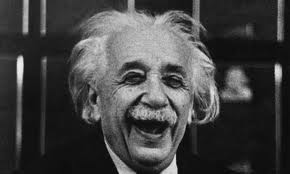
Albert Einstein is of course well-known for his theory of relativity, and E = mc and other cool phy sics stuff. Max Born,  giant of 20th century physics, called his theory of relativity “the greatest feat of human thinking about nature.” But there is a lot more than that to Albert.

Einstein published hundreds of books and articles on all kinds of topics. He thought widely. But perhaps the books, the theories, and the smart reputation as a genius, all the intellectually fancy stuff, has kept us from the man.

Einstein, the man, is worth knowing. He was not just smart; he was fun. He was not just brilliant; Albert was very human. In fact at the very time that he was publishing his theory of relativity, he was in conflict with his estranged wife and wrestling to find a meaningful way to relate to his children. But for all his serious family problems and serious scientific theories he was not just serious, he was droll and naughty in a schoolboy kind of way.

He wrote: “Common sense is the collection of prejudices acquired by age eighteen.”  

I like it!  I’m still trying to recover from common sense,  to finally think at least something uncommon.

Einstein also iconclastically quipped, “Education is what remains after one has forgotten what one has learned in school.”

Touche, even if it wasn’t entirely true! Curiosity and imagination and research lead him far beyond the classroom.

He said that “The only source of knowledge is experience,” and he practiced that, except of course for all the math and physics he learned in the classroom! He never lost his “holy curiousity.”

It’s the bit of rogue in him that I like, the maverick, the unconventional thinker, his,”Imagination is more important than knowledge.”

He advised against reading too much. “Any man who reads too much and uses his own brain too little falls into lazy habits of thinking.” I like it; I read too much, and if I can take Albert’s wry advice, there may be hope for me yet.

Einstein came at God this way, sideways, obliquely, interestingly. He said, “Coincidence is God’s way of remaining anonymous.” He also said, “I am a deeply religious non believer.” His “God doesn’t play dice with the world” has been widely repeated and widely misunderstood.

There is also the down to earth, kind of pure, in-the-moment Einstein. “I never think of the future. It comes soon enough.” It did for him — relatively.

And there is the Einstein who saw all the evils that could come from stupid national loyalties and from war.  I like his passion for peace, his love of our race, his desire to protect, his anger. He roared,  “Nationalism is an infantile disease. It is the measles of mankind.

He also said, “Heroism on command, senseless violence, and all the loathsome nonsense that goes by the name of patriotism – how passionately I hate them!”

Albert was a complicated man, with some complicated family relationships and some complicated math in his head,  and yet he wrote,”Make everything as simple as possible, but not simpler,” and “If you can’t explain it simply, you don’t understand it well enough.”

Before World War II, Einstein was so well-known in America that he it was said that he would be stopped on the street by people wanting him to explain “that theory.” He finally figured out a way to handle the question. He told the people who stopped him, “Pardon me, sorry! Always I am mistaken for Professor Einstein.”

He was practicing his belief: “Creativity is intelligence having fun.”  The wild man with the wild hair and the wild brain — it would have been fun to trade a few quips with him.

“A strong man who has known power all his life may lose respect for that power, but a weak man knows the value of strength and knows, compassion.”

So says Dr. Abraham Erskines, the German defector who injects stength serum in the anemic, weakling Steve Rogers who is about to become Captain America. Steve is the right guy to get strength serum. He has the character to handle it.  Strong, he goes out saves America by sacrficing himself. Steve’s a good guy.

In Shakespeare’s “Measure For Measure,” on the day before Claudio’s scheduled execution, Isabella pleads with Angelo to spare her brother, but Angelo refuses mercy. Frustrated by his heavy-handedness, Isabella cries out:

O, it is excellent to have a giant’s strength, but it is tyrannous to use it like a giant.

Isabella could have used a Captain America before America but not, of course, not before captains or tyranny. She needed a gentle giant, an enlightened tyrannt, a man tempered by fire. She needed the man who had been weak so that he knew how to use a giants strength, not as a tyrannt.

Weak and strong, everyone of us knows some of both, and it is one of the neat tricks of life to know how to balance the two. Paul Tournier, the brilliant Swiss therapist and writer got at this quite nicely in his book The Weak and The Strong. Tournier points out that really, depite the way we present ourselves in public, all of us are both weak and strong, and that we need to stay informed by these two parts of us in order to live sensitively and wisely.

Strong and weak, we need to get used to both becauses both are on life’s docket for all of us, and getting this right could make the world a lot easier for those who have to live with us.

This morning I spoke to a friend whos was saying that his mom had deteriorated, mentally. She could remember some things perfectly from years ago but couldn’t remember something he had said to her only a few minutes before. Another friend, listening in said that she had visited a retirement home recently, checking on a place for her parents, and that it was a bit shocking to see professors, doctors and writers in the fascility who could barely function anymore. Their brains had worn out.

No shame in that.

It happens.

The strong will one day become the weak, and some who are weak today may well be strong tomorrow.

What to do?

Well, all of us might do well to work at staying humble, because we certainly are not, nor will we ever be, in control of all that comes to us. If weakness comes then we would do well to use that as portal through which we might gain a beautifully gentle perspective on the world. And we might stay hopeful too, that we will have an opportunity to use power for good, learning and doing good whether weak or strong.

Perhaps it would be healthy for many of us to allow ourselves to admit and experience our weaknesses more, particularly if we plan to go out and play at being Captain America tomorrow. Say that happens, say we become a kind of Captain America in the future.  If we stay in touch with our intrinsic weaknesses, then we will have the best chance to avoid becoming  tyrannts.

Another Paul, centuries ago, commenting on this weak and strong thing, got right to the issue.

“When I am weak then I am strong.”

Bingo!

The disparity between what I want and what I get can be uncomfortable for me.

I have this, I want that — ah.

This morning, another option occurs to me.

This morning, I open my bag of steel-cut oatmeal and put my nose down to top and, ah — a fresh, oaty, grain-kissed aroma rises to greet me.

My wife pushes the button on my coffee maker and ah —  a roasted, nutty, rich java fragrance wafts through the kitchen and surrounds me.

I go out to my backyard patio, which this summer is dressed in green lawn and yellow flowers and silver pond water and sit with my coffee and read the proverbs of King Solomon and, ah — an emotionally-energizing and rationally-enriching concept passes through my frontal lobe.

Wisdom has the sweet smell of contentment in it.

To reach for my cup, to walk to my gardern, to read my wisdom literature, to sit quietly in my garden and reflect —  this is a present-tense good that quashes that ubiquitous, unrelenting universal push for more.

It is enough for me in this moment to be able to walk, to be able to reach, to be able to taste and smell, to be able to sit quietly. It is enough and more than enough in the morning to have someone else in the kitchen to start my coffee for me.

There will be time, in the push and shove of time, for the working out of my good dreams and passionate visions.

But for now, the simple, gentle movements of the morning,  with someone who loves me, far removed from the bluster and press of my daily ambition — so frequently fraught with stress and anxiety — these are most beautiful, refreshing and precious.

At that moment, the main thing I felt was fear, but I also knew I wanted to do it anyway. Something inside of me was pushing me, hard.  “Step up now,” a voice inside of me said fiercely to me, “and say it.”

I raised my hand, and then I spoke for maybe 17.4 quivering, stammering, but nicely contributing seconds. I was aware of each tenth of a second. When I got done, I was all shaky inside.

That night, after the group ended, someone told me that they liked what I had said. Nice. I hope so; it cost me.

It’s stressful when the impulse to be quiet is fighting with the impulse to speak. It’s stressful being immature, plus shy to the fourth power, especially if you also want to be heard so much that you are willing to be scared shaky and yet still try. Between the ages of 18 and 28 shaky was common for me. On my way to getting to know myself, I experienced a lot of rattled. Many of us do.

During our figuring-it–out years, the years between child and adult, between immature and mature, between amateur and professional, many of us suffer from a significant and debilitating lack of confidence.

I remember that in high school I was afraid of girls. I adored girls, but from afar. I had no confidence around them. They had grown into something too beautiful, and I was unused to that. When they were little, we could play games together. I had some grade school friends who were girls, but when they and their kind got all perfect, I didn’t know how to reply to their amazingness. It took me quite a while to recover from their awesomeness.

The transitional years are often defined by insecurity with the gender we are not. We are trying to figure out how to relate to other newly remodeled creatures, to know what’s acceptable, when we are with them, what crosses the line, the line that is invisibly drawn in some unknown place that we don’t  know how to find. And we massively struggle with what to do with our infatuations, crushes and  transient moments of pure and true ephemeral love.

In high school I loved Linda, a cheerleader, but I didn’t know how to tell her. I smiled at her across the room, and I enjoyed the electrical shock therapy I received from her, but I couldn’t walk up to her and have a normal conversation. In the college years I think I  was for a brief moment adored by Valerie, a tall, leggy beauty,  but I was never quite sure, and I think she didn’t quite know how to alert me to the possibility of us. The not being sure if they love you, it can torture you — playground to grave.

It was the same with academia. Early in my education, I knew I wanted to be a writer, to say stuff, in the classroom and to the rest of the leaders of the world,  but I wasn’t sure I had it in me. After all, I had no manuscripts, and I had no adoring readers. I wrote a poem in grade school. I still have it. At the university, I wanted to step up and to enter the conversation, the centuries old discussion about the great ideas, but I didn’t because Shakespeare, Hegel, Plato and my literature and history professors were over-wowing me everyday.

Those of us who want to be included in the conversation, those of us who even want to go to the front of the room  before we know what it feels like up there or what a leader is, we suffer. The want-a-be-contributors take it on their aspiring chins. Those of us who feel like we can be more but have never proven it — we eat it until we become the more within the less of the very us.

Hard — this was hard. There was no small amount of  awkwardness and a truck load of social pain in my years of low confidence, and that pain lasted a good ten years, even, to some degree, ten more.

Why?  Why do we suffer in the becoming years?

For one, it’s all the new stuff. New stuff makes newbies feel incompetent, and a bit of aloneness can pile in on us during those years. We keep graduating, into new levels,  new roles, new kinds of relationships. We are  incompetent transitioners because we are semi-incompetent in each new place, and also because sometimes we are too much alone when working out all the new stuff.

Between 18 and 28 or 35 or 43, or somewhere down the road, most everything turns into something new and perhaps a bit isolating for most all of us   At 18, I moved out of my family home. It was new to go it on my own, to make dinner, to pay the bills, to not have a family to hang out with in the evening. I was lonely and couldn’t even admit that. There was no new safe place once my parents stopped parenting me. They wanted to stop, and I wanted them to stop, but that meant that I was navigating the new while newly alone.

Neo-solo isn’t confidence building.

I went off to college to study literature, philosophy, psychology,  history and linguistics. There were suddenly new concepts, new world views, new ways of thinking which resulted in new excitement for learning and some new confusions.  I found a new form of lostness, in ideas.

Plato’s Republic got me to questioning the Biblical world view that I grew up with. What was the ideal society made out of? I didn’t know, but now I knew there were options to the monolithic view I was handed as a child.

In my becoming years, I took new jobs. Every new job put me in the role of the fumbling beginner. I became a janitor. That didn’t turn out well. My boss fired me for not having a good attitude. I didn’t have a good attitude.  A good attitude while vacuuming was new to me.  I hadn’t always done my chores at home with a good attitude.  I also worked building a freeway. I didn’t get fired from doing that. That job paid my first year’s college tuition, but it had some sucky working conditions, like moving every time we finished a new stretch of road.

Really, that’s what the transition years are all about, moving.  We keep moving, while we build the highway that we will  spend the rest of our lives driving on.

During the schooling years, I worked as a grocery store box boy, I shelved books in a library. Every job, every new social part to play brought its own social challenges. I  became a part of  a church; I met a bunch of cute girls; I survived them telling me that they liked me when I didn’t like them the way they liked me, That was awkward.

I found the right cute one that I liked,  but she liked someone else. That was awkward, but after a bunch of drama I got past her awesomeness and saw her personhood, and we fell in love so hard that we got married.

Wow! My transition years didn’t flow; they bumped along,  they pounded down the road, they careened into the ditch and they bounced back on to the highway, spun around and set me headed in the opposite direction. I brutally pounded and spun my way toward maturity.

Right when I got married, I began a career  as a teacher, the front-of-the-room guy who I always kind of wanted to be. It threw me into a total nervous disarray. To stand in front of five classes everyday, to have a conversation with a whole room full of people, all day, it made my stomach hurt.

What can we do, to grow into our own skin, to become more confident, to grow into a professional status? I have some ideas, from my experiences.

I am no longer new or in the grip of the new as much as before. In fact, I am in a second career now, and my daughters themselves are in the transition zone. I have learned just a few things, and they make me want to help a little, because I know what it is like to move toward maturity,  and move again while experiencing low self-confidence.

Here it is. Do this, my young friends, to get through it. I urge you to rush down the pipe, and kick down the door. Knock the steel door off its hinges and jump head-long into the sea of things that are in your hearts to do. Do this. Do the very things that make you feel incompetent. Try to be the thing you want and need to be even when you won’t immediately be successful at being it.

And if you can’t do that, if what you try is not your thing, if it is not within where you are going or really can go, then you will find that out by trying. If you do learn that something good is not your good something, then you must have the courage to drop it and move on to the next good thing.

I always wanted to be a musician. I practiced and practiced the guitar. It was not my thing, and I learned from playing the guitar, to put it down. I still play, for fun, on the side, very minor, so that I can major in the major things that I do much better than playing the guitar.

That’s the thing, finding what you it feels like you were meant to do. And then,  if it is in your heart, and within your reaching grasp too, and it is going to be your thing, then you must rush it. You must raise your hand and speak to the group even while you are shaking inside with insecurity.

If it is in your DNA of aspiration and ability, then you must walk to the front of the room, and stand and play the part of the teacher or leader while all the time thinking that you are perhaps a total fake and that everyone watching knows it, but of course they really don’t, and of course you really aren’t. I know. I did it.  Pretending to be something is the first step toward becoming it.

And about the girl-boy thing, there you must learn to be brave and to tell awesome girls and totally cool boys that you love them when you do, or  to sometimes tell them not. You must sometimes tell them not when you can discern that they don’t and won’t reciprocate. Then you will protect yourselves from that completely unnerving experience of  unrequited love.  You must learn when and when not, and when “when” is the most important unknown factor in the when-and-when-not social equation.

It comes down ro this regarding the confidence factor and confidence-building-type-things.

Do what you need to do today and you will become more confident tomorrow. Experience is the fastest road to get to the that very cool place that we called confidence. Your personal insecurity is bested when you are willing to be insecure in order to become more secure.

And one warning. Doing nothing for too long may lead to being nothing for a long time.

If you are afraid to become what you want to become then I urge you to do the opposite of what your fear is telling you to do.

Go for it, because I wish you, my lovelies, my beautifully insecure and shaky road makers — more confidence.

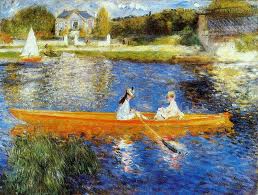
In the National Gallery in London Pierre-August Renoir’s “The Skiff” lights up the room. I am falling in love with it a little more every minute, and I can’t understand why someone  put it in a small corner.

It overwhelms the space it is in. The green grass jumping up out of the lake in the foreground, the sparkling blues blue water grabbing the sunshine out of the sky, the women in the white dresses calm in the middle of the burning orange skiff.

It is the orange that gets to me, the orange, very, very orange skiff, I can’t get over the orange skiff – all that warmth absolutely dominating the blue lake, leaking off the canvass and banishing the picture frame, the museum wall, the museum floor, and the whole of the room we sit in. I can’t see anything but orange. I am totally smitten by incandescent orange paint. I can’t stop ogling it.

The women in the painting are so calm. One is reading, the other is sitting and rowing so casually. They seem so un-startled, so undisturbed,  much like the people around me in the museum, shockingly respectful and settled.

But I am not so calm!  I don’t know what to do. Perhaps I should stay right here on this bench for a long time looking and pulsating. I will; I am deciding  right now to eat here tonight, and then sleep here. Now I am deciding not to. It won’t work; this Renoir won’t stop glowing, like a fire, and it won’t go down, like the sun. If I stay, it will be too bright to get any rest at all.

I won’t stay, but I will stare. At the bottom edge of the skiff I can see that the orange is coming off of the wood, and it is getting in the blue water. Renoir let it can away from him. The orange paint is jumping around in the ripples of the water that are coming off of the boat. The orange paint is getting all over the blue paint, taking over the gap between the boat and the lake. I can’t stop smiling. I like it that the orange has taken this step, has crossed over, has created an interface, has made this transition.

We leave the National Gallery. We get on the tube to ride through London to our refuge in West Finchley, our suburban home away from home that is housing our stay. We stand in the isle of the train because there isn’t enough room to sit down. A bell rings. The electric doors whoosh closed, and off we whir into the tunnel, rushing madly beneath the streets of London. We come to another station, we slow, then stop. The train doors open, and a woman’s voice, very British, says, “Mind the gap between the train and the platform.” We get off.

We mind the gap.

We always do, or not, depending on how well we are doing.

I love the gap. I love the people in the gap. I love young people crossing the gap between their immaturity and their maturity. I love me, crossing the gap into the next stage of life.

The spaces that exist between are always the most interesting, where the boat meets the water, where the blue meets the orange, where the train meets the platform – interesting, disturbing, transitional, difficult, formative, painfully beautiful.

Take the gap between childhood and adulthood — wow and superwow! This transition shapes the rest of life.  To get out of the boat, to step across gap, to bring one’s babyhood, ones adolescence, ones teenafication, one’s “becoming” into ones “I have become, “  to splash the colors from one place into another, this is at the core of the very core of every rippling and  transforming identity.

What is this thing,  this growing up? What are the paint strokes that get us across the gap? How do we paint the immature past into the mature present?

I’m not always sure, but here are a few of the brush stokes that may need to be mastered to paint across the gap:

We must overcome the fear that makes us not want move our brushes beyond what we have known before, or beyond what others like us have done.

We must come to  relate to the people in the boat, wisely, and not sit when they are sitting if standing is what we really want to do, or we must just jump, out of the boat, and into the orange water if really that is the only thing to be done when we are  so ready for change that sitting doesn’t work for us anymore.

We must learn, must we not, when not to judge but still to discern what is right and what is flat-out, dead wrong for us, even if not for everyone else.

We must try, and test and test again, our limits, when one more, or one is less,  or one is one too many, or too few or just right, if you know what I mean.

We must grow in confidence, to splash paint, from the boat to the water and on to the sky.

And what else?

What else must we do to get across the gap?

Tell me, so at the very least it is out here, on the canvass, to deal with, to face, to enjoy, to revel in.

We need protection — from voices.

Two potentially harmful voices come to mind.

The first one is our own.

When I finished my first year of professional teaching, I said to myself, “I hate this! I feel like a failure. I want to quit.” My own voice didn’t  offer good guidance. Fortunately my father, in a phone conversation about this,  said to me,  “Now you know how your students feel. Many of them  feel like failures. Now you know.”

That was a good voice, and I went on from there, following the leading of that voice to teach, until now, and I like it. When I finally do quit teaching, I think I’d like keep teaching,  part-time  —  for fun!

My own voice was suspect. This is hardly rare. Most of us have experienced bad feedback,  from ourselves, concerning ourselves.

Beware your own whining and sulking and quitting-talk.

The second kind of voice to avoid is the voice of the unwise family member or friend.  Family members — they don’t always get us right. Over time they tend to stereotype us.  “Well she always has been a bit edgy, or sad or dominant or shy,” or whatever they come to label us. Others in the family, may concur, and the label may stick, when it shouldn’t.

Friends are often also unwise voices in our lives. In giving feedback, friends tend to simply project their own reactive, unresolved feelings onto our situations. We need to face this; most people aren’t great counselors.  If they hate men, they hate our man. If they hate women, they hate our women. If they don’t resolve their own conflicts well, they won’t resolve ours well either.

What to do?

Pick mentors carefully.

Find people who have life experience, good and bad, people who have been able to resolve conflicts, who have learned something about healthy boundaries, who have had some long-lasting relationships, who have raised some kids (and the kids still love them), who have been successful in their careers but who have also gone through some career-hell and come out still feeling like life is some kind of heaven, who know something about God, something along the lines that God loves us and will never, ever stop loving us.

There are many voices. The world is full of talk. The deal is to learn which voices are safe and which ones aren’t, which voices to tune out, and which ones to listen to when we are losing our way a bit.

This is one of those things to figure out, to get right, to get a handle on, to give some time to.

The right voice, the right answer, the wise counsel — it’s beautiful!

It’s protection.

Age.

Disability.

Ethnicity.

Gender.

Marital status.

National origin.

Race.

Religion.

Sexual orientation.

These are sometime the basis for unlawful, socially harmful discrimination.

I’ve been discriminated against. When I was a teacher,  I remember one of my students looking me in the eye, glaring and saying, “You’re not capable of understanding.” Then I knew what it felt like to be on the receiving end of racism.

For me and for most of us, discrimination is something we think of  other people doing.  They are racists, bigots, fanatics, the unjust. But it is a symptom of the disease of unlawful or harmful discrimination not to see it in ourselves. With our “they” we  poke out our own eyes.

To actually experience condescension in our own voices, say when speaking to a sixteen-year-old or an eighty-seven year old or a disabled person, is harder.

We may also experience it in our silence. I noticed at one point that I spoke less to my daughter’s friend who can’t speak, than to her other friends. Why? He can’t speak back, so I felt awkward. I decided to change. Why shouldn’t he receive my attention as much as any of her other friends. It’s been a nice change for me. I have my own “way” with him now. We laugh a lot, together.

I know a young woman who in her twenties looks ten years younger. When she asks for help while shopping for clothes, store clerks sometimes ask her where her mom is or direct her to the “younger department.” She knows what it’s like to experience age discrimination, and while one might easily defend the clerks as having no way of knowing, such situations bring to light how easily we slight others and don’t  know it.

It’s subtle. I have felt a distancing going on in my mind as certain people have approached me. An observation of size or disability or age has  sometimes shot a small dose of fear or repulsion into me. I hate having to admit this, but my first impressions have sometimes been based  completely on superficial and  automatic distinctions.  And I don’t always catch on to the fact that I have done this.

Sometimes our racial or social distinctions seem to us to be  wise notations of  differences. We think of ourselves as understanding. We make a capability clarification or a  role clarification; we see our discrimination  as a necessity that reflects physical reality.  “There are differences between men and women.” As such, our discrimination begin disguised as enlightenment.

I remember in my younger days thinking that I wouldn’t go to a church that was pastored by a woman. I based this on an interpretation of scripture. I based it on no experience. I had none. I based this on my own insecurity. I based this on what other men and women that I knew said they believed.  Now I would gladly go to a church pastored by a woman, and now I can present a strong scriptural basis for this and now I am surrounded by other people who affirm this. It is so important to be able to change, to be able to shed former boxes of constricted and harmful thinking.

I have had to grow into the realization that different should not be disallowed. I have had to flight past social taboo and come out free to accept as women as equals and their contribution as enriching.

The truth is that we too often hide our “put downs”  in religious mandates, governmental programs, institutional values and herd mentalities.  “They can’t” or we “must not” or “God doesn’t want'” can be simply disguises for insecurity, fear and selfishness.

Discrimination often functions within social expectations and rules.  It is better to hear than to sign. It is better to see than to be blind. It is better to be light-skinned than dark. It is better to be rich than poor. It is better to be educated than not.

What is needed is a definition of what it means to not discriminate.

To not discriminate is to experience someone different from you and to not see them as less than you.

To not discriminate is to hire a person who is in some way the opposite of you,  and not compete with or intimidate that person. It is when an extroverted leader hires an introverted leader to enrich the emotional depth and quality of the organization.

To not discriminate is for a man to see a woman as his equal, fully empowered, taking her place in the family or the organization and being treated as in no way inferior or lesser or weaker or more emotional. It is for her not to be dominated and controlled or put in a limiting box.

To not discriminate is to treat the school smart daughter the same as the daughter who is in special education and to affirm them both, equally and to see that smart is not better it is just different and kind is not better either it is just a quality that some have more than others.

To not discriminate is to see a court case where the one charged is Hispanic and the one dead is black and to not see this as a brown versus black issue but a right or wrong issue that must be given a process that has as its goal the truth and justice and love.

The truth is that it is always a fight for the truth.

And the truth is that it is hard not to discriminate, that we all tend towards it, and that maturity and personal growth always involve movement toward loving other people more.

The beginning of the end of discrimination?

Think of it as something that you, not just “they” struggle with.