friend

Posted: December 29, 2010 in friends
Tags: , , , , , ,

Mostly we shot each other, with every kind of gun we could get our dirty little violent hands on. We often shot each other on Christmas day, after we had gotten a new kind of firearm. The best weapon I remember for blowing away family was a small hand gun that you filled with round silver bullets about three times as big as bb’s. Endless killing! You just kept pulling the trigger and watching your brothers fall. At a recent Christmas party in Los Angeles where everyone came and some were nasty, I thought of the old days and longed to fire away again, with perhaps a tranquilizing dart gun. But it wouldn’t work; I’ve lost my passion for sustained violence.

We also  found fellowship in riding things, like the day my brother herded a small steer into the corral, his friend Lonnie working the critter with him. Inside the fence they trapped the beastly transport system in a corner; Steve edged close and jumped — onto its back. The response was immediate. The steer, as if fired from a rifle, charged out of the small enclosure, into the woods, and toad’s wild ride was on.

Steve bounced on along the bucking steer’s spinal column, into the wild, green woods, past one then another then another and then they were scraping his legs on both sides, and the steer went scooching through and “bam” Steve was on the ground, downed by trees too tight on both sides, and Lonnie was yelling, “Yahoo!” It was a ride to be repeated, and repeat it we did.

Some of the best rides were on our pet steer, Moosehead. The difficulty with Moosehead was that he was broad, and so the rides were spread-legged, rodeo wild and short. He was a fun guy, a hairy  brother who we had nursed with a bottle, so he loved us, and getting on him was easy. He was friend. I now think, after years of studying the science of friendship that perhaps steers and dogs and cats make the best friends. Looking back, I’ve had more fun with of my cats, in the shower, my pet fish in the pond filter, my dogs and their puppies than some of my friends, but who is really to say for sure. Eventually we all come to realize that no friends last forever. The Moosester didn’t. One day he was present, the next  gone! It’s like that with friends, especially on a farm, here and then gone, and we never knew why or where.

Growing up my two brothers were my best friends. Think brother steer.  This is because they were my only friends, and my only options for friends, most of the time. In rural Missouri, the nearest house was a half-mile away, and the nearest house with children who went to our school, was miles and miles away. There was no neighborhood, just  brothers. Someone once said that friends are family you choose for yourself. They were, literally, for me; I chose my family when there was no other choice. And we chose to have fun. C. S. Lewis speaks of friends as being people not focused on each other, but on a thing between them that they both find fascinating. That was us.

We focused on rideable things, things mobile, each other, the Shetland ponies kept at the farm for camp children to ride in the summer, the  rideable cows, goats, dogs, skateboards with metal wheels, bikes,  coasters we constructed, sleds, a toboggan dad pulled behind the boat, water skis and eventually the ultimate ride — cars. The ponies were an obvious choice to ride, but they weren’t that much fun; they had to be led away from the barn, threatened, goaded and yanked. You’d think that unlike Moosehead, they knew they were being led to the end, but they weren’t. It got better when you headed them back home. Suddenly they were all animated and joyful; they began to trot and then grow younger and  sprint when they saw the barn, and then at the end they would become deadly serious and risk their lives in the home stretch as they flattened out in a dead run for the goal of life —  no saddle and rest.

We also drove cars and trucks before we had driver’s licences. We drove the Timber Wolf, a big old truck used to haul logs for firewood.  Especially crazy and fun was the old car my dad cut the body from. When he was done, the thing was just a hood, front fenders, a motor, and an open frame from the dash back, no roof, no doors, no trunk, no rear fenders and no floorboard.  My dad welded a folding chair onto the frame behind the steering wheel, and we drove it around the campgrounds for errands and fun. Crazy! If we had fallen off the chair, we would run over ourselves with the back tires.

Friends are people who have wrecks together or know each other’s wreck stories. We brothers crashed. One evening, on our way home, on our bikes, flying down the dirt drive, dodging the rocks, I hit a big one, straight on with my front tire. One moment I was pedaling hard, the next moment I ascended through the evening air, up over the handle bars and down again,  into the dust, hit hard and rolled.  I remember sitting up, feeling sick, looking at my bloodied arms in surprise and then grabbing my bike and heading on home with the brothers, but not fast. It was no big deal, it happened, to all of us, the battering, the bloodied skin —  it changed nothing, our speed, our wild abandon, nothing. I remember later, when my brother’s moved on to cars, and smashed up several in a row, we took it all in stride too, except my dad, who didn’t like it. But he was in on it, destroying stuff. It’s friend and family glue.

One day dad decided to haul a steer to town, so we could have steaks again, and not having a truck, he ran the steer up a dirt ramp and into the back of a jeep station wagon. Not so good. Half-way to town the steer decided that he was tired of looking at the radio, six inches from his nose, and he turned around. That didn’t quite work out as  he had planned, and he broke out all the side windows of the jeep. Fearing for his own life, dad stopped at a little country store where a real farmer was consulted, and he explained that a truck with side rails was best for this kind of job, so they completed the trip thus. I think at that point they should have let the steer go. He’d made a point. I’m sure, he would have beaten the horses back to the barn. The other day, when my family was together for breakfast, my dad told this story again. We laughed and hooted and spoke of his decision-making during that era, how he had almost burned down the town we lived near during a brush clearing project and how he had put buckets of coals in the back of the jeep, on the floor board, to keep us warm on cold night when we were driving to church. This is how family and friendship are defined —  people with crazy stories that they have in common.

The other day, my dad told  us again the story of  how he’d gotten the job on the campground in Missouri. Dad and mom had both grown up in California, and early in their marriage they bought a little track house in Torrance. There they attended a small church where Maurice Vanderberg, back from the war and recently married, was their pastor. After a time, Maurice moved back to Kansas City to run the Union Rescue Mission that his wife’s mom  had founded, but then needing help, he called  and invited my dad to join him in the work. So my parents moved. Moves change things, for families, for kids, but they are never consulted in such matters. Old friends lost,  new ones gained — no choice. The  move to the midwest eventually put us on the campground, which was owned by the rescue mission, and put my mom and us boys in a  isolated place that profoundly shaped our family, our friendships and more. My mom suffered badly, a California city girl transported to a small rural cabin without a bathroom, kitchen, or heat or neighbors to raise three little children. She lost some years there. No friends were present for her, except the boys and we were way too male.  Significant stuff — my brother Steve married a Missouri girl, Joyce, who turned out to be a good deal.  When we did leave Missouri, and returned to California, it was because another pastor, who my dad knew from the old Torrance church, invited my dad to move to El Cajon to work him. Friendships form the web on which we move, and catch food and are ourselves caught and eaten.

Part of the reason why the family didn’t always work for my mom was that destruction and violence provided most of the fun with my father and my brothers. I think that violence brought us closer to each other but  not to mom.  We blew up our little green toy soldiers with fire crackers, we killed the little clay spacemen by throwing their clay space ships onto the floor hard, we hit each other in the arms daily, we wrestled on the big, round braded rug in the living room until we either knocked over a lamp or somebody cried, and we eventually shot every kind of creature living in the woods nearby and caught, killed and ate every species of fish.

As I child, my favorite killing posture was not western style, the standing back-to-back, taking three steps, turning, quick drawing and firing. That cut the violence too short. I liked hunt-down-and-kill approach. It began with one of brother in one end of the house, another in the furthest extreme, the call, “Ready?” and both of us moving silently toward each other. Then the shooting commenced and proceeded until death. Shot in the arm, you had to switch your weapon to the other hand, shot in the leg, you were left with one hopper, shot in the torso or head, dead. I loved the final, trapped stand, both of us wounded, immobilized, having it at at close range, one behind the bed and the other shielded by the dresser. I loved it when a brother’s head peeked over the top of a bed and caught a round perfectly between the eyes. Then I would see him fall back, to the floor, man down and out with a final death rattle. You had to make a sound. “Cool, I just killed my brother.” True friends and loyal family are the people you can kill and then shortly after sit down to dinner with as if nothing happened. Your average American family does this regularly, the verbal assassinations followed by the evening meal.

When I got married and had my daughters, I continued in the same vein; I made my wife and daughters my best friends, built around our shared narratives,  games, interests and arguments. The thing missing was the violence, mostly. My girls and I did play shoot ’em up a few times. But mostly, in my own family, we gentilized. My wife and daughters and I have always shared a love for “getting out,” for water in all its playful forms,  for print and food and coffee and conversation in all their various addictive and nonadictive forms and we really like God, a lot.  There are other things, but fun has tended to glue us together. I see families where the members aren’t friends and it doesn’t look much fun to me. Some parents say you can’t be friends with your kids. I know what they mean, that you have to be a parent, which means sometimes being mean and saying “no” and doing things friends just don’t do. I know all that, and I’ve done it, and still do at times, but here is the deal. You can go back and forth, be parent, then friend; you don’t have to always play the same role with your children. I really like the times my girls and I are friends.

I took my daughter Rosalind to see the Little Mermaid for our first movie together when she was three years old. Outstanding fun, great Disney film, superb enduring memory for us. We still love the song “Kiss The Girl” and we love “Down by the Sea” and Sebastian the crab these many years later. Magical, the movie, our first father-daughter date, the many times since that we’ve reprised that kind of thing, gone out to eat, watched a football game together, played Yahtzee, taken a walk, talked long, wrestled on the floor and knocked over a lamp. The thing with friendship is not to define it too narrowly, within family or outside of family. We need it, we want it, in all its forms odd and familiar and normal and not.

I have a lot of different kinds of friends now, besides family.  I have friends from school. I have friends from work. I have friends from church.  I have friends in other countries. I have friends who are dead. I have friends who are not but pretend to be. I have friends who I meet for a tête-à-tête at Starbucks, and I have friends who add me on Facebook.

By friends we mean a lot of different things — people we got drunk with in high school but now have nothing in common with, a checker at Costco whose line we often choose, people who dabble in what we also waste time on, people who “get us” and leggo-people who used to get us but have now snapped off and don’t, furry friends, literary friends, our favorite dead poets, painters, novelists or philosophers, and lastly and most importantly, our real friends, the cherished soul-mates who hang on through it all and just won’t let go, like Taylor in Barbara Kingsolver’s novel, Pigs in Heaven, who won’t let go of little Turtle —  the mythic, profoundly archetypal lost child, “six pigs in heaven and the mother who wouldn’t let go.”  We all need a bit of this,  the will-not-let-go friend.

I’ve told my girls. There are all kinds of friends, from casual, even momentary, to life-long. There are all kinds of levels, and they change over time even with the same person. You can be close, then not close, then close again. And just because you are close, doesn’t mean you have to stay that way. It’s okay to let friendships change, even to let them go. Sometimes you have to.

Recently, my brother and I drove to a Idllywild, a mountain town half-way between our homes, about two hours away for each of us. We rented a room in a bed and breakfast and stayed overnight together. We talked shop, both of us being pastors, and we talked family and we ate good food. He had just bought a new sports car, a Mazda RX-8 with a 240 horse power rotary engine and so we took it out on the mountain roads to test its potential. It was the good old high-school days all over again, except we were driving fast Japanese rather than fast American, and  we weren’t drunk and there were no girls with us. What a shame, but maybe not. I’ve owned several sports cars and my wife claims that she doesn’t like being thrown against the doors in the sharp turns. So I slammed by brother against the door and went a bit too fast into a corner and missed a shift. It was all the same game again, flirting with danger, riding the steers, driving the cars.

In the morning, we broke out a plastic bat and whiffle ball and played a few innings of baseball.  It was fun. Depending on how you held the ball and because off the holes in one side of it, you could throw a slider, a curve a sinker and a rising fast ball. But we weren’t practiced up, and so after I hammered a few of his hanging curve balls up over the limb of the nearest pine tree for home runs, he started pouting and didn’t try as hard. It seemed like we had returned to our childhood again, two brothers killing and being killed in mock battle. But then in a short while he regained his form and struck me out and slammed a few of  my sliders that didn’t slide out of the park, and we both cheered up again. Brothers, friends, in combat and not — still.

Other friends in life, interesting.  Why did I make the friends I did?  What does it say about me? Having left our families, most of us find people who function as family. We meet them anywhere, somewhere, and talk, and touch, in time, on the same web, the same thread of the web, and then we climb along together for a bit. In high school it was John, Lonnie and Jim. We fished, hunted, drove fast, avoided girls, and engaged in boy-brother wildness-mayhem. Upon my move back to California, those relationships ended. In California I met a college student named Steve, and we surfed together and philosophized. I also met Jim, and we shared an apartment together with two other guys. It was cheap rent. He was an artist, using clay, me an artist, using words. I still have some of his art pieces, but not him. After college I met Tim, a won’t-let-go friend. We bonded over insight, books, faith. He became family, so to speak, and was the best man at my wedding.  We are still close. We go to the same church and we share a common passion for truth and radical love and justice for our community.

Fishing, wilding, cars, surfing, art, books, faith — my friends have often been my playmates, but more and more they have become my thought-mates. Time makes philosophers of most all of  us, clowns and killers alike. My friendships are now conversations. We  meet over coffee, books and food, and we talk, and talk and talk, but not always. A few years ago, my friend Tim and I fired off some loud, flashing fireworks near the house, and then ran when the police came. We hid in a fast food restaurant, bought cokes for camouflage, laughed like boys and  then headed for home to brag to our wives and children over what we  had done.

Friendship is and always will be a bit of safe violence together, a fast ride,  fast run, or fast pitch together, a laugh, a movie shared, a book discussed, a trip together,  a home run, a crash and a fire and a story to tell again and again until it gets good.

As I grow older, and fascinate more and more over  life, its people and problems and beauty, I find myself making more and more and more friends, of all kinds, in all  places. I am shamefully indiscriminate. Most anyone can be my friend, execpt a few former assaasins. Want to talk? You are my friend. Have something fun you like to do?  Tell me about it; you are my friend. Have a problem? Let’s explore it! I love a problem and the typical nearby solution.

What am I doing?  I don’t like living alone. The friend thing is now under my control, mostly; no one is moving me.

And so Iam adding friends. They are the family I am choosing for myself.

girls

Posted: December 23, 2010 in girls
Tags: , , , , , ,

 I grew up afraid of girls. 

Perhaps it was because some of my early crushes didn’t work out that well, like the little girl  at camp who I kissed on the cheek on a hot summer night while we were playing tag. My brothers ridiculed me for that. My pre-teen love, Teresa, had a magneto-electro smile that virtually paralyzed me for six years — we locked eyes in class regularly from the fourth grade to the ninth grade —  but I never, ever had an actual conversation with her. Then there were my few awkward high school dates. There was the cute girl who  got me down on the front seat in the car and kissed me hard but nothing happened, except we both got a little bored and our lips hurt after a while. Inexperience. And there was the high school girl I took out on a date, and we talked, but we really had nothing interesting to say to each other and I never talked to her again. That was a bit weird;  I guess you don’t know who you really like  until you talk to them.

When I fell in love with Linda, who eventually became my wife, she was engaged to someone else. We were good at talking to each other, very good, but the conversations got more complicated when I confessed true love. With girls, it can get scary.

Maybe my early fear was exacerbated by not having sisters, but I kind of did, so that couldn’t have been all of it. Connie and Beth, the daughters of my parents’ friends, hung around the house for a couple of summers when their mom was working at the campground my parents ran. They were cool, not so much like girls, more like family. We played games, teased each other, made alliances with each other against other factions of our blended family and played war with playing cards. I like war with girls. My mom and I used to argue a lot. When my dad would protest we would say, “We aren’t fighting, we’re just having a discussion.”  War. During our summers with the girls, it was obvious that Connie could get emotional, and so could I. I remember the time I threw the monopoly game board over on the girls and my brothers, the red motels and green houses flying through the air and me flying out of the room. It seemed like a good thing to do in the moment but later I felt ashamed and then again I didn’t  — these girls were family.

My grade  school teachers were all women. What is that about? Our culture is afraid of men being with young children too much.  These wonderful women were smart, professional and demanding. They seemed to like me, maybe because I was smart, I wasn’t sure on that, but I feared them all. Mrs. Protova was so stern and large, but what adult isn’t huge to a first grader. Mrs. Meyers was all business. She expected things; girls do. I fell in love with my third grade teacher, Mrs. Kibby. Even at home, my family talked about how hot she was.  It seemed normal to me, to love her, but of course I never told anyone. Fear! What would they say?

Then, early in high school,  there was the girl I played footsie with during a movie at the local theater. I didn’t go to the movie with her, a gang of us were there together, but a spontaneous flirting game happened between us, and as a result I missed the movie and left feeling like I didn’t get my money’s worth — for the performance. Did she like me? I couldn’t tell. I liked her, but I think that all she wanted to know was that I thought she was cute. Thinking back on it now, it was a competitive sport for her. She tasered me with her foot, and I surrendered.  I didn’t understand anything about girls back then, and so I left the movie feeling a bit confused and not knowing why. There was also the girl in my biology class who I never spoke to because she looked like the Venus de Milo with clothes on.  And there  was the adorable cheerleader in the green and white school sweater and mini skirt who I just couldn’t risk making a mistake in front of because she was so perfect to me, so I didn’t — big regret. They all fell into the category  “Wow! Wow! Wow!” — fear and trembling unto death. Too beautiful can be distancing.

Then there  was my mother. She liked interesting things, the iris in the front yard, the cardinals and jays that came to the bird feeder, Zane Grey’s Riders of the Purple Sage, which we read together, the movie Third Man on the Mountain, which she took us boys to see.  She was different from other girls, because she loved me and I loved her and that took away the fear. And now I see that I grew up to love what she love, natural history and stories and children. Lots of girls follow guys around and do what they do, even though they don’t especially want to, but they do it because they love them and want to please them  — fishing, working on cars,  shooting guns, looking through telescopes. It’s okay, but it goes both ways. A man who loves a girl will also choose to  love some of what she loves. Men who love girls follow them around.

We didn’t always do a good job of loving my mom; we teased her too much about the food, being different from us, my dad too, and when I was a teenager, my dad told me that was wrong. I thought so too, but teasing girls or joking with girls is still something I find myself doing a bit when I like them. I consider it my calling to make my daughters and my wife laugh a lot. Men like to make women laugh and women often laugh with men they like. Laughter is good between us, mostly. But we didn’t laugh when my mom got cancer. I went in and sat by her bed and talked to her. She told me a while back, now many years later, that this was meaningful to her, special, for me to just sit with her.

I like that way of relating to women, to sit beside them, to be there when they are going through something, in a safe way, in an unobtrusive and supportive way. Safe gets at it. Safe means seeing women as people and as family. A young friend told me recently that he didn’t feel so good about some porn that he had looked at. Porn is no proud accomplishment, for the people who view it or who make it. It seems to undermine progress — toward real accomplishments and real relationships.  Porn  girls are not family, well they are somebodies’ family but they are presented online as having  no family. A woman told me recently, after she caught her husband looking at girls on the Internet, “The thing is, I can’t compete with those woman.”

 I thought about it, and actually I think she can compete, really well, and win.  She is real, unlike the images, a real women, not an airbrushed woman. She is a talking, thinking, a real-time-and-space woman, with bending arms and legs and she is better than any flat-screen girl. Porn girls’ pictures don’t match up well against real-girl bodies, against curvy, warmish, bright-eyed, taking girls with fun laughs and quick repartees. From my experience, girl reality offers something far better than  vapid, non-relational and untouchable nudity — fascinating friendship topped off with hugable bodies, really good smelling hair and remarkable tasty lips, available for tasting if they turn out to be girlfriends or wives.

But I’ve noticed something interesting here; girls tend to check out girls as much as guys do, not internet girls with no clothes on, but catalogue girls and walking-by girls, especially thin and “pretty’ girls, their clothes, their hair, their make-up, their everything. It’s the fatal female-to-female comparison, and it doesn’t work too well for most of them. “She has better legs, better teeth, a better nose, ohhh, than me.” It’s torture! It’s self-hatred. It’s sad, and I wish it wasn’t so. All girls are beautiful girls, in some way. To love oneself, and not compare oneself with others — “ahhh” now there is the trick. It is so much about, to put it simply, being gentle with ones own perceived imperfections. A girl told me recently, “I’m not normal. I burp  in public, and my husband says, ‘That was really attractive,’  and I can’t find boots to fit me because my calves are too big. It happened because I walked on my tip toes too long, when I was younger.” She repeats, “I’m not normal.”

But this kind of  “normal” can be just another form of tyranny — this is too big, this is too little, this is too loud, this is too soft and squishy, this is just right. It’s Goldilocks all over again — it has to be “just right.”  Individuation is a step toward freedom from the domination of the “just-right.”  Love means not having to conform to exacting specifications published by the group and used to tape measure oneself.  A girl once told me. “If you don’t love me, there is something wrong with you.”  May her brand of insouciant self-affirmation  increase. Normal is what you are, and it becomes even more normal to you  as time goes on because you experience the you of you, more and more. “Pretty girl” is a fabrication of the mind, and there are so many changing ways to be pretty that the mind must be discipline to expand its neruro-electrical  and  phsycho-social list of  possibilities. Many astutes have noticed that when we love girls, they get prettier, when we love men, they become more handsome.

Perhaps men have ruled this conversation too much. A girl once said to me, “Why would anyone have their lips and breasts made bigger?” And before I could try to reply, she answered herself, ” Honestly, because men want it!  The discussion is dominated by body strength. And if women stand up for themselves and try to refute these kinds of standards, they are perceived as unattractive. Women who don’t buy in are seen as having something wrong with them. Body parts don’t make you superior. Why are men calling the shots on what is beautiful?” Whew! Somebody isn’t happy with how its gone down.Touche!

It has occurred to me that it is also true that guys compete, with each other, according to some kind of beauty standard. A guy’s sense of “handsome” is in part culturally conditioned by his sense of good skin color, eye color, cheekbone shape, chin angle and on and on.  Think Brad Pitt, Hugh Jackman, Olando Bloom and George Cluny; they set the  modern standard.  And throughout history, men have tried to settle the issue of who is superior, who is a stud,  by strutting their stuff and by peeing on things, and by making conquests of women,  and by making money, playing soccer, and killing each other.

What to do? I told my young friend who felt ashamed of his attraction to porn, “Go find some girls and make friends with them.” It’s the hopeful approach, the future-oriented approach, the think-about-what-is-imperfect-but-still-good approach. Friendship with real girls is the opposite of lust. It is also the opposite of a very ineffective way of dealing with your hormones —  asceticism, self-hatred, the making of behavioral laws and moral rules and killing people.  I don’t much admire the techniques of the flagellants of the 14th Century, marching in public and whipping themselves for their failings.  Self-mortification never made anyone holy. More and more I believe that life should not  be about beating up on yourself  for being human, but about loving yourself for being human. No matter what standards of beauty and rules for relating we come up with, it is normal and always will be for men to adore women, and women to adore men, and women and men to admire women, their bodies, their minds, everything about them, and it is so fun and right  to find ways to honor that without it becoming obsessive and sick or objectifying or depersonalizing. I think so much good can happen when we center on what is good, instead of pounding on ourselves for where we have failed.

I met my wife-to-be while I was in college. She went to the same church as me. I remember talking to her in the library. Books and girls — I love that combination. She was engaged, as I said before, but that didn’t work out. I told her, “I loved you,” which is never a bad thing to tell people, unless you don’t mean it, and true love changed her sense of the future, and so after some fall out and some talking it out and some waiting we got married. I tell her now, “I fell in love with your brain.” I am still in love with it. She in an individuated thinker, and I can never be sure what she will say about a new topic we get into. I love that in her! To love a girl is to love her brain. And there is more, because her brain is resident in her body, and I love her body too, all of it, perfect and imperfect. She is mine and we are one and I love her body the way I love my own body, in a comfortable, accepting, non-shaming, unconditional way. I didn’t always do that, when we were younger, and its been a journey to get to where I am now but one worth traveling. Acceptance and gentleness is the most advanced way of relating to girls.

Not everyone gets that. This morning I was listening to Pandora radio on my phone through the Internet. I put on “A Fine Frenzy” station. Alison Sudol  was singing, “You go on and I’ll be happier,”  but she won’t; apparently, according to her, he’ll be happier. Then later, Meiko was singing, “Here I am with my heart on the floor and my love out the door.” There is a lot of pain on the radio, because there are a lot of women who have been abandoned. It makes for  good songs but  lousy lives.

I know some of these broken-hearted women who had someone who said all the right things and then they didn’t and now they only have pictures in a box under the bed, and then maybe they get to the point were they even throw those out. But they don’t stop loving, themselves and their kids. That’s amazing. I am so impressed with the single moms, and dads. The single moms I know work so hard, in retail and in offices, making just enough to survive. They live for their kids. One absolutely beautiful single mom I know, beautiful by any standard, beautiful in mind and body, never remarried after her divorce. Why? Considering how absolutely brutal her husband had been, she chose to keep it safe, for her, for her kids, for her mom and she made a life without a man, and made it good. I honor that. She didn’t think of herself; she thought of how important it was to create a safe space for her family. Her children were so broken by the divorce.

I remember going to her house when it was the conflict was at a  horrible peak. One of her daughters was hiding in the closet and wouldn’t come out , and we sat in front of it and talked to her. I asked this little traumatized girl in the closet what she wanted, and she said , “I want my family to go back to like it was before!” Ouch! So painful. This got at it. She wanted what she needed and couldn’t get. No wonder she was in the closet. The real world didn’t work for her. We couldn’t make that happen, bring back the past, but her mom did the next best thing possible: she made something safe and beautiful called a family without a husband and without a father. Her daughter is now married and has children of her own. Strong single, unselfish women — they rock.

Ever so often a new book comes out explaining how women are different from men. I find them insufferable. Of course we are different, but not in the ways defined by these purchased distortions of the popular mindset. These books go like this: women are emotional. Really? Well, I’ve noticed something too:  so are men, they just nuance it differently. Then we are told, woman are nurturers. Right! Don’t leave me out. So are men. I know a former gangster who is one of the most nurturing, sensitive men I know. He totally serves and protects and cares for his nine kids. We have also  been told that woman want to be rescued. Yep. Well, guess what? So do men. I know so many men who have been rescued by women. It goes on and on, these distinctions but it is silly. Some people like the women are from venus and men are from mars kinds of explanation because they can’t get along  and they find comfort in explanations that don’t make this their fault. Gender stereotyping is a dodge. “We can’t relate to each other because we are different. It’s not our fault.” That is bogus.

There are gender differences, and I like them, especially the ones that you can see, “Wow, wow, wow!” Love those girl shapes, and for the girls, sculpted men — cool too. The physiological differences between men and women, strength stuff, reproductive stuff,  are well-researched and published. And there are  obvious  behavioral differences too.  Men rape women; the opposite of that is rare. Men kill each other at a higher rate than women. Women birth all the babies. Women have perfected some really cruel ways to be mean to each other that men don’t know. There are differences. But when we get inside, less so, there are less differences when we confront our core humanity. We all need such simple and fundamentally human things — to be held, to be understood, to be respected, to have something meaningful to do, to be wanted, to feel okay about our changing bodies and our shaky minds.

This kind of experiential awakening has dissolved my fear of girls. Now, I fear them not. My wife took care of that by teaching me to be human again, after I’d lost that in high school, and by liking me so much that I was able over time to begin to really like myself. I have never met a person who I am so comfortable with as my wife. And my two daughters have taught me so much about girls, human girls, who are human first and girl second. I adore them both. I am their dad and their friend and a safe human being who loves them unconditionally.

My daughter Roz and I play a  game. Since she was a little girl I have asked her, “When will I stop loving you?” And she responds, “You’ll never stop loving me.”

Girls? Nothing to be afraid of here — just another form of human being to never stop loving.

water

Posted: December 20, 2010 in water
Tags: , , , , ,

You can surf  a 60 foot wave — if you have a jet ski to tow you into it and the guts to stay there until you ride down the watery mountain. Crazy exciting, the liquid stuff on our planet. Some claim that 100 foot waves are out there, somewhere, sinking ships. I hope not. I really prefer the safer forms of H20 — a tall glass with ice and lemon — ahhh! The surface of the earth is about 70% water, most of it in oceans, a little bit of the fresh variety scattered about everywhere else in all kinds of interesting forms.  How fun is that! We like it; we love it and tend toward being all over the liquid stuff, swimming, sailing, fishing, boating,  skating, skiing, kayaking, diving, surfing it. 

It goes further; we are it.  We humanoids are about 60% water, although that progressively decreases with age. We should each think of ourselves as bodies of water, which dry up, eventually. The Egyptians just speeded up the end game with the mummy thing.

But it varies, the human water ratio. An infant can be as high as 75% water; an adult suffering extreme obesity can  be as little as 45% H20. Females tend to be a lower percent of water than males, less wishy-washy internally. But obviously, a good deal of washy and wishy is essential to life.

Water is good, and good water is all over the place, but less so now. According to a study by the US National Center for Ecological Analysis, 41% of the world’s oceans have been strongly effected by pollution. The British Petroleum disaster in the gulf this year made my hear ache for the earth, my wild little sister, as gooey tar gushed into her clear blue sea. Nearly a billion people don’t have access to safe water. We need it; we want it.

When we are away from it we tend toward driving or flying to it. Vincenz Priessnitz, the founder of modern hydrotherapy, got folks to thinking about the curative properties of water. I am  disciple of  Priessnitz; I am hydrophilic. Showering for me is as much about being healed as about getting clean. The other morning I stood in the shower transfixed, hot water pouring down the  back of my neck, the steamy water vapor swirling up from my body, the elegant waves and vortices  of steam arcing through the air, lighted by the sun streaming through the window. I lifted and waved my hands, and the steam went wild. The heat penetrated me. The warmth surrounded me.  I was momentarily healed of stress. Water heals and entertains.

When I was a young teen, my dad bought a heavy wooden Chris-Craft kit  boat and pulled it down to the shop at the campground.  We painted resin on the bottom and spread fiber glass fabric across the hull.  The smell of the coating was strong, powerful and chemical.  My dad screwed on a plywood cabin, and we brushed on a coat of white paint all over to integrate and protect it.  Then we towed it down to the  Osage  River in the evening, my two brothers, my dad and I,  plunked it into the river, and pulled the starter rope on the 25 horse power Evinrude outboard motor — roar, blue smoke, clunk and slow glide. This felt familiar — an engine, a seat, a steering mechanism and a throttle, like my first pickup truck,  it was zoom and turn all over again.

“Hit it,” I yelled and braced my legs. I plowed through the muddy water hoping I didn’t hit a submerged log, and  pulled myself out. Dripping with the river and charged with ancient evolutionary forces,  I rose from the heavy, resistant world of the fish and ascended into the flying world of the birds. 

It was a moment that I experienced often that summer. “Let’s go skiing!” my dad would say, and we were off, in turn, and it was my turn, and I pulled on my vest, tossed the skis in the water, dropped over the side of the boat and pulled them on.  Loved that feeling. The slack rope taken up, the slow drag, the skis going parallel, balanced, ready, the yell, the roar, the force on bottoms of the feet, the stand, the skis flattening, the wind glancing off my face, my arms and fingers stretching out in front of me, and the water receding with a hiss below. 

I was in the moment. I energized and  jumped on the moment with a sharp lean, a quick cut, an up-and-down over the wake, and a smooth slide out onto the glassy evening surface. Speeding forward, I raced up beside  the boat like a darting swallow. Catching the screaming outboard, I looked across at my comrades,  and then feeling the slack in the rope, I turned sharply back to where I belonged, behind the smoking Evinrude. I picked up speed, cut again, hit the wake hard this time, flexed my legs up under me and  flew through the air. I landed splat and fast on the water again and popped up over the second wake. Out of the edge of my eyes I saw my brother making a circular motion with his hand and  my dad crank the steering wheel, sharply reversing the boat’s direction on the river.

This was the moment.  A small, heavy, underpowered boat, with too many people in it, can still pivot, and when it does a skier behind it is placed into a wonderful moment of opportunity — the   physics of  the whip.  A weight at the end of a string swung, experiences the increased speed of centrifugal force. And so that evening, my body was propelled outward —  scary, crazy, dangerous fast. Quickly I was flying, zipping across the glassy evening water like a bullet fired from a high-powered hunting rifle punctuated by my brothers’ hoots on the other end of the taut pull rope.

I slowed as I caught up with the boat again, then cut sharply back across the wake and dug in, settling in the center of the wake.  I lifted my left ski out of the water, and with a slight twist of my foot, shook it off. I wobbled for a second on one leg, then carefully set my left foot down into place in the rear binding on my right ski and relaxed comfortably back in the water. The drag increased, my arms stretched  and my heart beat faster. I bounced a little to test my stability, then with cool abandon cut fast and hard out over the wake, with increased agility, speed  and maneuverability. Powering  toward the river bank,  I knew the beauty and  prestige and power  of the slalom.

I blasted forward with a huge watery tale  shooting up behind me, looking good, having fun, propped up by fiber glass and wood, cheered by my brothers, full of speed and thrill and life. But then, as one is want to do on occasion, I suddenly wobbled, lost control, pitched wildly to one side and let go of the rope. Boom. I bounced across the surface of the water, the ski ripped off  my feet and my shoulder twisted violently under me. I flipped head over heels, went under, slowed sharply, and quickly bobbed up again to see the boat calmly turning back toward me sputtering oil and gas and rescue.  The spotter had done his job; my brothers shouted, “Whohoo!”

I was a hero — for a horrific crash.

I love the water! It is absolutely one of the  most inspired concoctions in the universe — H2O. Cool, hot, cold, warm —  elegant in all its temperatures and forms, liquid, gas or solid. I love ice in a drink and steam in the shower and every manifestation of liquid comfort in between.  Well, not every. I didn’t love it one evening recently when I was lying under the kitchen sink, twisting a compression fitting on a shut-off value on tighter. I didn’t love it when the stop popped off the wall and a blast of water hit me in the face. I didn’t know at that point that the pressure regulator had failed and that the house’s water pressure was at 160 pounds per square inch. It should have been at about 4o or 5o. But I knew it hurt to put my finger over the end of the exposed copper pipe and held it back until my wife could turn the water off in a panic and a rush to the street. And I knew it scared me. Water in the wrong place at the wrong time —  not good. Think Katrina or the tsunami  in Indonesia in 2004.

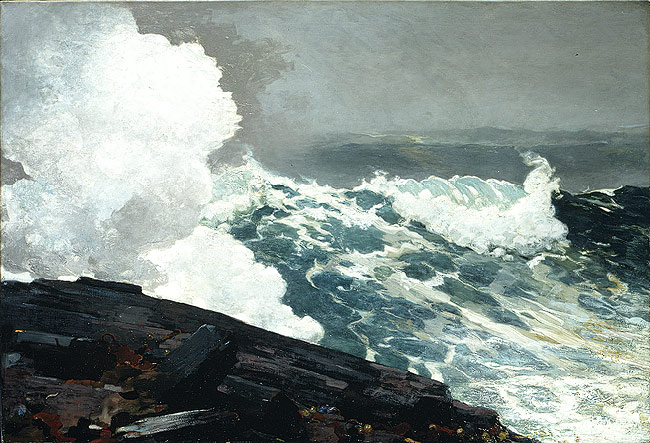
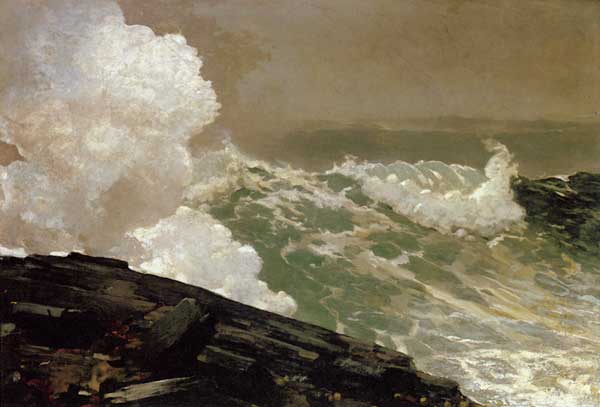
But I still love water. Winslow Homer, John Marin, Albert Pinkham Rider — show me more. Water creates the opportunity for us to experience the world in a unique way. To slide  over the water in a boat, on skis, on ice skates or on a surf board is to experience the world as the pelicans or the black skimmers see it — a smooth flowing surface falling away behind us, a glittery, bright plane we glide over but not into. Water offers to us all the thrill of the  glissade — en avant, en arrière, dessous or dessus.  

When I was in college, I moved back to California, to San Diego and I met Steve, who surfed. I didn’t have many friends, and surfing sounded fun and so off we went to the beach early in the morning to get some of that same glass I skied on with my brothers. It was different. The first time I went water skiing I got up; not the first time I went surfing. I got knocked down. The waves beat me down and under and over and around.

Surfing is hard. It requires strength, endurance, timing, agility, balance, knowledge of the ocean, good waves and other stuff I don’t even know because I never mastered it. I remember surfing days when we never even got past the white water. It was too big, too fast, too strong. I remember days when the best ride was along the bottom, bouncing over the sand. I remember days of falling off and paddling back out and falling off again. And then there were the rides.

We drove up to Del Mar early in the morning and paddled out over glassy five-foot waves that ran into the beach smooth and fast. Lying on my stomach I looked out to sea, saw a dark swell forming and paddled to it, turned around as it rose up off the sand,  put down a couple of good slaps into the water, kicked my feet, felt the energy of the wave pick me up and tilt my board down, looked along the quickly lengthening wall of water,  jumped to my feet, dropped fast and furious down the wave,  turned my board at the bottom,  raced madly along the watery wall, saw the fatal curl deepen at the top,  put my weight back on my left foot, cut straight up the wave cliff, hit the lip, launched into the air and fell with a splash on the safe side, wave rain falling down upon my head and sprinkling me like at an infant baptism.  Fun, fun, fun — what a rush, all the bad days and falling down and paddling out — worth it.

A clammy wet suit pasted on your body, the sweet smell of surf wax in your nose, salt crusted on your lips, the grimy feel of sand and sea weed  in your swim suit, the sticky feel of sea water on your skin and hair,  the warmth of sun and sand as you walk back up the beach, the amazing salty-sugary taste of Snicker bars in your mouth, and the bitter flavor of hot coffee on your tongue, the pleasure of relaxing into a nap  when you get home, the poignant memory of the rush along the wall — all this is the joy of surfing.

Water, water, water — I can’t get enough of it. The turquoise ice bergs we flew over at Glacier Bay, the small wave I totally carved up one day at Tourmaline, the beauty of a glitter path on the sea at sunset in Coronado, the gifts pile up through life like presents under the tree.

I will always remember the crystal clear water we snorkeled in at Honaunau bay on the big island of Hawaii. We bought home-made chicken sandwiches on the way down to the City of Refuge, left our stuff on the black lava rocks at Honaunau, and slipped into the bright, blue, clean water — excited. We could see the colorful  fish and green sea turtles even before we  stuck our masks under the surface. And when we did, whoo hoo! Fabulous colors on trigger fish, butterfly fish and tangs. Beautiful glides along the black lava with the sea turtles flapping their big flippers along side of us. We were immersed in the yellow, black, orange, blue  and green palate of life and the only thing that finally drew us away was the sudden splashing mid-bay and the realization that the dolphins had come to celebrate the beauty with us.

We stroked our way out among them, all the time hoping they wouldn’t spook and leave. They didn’t. Down they circled below us, into the deep, and up they came among us, rising like spirits from the bottom, bigger and bigger as they ascended,  joyfully splashing around us, their grey-silver bodies sleek and glowing, then back down they went to the bottom again. We celebrated their coming in and their going out, both then and forever more.  Priessnitz would have approved — we were healed at the watery playground of the dolphins. Hydrotherapy is no humbug. Go to Hawaii, now.

Finally exhausted by dolphins and sea turtles and butterfly fish we restored by eating our fresh sandwiches on the back lava rocks in the bright sun, content, delighted, eventually full for a few moments.

And so we have gone to other watery places, Alaska, for instance. It is like Hawaii, a world of water, but different — cold and vast and frozen. There we discovered that glaciers are a really fun form of water. From the air I remember the pilot announcing that we looking down on a glacier more than 60 miles long. That’s a lot of ice. As we landed in Juneau, I remember looking out onto the Mendenhall glacier, a stunning beauty with long legs. We had to get closer and so we went out to it and hiked in a moraine. The power of moving ice is incredible, dragging huge boulders down from the heights, powerfully sculpting the land underneath, carving deep valleys with vertical walls — think Yosemite National Park. Ice carves rock wonders.

From Juneau, we boated down the Tracy Arm fjord to the Sawyer glacier. On the way we had a holy moment of silence among a pod of Orcas in the Gastineau Channel. They swam with us, arcing up above the surface, adults and a baby, black and white and sleek and finned and lovely, back down under and back up onto the glassy surface again. Such are the motions of life in the water, on skis, fins or surf boards, up and down and up again. I love the up and down again in the water. We saw a grizzly bear prowling the edge of the channel, huge and elegant and dressed for cold and armed for the take.

When we got to the fjord, we weaved between islands of floating ice. They absorbed the spectrum of light, except for the turquoise blue reflected. I couldn’t stop gawking — water sculpted into blue glass, great floating cathedrals.  The vertical cliffs that rose above us to 3,00o feet were nested with Arctic terns and pigeon guillemots. Waterfalls poured down their sides everywhere. We saw a group of mountain goats gracing the rocks.

Above the cliffs, the mountains rose to 7, 000 feet. It was an awesome experience of rock and sky and fin and feather and water. We stopped before the Sawyer glacier, far enough away to be safe, close enough to see the wonder. Harbor seals dotted the floating ice around us. The glacier popped and with rifle-like cracks, little pieces of ice flaked off. Then it calved, a huge tower of ice suddenly collapsing off its face, a landslide of ice enveloping  a whole section of the glacier — the white thunder, the slow motion fall, the birds winging away to safety, the explosion of water, the hoots and calls and camera clicks, the palpable gratitude (we were here in this so-right moment!),  and the soft rocking of the boat as the waves from the great fall picked us up and let us down again. Good! Up and then down again in the water is so good!

I sip my coffee this morning, I go the bathroom, I wash my hands, I take my shower. I drive my daughter to work. It’s raining. A red traffic light glows in a puddle on the pavement. A car facing me shoots long, broken parallel lines of white light onto the black top. In the shopping mall parking lot, the white roses are weighted down. I glance out of my side window as I wait to exit the mall; the glossy, dark, wet, leaves of a magnolia tree shine like mirrors. The pointy grass along the edge of the sidewalk is dark green.

I go home, but must go out again — another sweet one, formed in water, not yet dried up, still mostly water, is off to work. It’s Rosalind, and I ferry her gladly to Subway where she will spend the morning washing dishes.

My windshield wipers go up and down, intermittently. Below their reach I see the rain beaded on the car’s window glass. On my side windows are hundreds of silver rain beads, with streaks between them where the water has gathered and run. The world is full of liquid grandeur.

We stop for a Starbucks for hot chocolate with whipped cream and chocolate shavings. There are snow flakes hanging from the ceiling,  geometrically fascination water shapes. I sip the sweet liquid.  I drive home; I look up. The sky is grey, cloaked, filled with vapor. We are immersed. The wipers take a swipe. I like the pattern, in the immersion.

In fact, I love it.

close

Posted: December 11, 2010 in close
Tags: , , , , ,

Picasso’s Guernica reveals the senseless destruction of an unsuspecting and defenseless city bombed  in Spain on April 26, 1937 during the Spanish Civil War.  The painting is 11 by 25 feet of violence, suffering, pain and protest.  Picasso’s outrage is big, brilliant and eloquent.  Powerful forces  tear the world apart.

The Black Death, peaking between 1348 and 1350,  is estimated to have killed 30% – 60% of Europe’s population. It  reduced the world’s population from an estimated 450 million to between 350 and 375 million. It took 150 years for Europe’s population to recover. Stunning! Catastrophic! What a huge number of lives, an incredible number of families  were affected.

Epidemics, plagues, famines, wars — they have shaped history, determined the length of  lives, brought huge amounts of pain and grief into our world.

A volcano  erupted in Tambora, Indonesia in 1815. It is estimated to have killed about 92,000 people. It cooled the world climate for more than  a year.  Bam, different, with one fiery belch of the earth — death, and cold, everywhere.

It is estimated that in World War II, from 50 to 70  million people were killed.  In the gigantic epidemics and wars, estimates are inaccurated by the millions.  Unthinkable — millions of individual lives, with names, ages and unique personalities lost and lumped into to a horrific number.  This is unacceptable!  But it happened, and not long ago. By the end of the war Europe had more than 4o million refugees.  How devastating to so many families. The memory of this is still with us.  I spoke to a friend this week who grew up in Ireland during the war. She remembers hearing the planes going over; she remembers the bombing of England, her blacked-out city, the news of devastation. She moved to London when the war ended to work as a nurse in a hospital.  

It hasn’t stopped — huge,  uncontrollable and unpredictable forces churn through lives. The Oslo Conference of 2010 reports that over 230 million people across the globe are now unemployed, an increase of 30 million since 2007 as a result of the current economic recession.  Not enough work, not enough food, fear, anger, hopelessness, depression — a huge blow to the world’s psyche, a devastation of confidence, a  tragic loss of  basic essentials for many. Hearts ache over the ache of the earth.

And all this is close, not far from us each of us, not far from me. People are caught in the blustering wind of economics, of political decisions, in the icy storms created by their own foolish decisions and they suffer terribly. 

 I live in a nice master-planned community, but I work where homeless people live. They camp in the weedy area down behind Target, also down by the flood control channel that goes along the 54, and I am told, down by the San Diego Bay in the undeveloped area at the foot of E Street.

These areas are trashy, weedy, hidden from the public view, unused tracks of land at the edges of businesses, freeways, water. Cities have often been established by water, homeless encampments too.

I meet these people who live on the edges, and I talk to them and try to listen.

A while back, I met Thomas; he was sitting on the steps at the church. From a distance – he was scruffy cool, in jeans and a t-shirt. Up close –  he was denim and cotton and psyche beat to pieces. He was with his new friend Robert who had been living on the street for a long time. As we talked Robert drifted off.

Thomas’s story came out in oddly connected pieces. He was sleeping behind the grocery store on E Street and showering at his girlfriend’s house. Her mom wouldn’t let him sleep at the house. He was recently out of prison, and he needed  money to attend a program that helps ex-cons get a job. Sometime back he had been diagnosed by doctors as bipolar, but he was smoking pot regularly. He had been smoking it pretty much nonstop since he was thirteen. He said it like someone saying, “I’ve pretty much been eating vegetarian food since I was thirteen.”

He told me his mom wanted him to come home so she could take him to a doctor for prescription medication. She would pay for the flight, but he wasn’t sure he wanted to do that. He didn’t think he would like the side effects of medication.

Then he blurted out something I didn’t see coming. Neither had he. A few years ago, he told me, looking down at his shoes, “I was driving a car, and there was an accident. My brother was killed.”

I heard him say that, and then we were in one of those moments when it doesn’t seem possible to say anything  remotely appropriate. I have a brother. We talk on the phone. My brother is part of my sense of connectedness to something like me, but bigger than me, my parents and my other brother and their kids and our sense of family that we go through life with.  “How does one speak about …”

I looked at the deep lines of anguish twisted across his cheeks. I’ve never seen so much pain compressed so deeply into one human being. The force of it almost drowned both of us on the spot. But at the same time, in that raw, open moment there was this – brutal, honest connection between us. The  space between us felt insanely holy. I was staring at him, and he was looking down at the steps and crying and saying, “After my brother died, I kind of went crazy. “  I got it, a little, as in waves.  I hated that this had happened to him.

Thomas kept talking. When he woke up, in the mornings, lying behind a dumpster, he didn’t want to be alive. But he didn’t want to kill himself; he just didn’t want to be here. It was good to be out of prison. He had a girlfriend, and he desperately didn’t want to disappoint her, but if things kept going like this she might get tired of him. He wanted so badly to get it together for her, and them. He had just applied for a cooking job, but he didn’t get the job. He told me, “It’s hard to get a job when you don’t have your own phone number. People expect to have a place to reach you.” He wanted to get a cell phone.  

 Then he told me that he had recently had an interview at a restaurant. He thought he had done well, and he said he knew he had the credentials. He heard nothing back for weeks at the phone at his girl friend’s house for weeks.

He went down to the restaurant and found one of the supervisors and  asked if he knew anything about why he didn’t get the job. All the supervisor would say was that he heard that the boss who interviewed Thomas had said, “He wouldn’t look me in the eyes.”  

I wanted to fix Thomas, right there, but I knew I couldn’t.  He looked up from the steps at me; I looked at him. The moment felt like an invocation. I prayed for him. I encouraged him to go home.  I haven’t seen him since then. I hope he went home.

A month or so later I ran into Robert downtown. He was zombie-like drunk. We talked. He was a bit embarrassed to be as he was. We talked about changing, but there was something helpless in how he presented himself. A few weeks later I heard that he had died in a nearby park, but that wasn’t the case. He was found in the park and died in the hospital – alone.  

I eat my lunch today. I cut up the fresh red tomatoes, the bright green cilantro, the orange peppers, dark romaine. I cook a crispy brown turkey burger and put the vegetables beside it on a white plate.  I blend a shake from strawberries, blue berries, soy milk and Splenda. I pour it into a clear glass. It is purple, with dark flecks of blue in it. I’m starving.  I’m taking care of myself. But I’m thinking about Thomas. I wonder where he is. One loses track of such new friends so easily.

I think of him sometimes when I feel afraid and uncertain what to do next. There is something in him that is a copy of something in me, a profound need to be connected to family, to someone to love. I think of Thomas when I meet other people who are living on the street. My street friends are beginning to collect in my thoughts. Now there is Carla.

I first heard about her on the phone. I had never met her, but I knew her. It’s possible, to know someone without having met them. I’ve been listening to her, through other people.  

Pat,  a substitute teacher, called me about Carla. She met Carla while giving out food to people here in town.  Pat told me that Carla had left her apartment because her boyfriend was abusing her, and that Carla was living on the street.  She called to ask me what she should do for Carla. On the phone, tired and kind of empty myself, I didn’t really know what to say.

Several days later, Carla surfaced again, though my wife.  My wife met Carla through our friend and  told me that she offered to take Carla to a battered women’s shelter. Carla refused. She said, “The shelter won’t take my dog, and I’m not leaving my dog.” My wife and I talked about it. We understood, but we didn’t. Maybe the dog was Carla’s safest relationship, but Carla herself needed to be safe. My wife called the shelter to see what they had to say about the dog.  They had seen this before and had a tougher point of view: The dog might be an excuse to avoid getting help.

We gave Carla more food, and she was down to the weedy area by the bay to find her own form of refuge. We thought of her as we went to bed that night, wondering aloud to each other if she was safe. We almost went down to look for her. We didn’t.

I don’t know what to do for Carla. She hovers in the back of my mind like a shadowy part of me that I want to bring closer. She is trying to protect herself.  I know what that feels like; I know that sometimes as you try to protect yourself, other people have no mercy and they attack you harder. I’ve been witness to that.

A few weeks ago George came to the door of my office.  He needed food. I gave him some. He is newly homeless. He has been living in a home with an older lady the last 16 years, but she just kicked him out. She found him smoking pot. He defended himself saying that he didn’t drink and only smoked a little to calm himself down.

He was anxious, disturbed. He explained that he was not used to sleeping behind a shed on Third Avenue  and eating hot dogs from 7-11. But he said he wasn’t very hungry. He noted, with the coolness of a psychologist looking at a text-book case, When you are afraid, you lose your appetite.”

He explained to me that he had been homeless before.  “But it’s harder now,” he said, “in the recession, out on the street, being older.”  He told me. “A while back some people roughed me up and took $150 of my social security money. I was drinking with them. I’m not going to do that again. ”   He is 51. He is bi-polar, he isn’t eating much, and he is afraid.  I asked him if I could pray for him. He said yes. I asked if he would pray for me.  It just didn’t seem like he was the only one who needed prayer. I did too. I’m not so comfortable with relationships where the giving only goes one way. It seems such a paternalistic way of treating adults. I don’t know what to do with his fears in the same way that sometimes I don’t know what to do with my own fears.

George asked my if I could put down my office address as the address where he could receive his Social Security check. I told him he could. This month his check came on my day off. I went down and waited for the mail to come with him. We sat on a wall and talked. He said he needs a plan, but that he can’t seem to make one. He lost his ID but is afraid to go to the DMV to get a new one. He could get an apartment if he was approved for section eight assistance but the wait could be years and so he hasn’t ever applied.

His procrastination is deeply embedded in his insecurities. He reflects that he fears that if he gets it together and takes medication for his bipolar and gets an apartment, maybe he’ll lose his Social Security. If he gets better, he won’t get assistance.  He talks, I listen.

He tells me that sometimes he wakes at night crying. He just wants someone there that he can talk to, or perhaps someone to hold him. He feels so alone.

I think about this, the aloneness. It must be the worst thing.

I finally met Carla the other day.  She is articulate, intelligent. She tells me her family has money. But she has lived like a nomad, all over the United States, in apartments, shelters, on the street, in room where people gave her temporary places.

She is terrified by the prospect that her ex-boyfriend will get out of prison soon, find her and force her back with him. She is worried that he will kill her. We give her food. We provide a chance for her to take a shower.

She tells me she is selfish. This wacks me in the head. Someone who has nothing is selfish. But she is. She is living alone because she is afraid of her boyfriend, but also in part because she won’t and maybe can’t live with anyone else. She has gotten so used to doing what she wants, when she wants, how she wants.

She lives in a tent shared with no one. She eats alone. She sleeps alone. She answers to no one. She is gradually becoming incapable of living close to anyone.

We find a place for her to live. Then she finally makes the choice. She will go to a shelter. It is winter. It is getting colder. She knows she isn’t safe, living outside in the cold, living near so many homeless men. Most of them are safe, but are they all?

The shelter will take her dog. They will help her change her identity. They will help her get a job.

I’ve been listening to people.  I know I can’t solve all their problems. I know I can’t fix their eyes or their hearts. I know one handout doesn’t solve the problem. I know I can’t heal all the damage done to them by what they have done or what other people have done to them. I know I can’t even make them take the next step they need to take to improve their safety or health.

But, nonetheless, I have been listening to people who don’t have safe places to sleep.  I am grieving their losses. I am identifying with their fears. I am holding them with dignity in an inquiring space in my mind. I want to meet more of them.

One of  my goals  — to be there to listen.

A friend called. She doesn’t have enough money to pay the security deposit for a new apartment.

A friend came by. He is getting kicked out of his father’s house and doesn’t have anywhere to go. This friend is almost 50 years old.

A friend took me aside. Her car is in the shop. She doesn’t have the money to get it out.

Another friend stopped in. He doesn’t have enough to eat this week. Food stamps come again next week.

A friend called. She just lost her job.

I read the news online.

There  is not enough food.

There is not enough shelter.

There  is not enough water.

There is not enough work.

There is not enough health care.

There is not enough opportunity.

Almost half the world, about 3 billion people, live on less that two dollars a day. One billion children live in poverty. In many cases, there is food available; people simply can’t afford it. Many people are spending up to 80% of their income on food. And with rising wheat and rice prices, it’s getting worse.

UNICEF reports that as many as 26,000 children die each day as a result of poverty. They “die quietly in some of the poorest villages on earth, far removed from the scrutiny and the conscience of the world.”

Such realities overwhelm me. I can’t even appropriately imagine this horror. And so too often I don’t.  I don’t think about it. I don’t deal with it.  I  distance myself from the pain of it, from the overwhelming deprivation. It’s ugly, it’s sad. But the people. They are people. They want what I want.  I want to open my heart to them.  They want me to. I need to open my hand to them. They need me to.

The Bible says,  “If there is a poor man among you, one of your brothers, in any of the towns of the land which the LORD your God is giving you, you shall not harden your heart, nor close your hand to your poor brother; but you shall freely open your hand to him, and generously lend him sufficient for his need in whatever he lacks.”   (Deuteronomy 15:7)

A friend of mine is back from Iraq. He has stories.  War has shaped life for children there.

He tells me that one day he and his comrades gave a ball to a Iraqi child. The boy immediately called his friends to play. The children came running. The ball was let loose among them, all day, all the kids, sharing the fun, bouncing with joy though the streets together. In the evening a family delegation came to the soldiers. The leaders of the family came  as a delegation. They were from the family of the boy who was given the ball. They wanted to formally thank the soldiers for the ball.

Burmese refugees live in my city.  Forces greater than them have determined that they now live away from their homeland, in San Diego.

This Christmas a friend of mine organized for families to give the Burmese children gifts. My family chose a child. On the day  the Burmese children opened their gifts an unexpected thing happened. The gifts were laid in front of each child, brightly wrapped toys and clothes. Then they were told they could open their gifts.  They just sat there. The translator spoke to them. “You can open your gifts now.” They just sat there. “Why aren’t you opening your gifts?”  The children came out with it. “They are so beautiful. We want to share them with our families.”  Most of them took most of their gifts home unopened that day.

I think about the fact that the recession has shape my life too, has made me afraid too, has changed my future. The great economic and social forces of lives look to me like the huge storms that swirl down from the Gulf of Alaska into Southern California each year, moving on the doppler, unable to be stopped, something we wait to “hit” the city. They bring rain and cold. They are good, mostly, but beyond my control.

War, diseases and economic crisises are similar, huge swirling storms. I can’t stop them. And yet, I  want to do something, not nothing. I want to listen to Thomas, and George and Carla and bring compassion and help to them.

It rained when I was in London recently, a cold, wintery London rain. I had an umbrella with me. I put it up. I held it over my wife, close.

Last night a young married couple called me. They are struggling. I went to see them. We talked and talked. Their lives have powerful, unwanted forces in them. We talked and prayed and hugged. It was better then, for the moment. They don’t know if the future will eat them alive, but it was good between them when I left. They were suprised I stayed so long. I wanted to.

I know all too well the powerfully destructive forces, my daugter Roz’s seizures, her brain damage, our inability to fix it. I have never felt so powerless as when I have held her and watched and felt her twist and shake and convulse and turn blue and seem to stop breathing — the heart in the throat, the 911 call, the rush to the hospital, the fear of the worst. It wasn’t the worst.

I refuse to believe that I am powerless before it all, some of it, but not all of it, not the angushed horse and man in Guernica.  I lift up my arms  with that man and ask God if I might be given a chance to help.

This week I bought 20 gift cards for children whose parents can’t buy them Christmas presents. I was able to do this through a gift somone had given our church. I thought about it being better to give than recieve. It is better.

In a few minutes, I’m taking my daughter down to help pass out food to people who don’t have enough.

The people of Guernica, these day I find myself wanting to bring them close.

plantae

Posted: December 8, 2010 in nature, plants
Tags: , , , ,

I am in love with her. I confess; I have stocked her, bagged her and brought her  home. I have pealed her,  devoured her, and I will again. I can’t stop. I’m addicted. I love solanum tuberosum.  I love her  hot and mashed, with a pool of butter or gravy on top and salted — suck, smack  and bam, mouthfuls of  comfort and love.

And this is only the beginning of my confession. I am permanently, incurably smitten by the whole kingdom, Plantae — lovely. It’s not just the veggies, though I love my vegetables, the spicy lentil soup last night, the firm, moist slices of avocado with my mushroomed, onioned and green peppered eggs for breakfast yesterday.  I love the whole of this kingdom, the trees, bushes, grasses, herbs, ferns, vines, mosses and green algae. Amazing! I love them all so much that I go out, on the hunt, and find them and bring as many of them home with me as I can, and I lovingly  nurture each ones idiosyncratic beauty in my cupboards and in my backyard gardens.

This week, driving up East H Street away from my house, I couldn’t help but notice  the liquid ambers in the center divide. I almost drove off the road ogling them. It’s December and  fallish in San Diego and the ambers are red hot and fiery yellow and orange —  wicked pretty, like Maine earlier in the year,  but less so.

I fell in love with plants early. I’m sure it was the mashed peas, the yellow squash and the cereal my mom spooned into me.  Or perhaps it was the lovely, dolled up tiger lilies in the front yard, or the curvy iris she planted at the top of the drive,  big purple-golden and voluptuous blooms.

When I was big enough to get out on my own, into the woods, I was seduced by the Podophyllum peltatum with their long skinny legs, their deeply cut lobes, their single secund white flowers, their reaching rhizomes and their shapely  umbrellas. I found them in the open mesic woodlands of Benton County, Missouri where we lived. I discovered them as clonal, encamped  green canopies, gathered like beach umbrellas on a hot day at La Jolla Shores. I wacked them with a stick, knocking down whole forests of them for fun. It was fun, the harvest, or the battle, which is similar, I guess, but  now I regret it.  The mayapple is a larval host plant for the Variegated Fritillary. What dismay when the fritillaries came back! I repent, and now I plant passion vines in my yard  to try to make it up to them.

One other special plant I remember from the primordial woods of my childhood is the lovely Morchella. When I first saw her in the woods, moist and supple among the dying elms, I was undone. I took her home, washed her, laid her down in egg and flour, fried her up and ripped her apart with my teeth.  “Yum!”  I went looking for more, and that was a good deal of the fun, the hunt, almost as good as looking for arrowheads, but tastier when found. I remember going out in the spring, after a rain, and looking around rotting logs, in soft, moist, rich soil,  safe spots in the shade, eyes scanning, then suddenly the find, and another and, “There is another one!” Love it.

Some authors suggest that the genus only contains as few as 3 to 6 species, while others think there are  up to 50 species. Phylogenetic analysis based on both RFLP and  restriction enzyme analysis of the 28S ribosomal RNA gene support the former hypothesis, that the genus comprises only a few species with considerable phenotypic variation. The morels deserve the attention of the botanist as well as the gastronome. I’m  good with the attention given to these lovely beings, and the findings. It has also been discovered that  morels contain small amounts of hydrazine toxins, and have been thought to be a bit intoxicating, another reason to hunt and devour them.I’ve eaten too many. I’m irreparably intoxicated.

After I got married to a human, I confess that I went after the plants with even more passion. I got books, plant identification books, dessert plant books, marine plant books, mountain plant books,  and I went out with literature in one hand and my wife in the other to find more lovelies. There was Claytonia perfoliata,  a California trailing spring beauty. Their cotyledons  are bright green, succulent, long,  narrow bowls filled with tiny white and pink flowers. Like the morels, they love cool, damp places, under trees, along logs. Their common name is Miner’s lettuce and refers to their use by California gold rush miners to prevent scurvy. I like it when a plant has a known history like that, that ties me to the plant hunters of the past.

This fall, I visited the Chelsea Physic Garden in London,  a walled, “secret” garden founded by the Worshipful Society of Apothecaries of London in 1673 so its apprentices might study the medicinal qualities of plants. A worshipful society — I’m a part of that, in awe of God’s plant work.  It was cold the day I visited the garden,  and much of it was in winter mode, but the long history of the place was in full parade. Dr. Hans Sloane had a hand here too, purchasing about 4 acres and leasing it to the Society of Apothecaries for £5 a year in perpetuity. Some of the  plants that have taken sanctuary here, such as Rosmarinus officinale  and Jasminum officinale, have been in cultivation in this spot for several centuries. Official plants; I’m impressed. I went inside, where they were serving food, and ordered a veggie lasagna. It was hot, and vegetablish and delicious, a perfect feast at the Physic Garden.  

The World Health Organization estimates that 75 to 80% of the world’s population still uses plant medicines. It has been estimated that   70 percent of all new drugs introduced in the United States in the past 25 years have been derived from natural products. Plants are the medicine cabinet of the world.

I honor this, and pay tribute to the Rubiaceae. When we visited the lovely island of Kauai a few years ago, we stayed one night on a coffee plantation, and took a tour. We awoke to green geckos on the walls and green tropical  plants all around.  Fascinating — the evergreen shrubs  and small trees, the  glorious green berries, the dark glossy leaves. The berries are green when immature, then they ripen to yellow, then crimson, and turn black upon being  dried. I love this plant, and what she does for me. I live through this one.

Every morning when I wake up, the first thing I do is to go downstairs, with Megan following, her tail up as she descends the stairs, and together we enter the shrine to edible plants. I take down the special container with  the dark brown  Coffea canephor or Coffea  arabica, and I pour the filtered holy water into the clean, clear glass pot, spoon the  large scoops of the finely ground, roasted seeds into the paper filter,  close the top with a click and press the bottom button. The magic commences —  the steamy dripping, the seductive aroma, the growl and sputter as it finishes up, the slow pour into the mug with the warm milk at the bottom, the creamy tan swirl,  the warmth in the hands, the first bitter sip slipping over the tongue, the flow of   life down the throat, the return of energy and sanity after the long night — this is a bit of the summon bonum.  By the second mug, I feel the magic, the buzz, the alert signals, the brightening colors, the return of hope. It has been said that coffee is proof that God loves us and wants us to pay attention.  Yes, and yes, I feel the love.

This gets at it, the thing about love. Plantae is proof that we are loved. The plants delight us, heal us, feed us, shade us, energize us and more and more and more. Yesterday someone brought peppermint bark to a Christmas party I attended.  I had four pieces, with coffee, and left the party happy with the world and  assured that we are all loved.  Theobroma cacao has to be one of the great sweethearts of the earth; it is so divine, so full of love, so helpful when life isn’t going quite right. Studies show that the plant originated in the Amazon, the hotbed of some many love-rich plants. I would not want to live without her, white, dark and every other form.

And even if we didn’t energize and glow from the use of the plants, the mere presence and appearance of this kingdom would alone be enough for us to glory in it.  Take  Cezanne; he loved the apples; he loved them for what they are, and taught us to love them too.  He loved their special roundness, their unique color.  I’ve seen the essence of the essence of the apples  in his Pommes et  bisquits in the  Musee de l’Orangerie in Paris. Cezanne instructs, points, suggest the possibility of loving  more of the less,  the simple forms,  the minute variations in tone and color, the basic geometry of  nature – the beauty of the cylinder, sphere and the cone. The plants offer this, the arc of  the leaf, the sphere of the seed, the cylinder in the trunk, and thus they so look good up against the straight-edged world that we have created. 

I’m undone. A world without plants, can you even imagine how vacant and comfortless it would be. It would be an unloved world. And so we must not let this go unnoticed. We must wake and shout, rave, jump up and down, dive in, look around, surface and praise God for the plants that decorate and energize our lives.  We have way under-reacted. We are far to silent. If we don’t wake up and raise our voices, the rocks will animate and cry out.

And so today, waking and alerting, I celebrate Plantae, each and every one, my society garlic, raising their purple mouths to the sun in my backyard. My water lilies retreating into the rocks in my pond, preparing to rise again next spring,  my Ficus standing guard in front and back.

And I sit and sip my strong coffee and chew my wheat checks drenched  in soy milk,  and I am thankful for plant life washing my eyes and washing down my throat again today. 


The early practitioners of science in Europe formed collections, cabinets of curiosities,  bits and pieces of art, natural history and antiquities. The boundaries of these early collections were undefined —  fossils, shells, a stuffed mammal, some minerals, plant specimens, a tusk. These cabinets were the precursors to museums, which have become very popular.

But our human tendency to collect was the precursor to the collections. People tend to gather stuff — food, Christmas ornaments, clothes, junk anything. There is an asphalt museum in Sacramento. Ever help someone move who has lived somewhere more than five years? Overwhelming.

I was in the Louvre recently. The collection thing has gotten out of hand.  I got lost, hunting treasures among the treasures. If you have never been lost in the Louvre, then you have never been to the Louvre. I walked by the Venus d Milo so focused on my map that I didn’t see her the first time by. Travesty! She is so fine; it is absolutely de rigeur that she be ogled by the girls and boys alike.   

I have a box of arrowheads in my garage. I gathered them when I was in grade school. I got the idea from my school bus driver, who was also a farmer and collected the Indian artifacts he found on his farm. One day, on the bus, he gave me an arrow point he had found in a field. It was almost perfect, but it had the tip broken off. How did the tip break off? I used to walk with my eyes down, looking for more mystery. My bus driver also gave me a smooth, soft red rock. War paint!

I’m impressed by Hans Sloane, an 18th Century London physician who put together a really nice natural history collection along with some other curiosities. Upon his death,  it became the foundation of the British Museum.  I like Hans; he is my type of guy — one fascinated by arrowheads and by making  a cabinet of wonders. Hans started something good. I’ve been to the British Museum, and the whole thing has progressed quite nicely to say the least.  Wow, do I love the winged lions from ancient Assyrian, five meters high, five legs strong —  grey, stylized stone gone super-powered.  Hans would be thrilled by the big kitties.

Thrilled gets at it. It’s all about the hunt, the find, the thrill of the interpretation. Several nights of my life I have had  dreams: I am on my knees, digging in the earth, and as I dig, I uncover a hoard of arrowheads.  I keep digging quickly with my hands, and I uncover more and more perfect arrow and spearheads.  Cool! It is the adventure of living in an old world, treasures lie buried in the ground.

One of the colossal lions in the British Museum was excavated in Iraq by Austen Henry Layard in the 19th Century.  He enjoyed the dig and the thinking that comes after. Part of the fun in this kind of thing is figuring out how to interpret the things found. Austen suggested that the giant cats embodied the strength of the lion, the swiftness of  the bird (indicated by the wings) and the intelligence of the human head. The rap on these divine creatures is that they protected the Assyrians against demonic forces. They didn’t; the Assyrians were brutal killers. Demons of violence controlled them.

Whatever the interpretation of the artifacts, the Assyrians lions are awesome and the British Museum is some cabinet. If Hans knew, what it had all come to, he’d go wild. But not everyone is happy,  Iraq for instance. The Brits have their stuff.  And the Greeks are not that happy with the British Museum because the collection  includes the Elgin marbles taken from the Parthenon by Lord Elgin in the early 19th Century.  Now the Greeks want them back, and they have built a “cabinet” to house them, the New Acropolis Museum in Athens.

It’s the power struggle again; it keeps showing up, even in the arts.  Somebody should figure out a win-win regarding the Elgin marbles; we need to put these historical artifacts in range of as many people as possible. Museums are crucial for all of us.  I’ve been to the Holocaust Museum in Washington D.C. I walked out with my jaw set, and I said very clearly on the steps outside, “This should never have happened.” I got it. I hated what was done the Jews. The museum got it for me.

But here’s the rub: not everybody gets to go Holocaust Museum in D. C. or the British Museum in London. It costs, if not to get in, at least to get there. But historical cabinets aren’t limited to these cities of course and there is something else to understand about cool stuff.

In Paris one day, we rode the metro down to the Grand Plais to see a major exhibition of Monet, excluding 53 paintings taken from the Muse d Orsay. We were very excited. We could hardly wait, the cathedral at Rouen, more water lilies. But through a bit of confusion and a miscalculation on our part, it didn’t happen, and we were left standing outside the Grand Palis empty-handed.

I was depressed, which was the only valid response possible,  considering Monet and his work, but as we turned away, there along the edge of the walk  — Chrysanthemums. They were big, beautiful yellow explosions amidst dark green leaves. It was fall, and the trees were losing their leaves and some of them were bare and so the Chrysanthemum were a  startling contrast to the other plants in decline along them. I was smitten; I started shooting pictures, from every angle capturing the eight to ten blooms glowing like suns in the midst of falling leaves and dying plants. It was like uncovering a trove of arrowheads —  lovely, unexpected, astonishing.

My daughter, remarked from the sidelines, “You didn’t get to see the pictures, but you got to see the real thing.” We haven’t all been to all the great museums, but not to worry, the world itself is a cabinet of wonders. We don’t have to go; we just have to open our eyes to see.

G.K. Chesterton, in his classic little work Orthodoxy, wrote of the human “instinct for astonishment” that children possess and is resident in the fairy tales. He remarks that most of us are astonished when the door is opened and behind it is a dragon. But the little child is delighted and astonished just to have the door opened. It is an always so; every door opening is amazing. 

Since I have opened myself to God and all  his wonders, I seem to be regressing. As I’ve grown older the world has become to me, more and more enchanted. Perhaps like Merlin, I’m now living backwards in time, growing younger with each year, every door opening becoming more and more exciting. As a little child I loved the fire flies in the field in Missouri out front of the house, the glass-smooth water of the Osage river that we water skied on in the evenings, the  arrowhead that I found on the ground, the fallen tree fort I played in with my brothers, the beauty of the silver icicles hanging from the roof cabin that we lived in Missouri. But now I don’t need an icicle or an arrowhead.

Today, driving down H Street, I absolutely exulted in the light blazing on each and every Magnolia leaf in the center divide. The trees on the steet to my house open the door on the astonishing world of light. Light, light, light — I wish I had been instructed by the Impressionists earlier so that I could have been noticing it longer. If only Renoir had been my childhood friend and taught me color, the way my friend who was always drunk taught me the chords on the guitar, I might have seen into the cabinet of wonders deeper and earlier.  

W. H. Auden is one of my favorite poets. He knew that the world was a cabinet of wonders and said so in so many brilliant ways. He wrote in one of his poems,  “The world is charged with the grandeur of God./It will flame out, like shining from shook foil.”

I see it, the grandeur, the flame already burning, the already shook foil. This is not because I am up to Auden; it is because I live in San Diego. To live in San Diego is to live in the fire and to  live among jewels.

In Shakespeare’s Measure For Measure, Angelo says,  “The jewel that we find, we stoop and take it,/Because we see it; but what we do not see/We tread upon and never think of it.”The precious treasure that we San Diegans walk on daily is the sun, the fiery jewel that fills the cabinet here.

Sun, sun, sun – in this town we walk all over the cabinet of wonders.  Here we must always be checking the bottoms of our shoes to see that they aren’t melting.  We bask in sunshine about 70% of the daylight hours. City hall scandals, half-a-million dollar house prices, Qualcomm stadium, Balboa Park, the San Diego zoo, Sea World – all and more make up the local identity, but it is the average daytime temperature, the 70.5 degrees, that best defines this city. The essence of San Diego, in the long run, is what piles up on the red tile roofs, covers the sidewalks and fills the potholes in the streets most everyday – sunshine!

One of the primary lessons the impressionist painters taught is that we can catch light on flat surfaces, lakes and fields and buildings. In 1892, Monet rented a room opposite the Cathedral of Rouen and painted the church’s facade over and over again. Each painting is a unique study in light, because with the changes in light, the colors and angles of the walls were ever-changing. 

San Diego may not house a great cathedral or a massive museum, but its downtown architecture is a great sun catcher. In the afternoon the huge windowed walls of San Diego’s buildings turn into great sheets of fire as the sun sets over the Pacific. Solar fire falls onto all unblocked offices and homes facing west. Every window becomes the sun’s picture frame. Some places in the world are defined by ice. San Diego is defined by fire.

It’s all over the place, like arrowhead stored in the ground. On a sunny afternoon, the edges of the city, an overhead street sign, the top of a building, a fender speeding down the Interstate 5 – all turned to California gold. A custom wheel spins the local yellow star into a perfectly straight thread of gold. Here, the ordinary commute home is a solar fantasia worthy of the great museums of the world.

It is not different anywhere. If it is not the sun, it is the ice. I flew over Montana last night. From the plane window I could see hundreds of miles of snow and ice sculpted mountains and lakes. No sculpture in the Louvre is better done than the ice-covered mountains of  Montana.

Last year I stood in a field of sand verbena in Anza Borrego desert. The brilliant pink and purple flowers were master work, the envy of any great collector anywhere. John Bartram would have been stoked.

Today I drove over to the college to pick my daughter up from class. At a stop light, I glanced over at the face of the girl driving the car next to me. She was talking to a young boy in the passenger seat beside her. Her face glowed with animated enthusiasm and the joy of life. She was an artifact, an icon, a perfect specimen, a bit of grandeur, a jewel,  the glory the cabinet.

It is always like that, wherever we go, the doors open and out flow sunshine, ice, flowers, faces — these and so much more,  fill the cabinet of the world with wonder.

In occurred to me recently in Oxford, as I walked through the spaces formerly walked by Lewis Carroll, C. S. Lewis, and J. R. Tolkien,  that the children’s stories that I love most are all about  journeys, Alice in Wonderland, The Wind In the Willows, The Voyage of the Dawn Treader, The Lord of the Ring.

The journey is one of the great motifs of art and literature and of life,  Alice traveling in wonderland, Mole and Rat down the river, the children through the painting and then onto the ship, the Dawn Treader, Frodo carrying the ring away from the shire to the mountain.

I want to get at this, the structure, the essence of the stories that I love. Paul Serusier, a French pioneer in abstract art, was interested in a new gospel of painting. His ideas help me.  Serusier sought to honor, I think, the shape and the idea behind things.  He was fascinated not by literal depictions of reality, but by the structure of certain motifs. With Gauguin, he was part of a group that dubbed  themselves Les Nabis, the prophets. They favored flat planes and bright colors.  I am with them. I lean toward wanting to see and understand the deeper things that can be shown by paintings, and I favor understanding the structure of  motifs when it comes to literature too.

In the  journey motif present in some of the best children’s literature,  the shape of the motif  is something like this: The departure of  travelers from home, their transport to a new place, their encounter with  new realities, the challenges and conflicts they experience, the changes that occur within them, and their eventual return to home as different people.  This shape of course is specifically the space drawn for the traveling characters. It does not necessarily get at the shape of the setting, plot, mood, theme or language of the stories.

But in itself, I find this extremely fascinating. It is really an invigorating question:  How do travels affect travelers?

There are so many ways to come at this. We all travel so much. There are our travels through the stages of life, our travels through our careers, our relational travels, our mental travels. They are all so amazing. There is also simply the travels we might take, if we are so inclined to new places, our vacations, our trips, our forays out.

We didn’t travel too far when I was young but we did get out. I remember a trip to the Black Hills of South Dakota. As we drove into mountains I remember the thrill of knowing ahead, we would find Mount Rushmore. And when we did, “Wow!” It was worth the miles. I remember the first drive into the Grand Canyon, the pinyon pines, the expectation that just around the corner was, and there it was, “Wow!” It was so eye-opening, so grand, so deep, so far across, so beautiful. I remember watching a storm form over the canyon, the cumulus clouds, the slanting rain, the chance to see the shape and structure of the storm, from a uniquely distant vantage point. And there it is, the chance to see. We travel, for the chance to see, what we haven’t seen, that defines, explains, and brings wonder to life.

The family I grew up in didn’t travel as a family to another country, but the travels we took were enough. I got the idea. And I found it a seed that I wanted to grow into something bigger.

And so when I got married, and I married, by no accident, someone interested in seeing too.  My wife Linda doesn’t like to stay home too much, even less than I and so together, Mole and Rat. We got out of our home in San Diego, California  to Chicago on our honey moon, and then we just kept going from there — to Sequoia National Park, (the place I fell in love with her) to see the big trees, to Lassen Volcanic Park to see the hot springs, to Tucson to see the saguaro,  to Seattle to see the water falls, to Alaska to see the orcas and the grizzly bears,  to Cape Cod  to see the horseshoe crabs,  to Hawaii to see the sea turtles, to  Rome  to see St. Peters,  to Johannesburg, South Africa to be with people in Soweto, to Mumbai, Swaziland to see new friends, to London to see the wonders in the British Museum, to Paris to see the art in the Muse d’ Orsay.  And because of my job, I have traveled too without her, to Rio de Janeiro  and to Mexico City  and to Washington, D. C.  These journeys, and others like them, have changed us, embedded as they are within the more central journey of our lives.

I wonder how.

Today,  I sit in  a house in West Finchey, in London. We have come to see our daughter Laurel who has been studying literature in London this last semester. We came so she could show us what she has seen. We have been to London before, but by coming again, we can see differently because we are seeing it with and through her. She ferries us around, through he tube, one tunnel to another, one station to another, we fly, following her, to see War Horse, Lion King, The British Museum, the British Library, Covent Garden to eat at “Food for Thought,” to Saint Paul’s, to Whole Foods. We fly down the tube from West Finchley each day, and zip back and forth through the city, and stream in a straight line back to Finchley at night. When she was little, we always told her, “We will take you to Europe when you are old enough to enjoy it. We were right and wrong. We are here together, but she is taking us.

We are exploring the world together. We have come here, as we have lived, as a family, together. Roz didn’t come; she didn’t want to. We respected that. Her disability needs familiarity. And when it journeys, it needs time to adapt, to reorient, to understand the new spaces. The tube wouldn’t work for her, the rush up and down the stairs, the terrifyingly steep and long escalators, the push of the crowd through the doors, the standing back-to-back, the coming out above ground in a new place each time, people and cars and buses everywhere. Nightmare, for the learning disabled.

 And so we skype her yesterday, and she told us about home,  and how the cats are doing, home where we go back in just a few days, to life with her and the cats and what is familiar. This is the journey, to do life together, to travel together, or if not to skype,  to  build shared experiences, to share the structure of the motif. We tell her about the big kitties, the lions, that we have seen in London and in Paris, sitting  happy with themselves in The Muse d Orsay, winged and magnificent in the British Museum, screaming off the side of Notre Dame. We get close, by talking. And we talk about what we have experienced and what we have seen because these things help make us who we are.

The changes that come with travel,  come through the people we go with, the people we that we tell of our travels and the people that we encounter when we travel.  I love the people I meet in  new places. They change me, define me and renew me. When I travel I find my own. I will never forget my  trip to Washington DC a few years ago.  I  went there for a Christian conference. But I had been reading Smithsonian Magazine  and my Bible, and so I had discovered that the American Art Museum was featuring an exhibition of the painter Charles Burchfield. A the beginning of the conference I saw an opportunity and made my way to the museum.  I attended later attended the conference don’t remember anything that was said; I can only remember the Burchfields in the museum. They were a revelation to me.  In the museum I woke up. I gawked. I wrote in my journal.  I didn’t want to leave.  I could see what Burchfield had seen the cathedral in the woods and God in the sun and the mystery of mysteries in the oncoming spring, and I saw it through him and with him, his way of seeing, his seeing the structure of the spiritual motif running through nature. 

This is it; this is why I want to travel.  It is about the people I meet,  in the  art museums of the world and on the streets of the world.  They renew me; they help define me; they remind me who I am and what I value. In them I encounter a new river, a new mountain, a wonderland and I go home different. In London and Paris I met Renoir. Renoir and I bounded, because Renoir is like me and so he adds affirmation to who I am. He loved children, and so do I.  He valued his own children, enough to paint them,  and so do I. In his La Lecture, the little girls, dressed with love and care, are bent over their book, focus, studying, learning. I love them. They are mine. This is my reality, teaching little girls, my daughters, bending over books, putting books and stories in front of them.  I have painted my daughters too, not with paint, but with words, and in that way I have valued them as Renoir did his own.

This is the part of the journey that matters, the part where in the new place, we meet  new people and  these people who are like us add to us and help us define what we value and who we are. Some of them are dead, and some of them are not yet.

Today I walked up to a market in Finchley to grab lunch. I bought some humos, some pita, some couscous, some brea and apple juice. The owner of the market was Turkish. We talked. I love to talk to people when I travel. We spoke of the weather in today in London. As newsman said yesterday on the tele, it is “bitterly, bitterly cold.” We compared the weathers in Turkey and in Southern California. I asked if he had family.

“Yes, I have two daughters,” he said, “five and eight years old.

 “Me too; I have two daughters too,” I said. “It’s good because daughters love their daddies,” I said.

  The space between us went small. We smiled knowingly at each other. Then we had to disconnect; someone was now waiting to pay. I wanted to keep on.

He gave me my change. He said, “Good to talk to you.”  I turned to go. I looked back at him over my shoulder as I went out into the bitter cold.  He was looking toward me again smiling. Our eyes caught, warm.  We knew each other. We knew each other’s reality, daughters. It was good; it was the deep structure of the motif.

I don’t know much from my travels. They have been too few and too short. But I learned a  few things.

When I was in Brazil, I met a little woman in Campinas, in a very impoverished part of town. She was standing in front of her unfinished home. She told me her son had epilepsy. I told her that my daughter Rosalind did too.  I could feel her pain, she could feel mine. We smiled at each other. The space between us grew small. I didn’t want to go.

This is it,  the trip down the rabbit hole,  what we find at the bottom, the queens and kings there,  the way they change us. And through such encounters, we begin to see what is true in us, and what moves toward the universal, and the planes and the colors that repeat, the central  themes of the piece.

The journeys change us.

We travel and then we come home and each time, we have met others and we have met ourselves and we are, because of this, slightly different.

In the National Gallery in London Pierre-August Renoir’s “The Skiff” lights up the room. I am falling in love with it a little more every minute, and so I’m not sure why someone here  put it in a corner. Never mind, it takes over the space it is in, the green grass jumping up out of the lake in the foreground, the sparkling blues blue water grabbing the sunshine out of the sky, the women in the white dresses calm in the middle of the burning orange skiff. It is the orange that gets to me, the orange, orange skiff, I can’t get over the orange skiff  – all that warmth absolutely  dominating the blue lake, leaking off the canvass and banishing the picture frame, the museum wall, the museum floor, and the whole of the room we sit in. I can’t see anything else.  I am totally smitten by incandescent orange paint. I can’t stop ogling at it. 

The women in the painting are so calm,  one reading, the other rowing so casually, sitting. They seem unstartled,  sitting demurely, much like the people around me in the museum, respectful.

But I am not so calm! I think I might be vibrating. I don’t know what to do. Perhaps I  should stay right here on this bench for a long time looking and pulsating. I will; I am deciding now to eat here tonight, and then sleep here.  Now I am deciding not to. It won’t work; this Renoir won’t stop glowing, like a fire, and  it won’t go down,  like the sun. If I stay, it will be too bright to get any rest at all.

I won’t stay, but I will stare. The  bottom edge of the skiff I can see that the orange is coming off  of the wood, and it is getting in the blue water. Renoir let it can away from him. The orange paint is jumping around in the ripples of the boat, getting all over the blue paint, taking over the gap between the boat and the lake. I can’t stop smiling. I like it that the orange has taken this step, has crossed over, has created an interface, has made a transition. I want to spread paint around freely like Renoir and Manet, but I know that it isn’t always this fun.

We leave the National Gallery. We get on the tube to ride through London to our place in West Finchley.  We stand in the isle because there isn’t enough room to sit down. A bell rings. The electric doors whoosh closed, and off we whir into the tunnel. We come to another station, slowing, then stopping. The doors open, and a woman’s  voice, very British, says, “Mind the gap between the train and the platform.”  We get off and mind the gap.

We always do.  I still distinctly remember walking into room 408 at Lincoln High School on my first day as a substitute teacher. I was young, a new teacher, and I was afraid, I had reason to be, and I would wake up with a knot in my stomach pretty much daily for the next couple of years. Charlie Mann, the math teacher in the next room told me, “If there are no fights, you have the job.”

 There were no fights, the vice principal didn’t get called down to the room, and so I got the job of Lincoln high school English teacher, but that year, there were so many days I wished I hadn’t.

The first day didn’t go that well, there were not enough desks in the room, there were no books, and there was no lesson plan, and except for Charlie Mann, I was the only white person I saw. For one of the first times in my life, I experienced a deep sense of confusion, inadequacy and isolation. Many people have felt this.  There are places that we end up in where we just don’t seem to fit very well. It is awkward, and can be for a long time.

That first year didn’t go that well. I threw Kevin Briggs out of my third period, ninth grade English class too many times. I wrote on his referrals, “Kevin refused…” and then added what he refused. Kevin refused to do much of anything I asked of him that year — write, read, be on time, not be rude. It was Kevin’s first experience as a student at high school, and it was my first experience as a teacher. I didn’t really know what I was doing; neither did he.  

The space that exists between immaturity and maturity can be really difficult. The orange doesn’t always come off the boat into a nicely complimentary blue.  I remember a couple of years into teaching, conducting a really excellent discussion of Steinbeck’s Of Mice and Men, and then taking a moment after school, sitting at my desk in the empty room, and smiling to myself and saying to myself, “I am a teacher.” I had safely crossed the gap. I had mixed the colors in the spaces in between before and after. And there was more retouching to follow.

 I remember Kevin Briggs walking into my classroom three years later, his first day of eleventh grade and my first day as a third year teacher. We stood near the door, he not very far in, me not to far from my desk, and he said slowly, “I don’t know Mr. Hasper.” And I said, “I don’t know, Kevin.” But  he came on in, and I initialed his schedule. We were different by then, through the gap, and all during that year, we had no rough spots between us. And I taught him Harlem Renaissance literature, Langston Hughes and Countee Cullen and Claude McKay and to show him who he was and where he had come from and what he might aspire to.  

I was at Lincoln for ten years. Eventually, I became the English department chair, teaching the new teacher how to teach in what was one of the most challenging assignments in San Diego City schools. We had the lowest test scores. We had the worst reputation. We were at Title One school, receiving financial assistance for most of our students,  we were referred to as a “minority isolated” school. But we weren’t isolated. Everything that happened everywhere else happened here. And it broke my heart in a way, the ego shattering realities of the black American male in this country, and it made me smile, Kevin, learning to think, to write, learning with me how to paint, and how to make a contribution.

I saw a girl on the tube in London yesterday, and she  smiled to herself, sitting in the crowded car,  reading a text on her cell phone.  I saw a woman in Starbucks today, and she smiled, reading an email on her computer screen. I love the little smiles, made alone, but not alone, a person satisfied with a connection, how something is going, how it is turning out. Both girls were paying attention to a space where  two different things  were meeting.

It’s interesting, the transitions. Lincoln worked for me. It taught me so much. It made me real, but I sometimes think about the space in between there and my next job. I left Lincoln feeling like a failure after ten years of success. I  had become a respected teacher and a successful department leader.  I had become a  mentor to the young, but I was done with the whole high school thing, much the way I was done when I was a senior in high school. You grow past a place sometimes. You want to get out of the boat. As a teacher at an inner city school, I was sick of marking slashes in my attendance roster —  absent, again, slash lines one after another in a long row. I was disgusted with picking up homework from only a third of the class. I was sick to death of recording 14 “F’s” in a class of 23 students at the end of a semester. I was done with students putting their heads down on their desks.  I wanted out.

And so, after  ten years in this challenging high school,  I took a job as a pastor at a middle-class church. That follows! My wife said it was pretty much the same thing: “Mind control.”  She pretty much hit it, but the real interface between schools and churches is significant. In both texts are central. In both, success depends on  communicating well, with passion. Both need leadership. Both require incredible courage, stamina, guts. In both people go missing, get marked absent, and do little to learn and apply what is taught.

And so I made the transition.  I took what I received from school and splashed it into the space I received at the church.  I stepped across gap. It is special,the bringing of one thing to another, when we make a change,  splashing the colors from one place into another. I remember one of the members of my church, John, telling me he had never heard a few of the words that I had used in some of my first sermons. I told him, “Bring a dictionary to church with your Bible.” And I should have added, and  ‘bring your copy of Shakespeare. Next weeks message will be from 1 Macbeth, chapter 2, verses 1-10.” I jumped across, carrying stuff with me.  I reveled in the same colors as before, but I learned to paint them on a new canvas. And I carried more than that, I am realizing now, since I have also left that church.

At Lincoln, I learned very precisely how to respect people who were different from me, black people, Mexicans, Asians. And I worked with women, who were my equals and my superiors, and I accepted them and respected them, my equals, my sisters, my friends. And I carried some of that into the church, except that the majority there was white, and staunchly middle class and some of them didn’t have the same view of women that I did.

And so,  I couldn’t carry all I brought with me across. At the church, I hired women onto our staff. I put women in place as teachers, despite some resistance. I had the leadership team, the church board read a book on women in leadership in the church. I wanted us to put women on our board. But the senior pastor and some of the elders wouldn’t go for it. It grieved me, the discrimination, the unfairness, the superior attitudes. It grieved me the whole time I was there; I never got over it, but I couldn’t change their minds. I remember an early-on-in-my-job discussion with a leader, in the parking lot. He had a very hierarchical view of the universe and of men and women. Little did I know how this would come back on me.

It is interesting, the stuff people believe who go to church, the things we go through in institutions. My friends and I have howled over the things that have happened to us in doctors’ offices and hospitals –the proctologist with his movie camera and crew, going places angels fear to tread, the psychiatrist with his own mental disorder straightening up our minds when they are less disturbed than his own, hospital gowns simply not large enough to cover our modesty and other things personal, shy and diffident. I am so glad that I live in the era of modern science; strangers have kept me alive. But some of them have been stranger than I might have wished. The proctologist said, “I’m going to go around the corner now, sir. This may hurt a bit.” You can’t believe how much it hurt.  

People do stuff to you, or try, but mostly I try to stay calm. Calm works for me, and laughter. During our conflict at the old church, the board member, a self-appointed proctologist of sorts, the one with the hierarchical view of men and women, came to me and said with a serious face that the main problem would be solved if I would basically just be a good wife. But me being a man, and the other pastor at the church being a man, I wasn’t sure quite how to take this.  I think, knowing his view of women, that he meant, “Submit, like a good wife!” But it came out something like, we have a problem here at the church, and it will be solved if you just lay down in the missionary position and do your duty.”  Hilarious! Don’t get me wrong, of course submission can be good, sometimes, for all of us. And church can be so fun, sometimes.

I worked at there in that church for twenty years. It was a great experience. We grew from a few hundred people to about 650 at our high point. We built a beautiful place for children and their parents. I made the jump there, from teacher to pastor-teacher. I learned to be a better leader there. I loved it; I didn’t. It worked for me, mostly, until the end, when I got murdered, and interestingly, the church leadership role ended, as I have explained, with me sick of it, literally.  Paul Tournier wrote a book called The Adventure of Living.   His point? An adventure is born, matures, and dies ugly, and then another dream is born.

It makes me think about my endings in my jobs. I  put them together; I see what they have in common. I left my first church in ways that were similar to the way I left Lincoln High. Both were good experience overall, I had become a different person in each space, and I when I was done,  I was well-done, actually, I was  burned on the edges.

In fact, I distinctly remember paying attention to such space at the end of my job at my former church. It was the evening when  I went down to  clean out my office. I had worked there for two decades and so there was a bit of stuff at the end, stuff to trash, and stuff to box.  A few friends and my dear wife, whom I will forever treasure for her honesty, goodness and loyalty, came to help me in the evening when we knew the others wouldn’t be there.  Endings leave bits and pieces. I know. I picked them up, paper clips and dry pens in the bottom of drawers, old power cords,  a bunch of paper clips,  a sticky with a a phone number on it, a crumb, a cracking rubber band, boxes of books, a drawer full of deeply felt and expressed  thank you’s.

Some of what was  a life in a drawer ended up as a jumble in the bottom of a trash can. We loaded boxes fast, just throwing everything in. It felt impossible. I was in a bad dream.  The last moments in my office were  incredibly silent, broken and sad. It was weird, the empty selves, drawers and desk top, the vacant end when the beginning and middle had been full of people and plans and dreams, mostly. But that wasn’t the end. Almost as I said goodbye to this church, another church sought me out and asked me, literally in a tiny gap between the past and the present, to come to them and to be their pastor, their leader their teacher. I will never forget this thing that happened.  I didn’t do it. I was broken from the leadership conflict at the old church and unsure of what to do, and this new place, what so soon to become a beautiful new canvass, came next. I only have thanks, and wonder inside at what I was given. I didn’t look for it; it was handed to me. It was given.

Only a few months after that last day in my old office, a new collection of supplies was carefully gathered in a new church office, for a new start, at my new church. And so I unloaded my boxes into new bookshelves. I hooked up my new laptop to a new power strip and a nice set of powerful speakers in my new office and thought about my new space and my new young, beautiful and amazingly skilled church staff,  and leadership team, that now included women. And I put a fresh box of big paper clips in my top drawer, just the kind that work well to clip my sermon notes in my Bible, and I looked around a new canvass in need of new paint, and I smiled. I had found a new place in which to teach and to lead and to be who I had been becoming for a long time.

And so it comes to this, in our going from old spaces go to new spaces, that sometimes we cross over the gap safely, and watch things move with us and spill their colors on to a planes and into new angles. And it is in the spaces in between things that life sometimes beautifies.

In the National Gallery in London, a Van Gogh, “Sunflowers,” hangs on the same wall as Renoir’s “The Skiff.” They team up to glow. This painting is a study in yellow and brown an green.  The green stems shoot up and twist down and bend with the weigh of the flowers. The flowers in bloom have wild pedals, full of life. The yellow has come off of them and is on the table and on the wall. Again, I am enchanted.  This painting is like my new church, it is full of shooting, twisting, glowing colors and backgrounds.

It interesting that in my new place of safety there is so much variety in color of skin. And the colors mix.  And ther are also  lots of couples with mixed backgrounds, and there are wealthy people  and middle-class and poor and homeless and we all live in the same space and and  there is an extreme gentleness that pervades the family put together there. It feels like home to me. I like the mix of colors and so do others because it seems now that new people show up each week and stay.

I love yellow and brown and I love the color orange when it goes smack up against blue.  For Van Gogh, yellow was the color of hope.  For me too it is hope,  and orange is the color of forgiveness.  People don’t know this because  it hasn’t been written about that much,  but it is nonetheless true.

I am more aware now of the colors, and more aware also to mind the gap that the colors fill.

it wants to be

Posted: October 26, 2010 in give
Tags: , , ,


In grade school I had friends who were alcoholics.  Swede was one. He was a really big man, and  he always wore bib overalls and couldn’t stay sober  long.  I never thought of him as in any way scary or weird or even much different from me.  I’d hear from my dad that he or some of the others were drunk again or gone or back but I really only ever saw him at our camp, under the supervision of my dad, doing his program, trying to recover, working, taking a moment to talk to me.

Swede had a family, but it wasn’t like mine. They didn’t want to see him. You can do enough to your family often enough that after a while they are done with you. After that, other people may come to believe in you and to care for you but not your family anymore. The bridges get burned, as they say, and there is no way back, only forward, without them.

The alcoholics were like big kids to me,  One of them taught  me my first chords on the guitar, C, F and G.   Yesterday I played the guitar after lunch. I still play C, F and G although now I’m much more fond of C2, F2 and G2 thrown in here or there for a bit of dissonance. And I much prefer songs in D or E with lots of partial chords and minors and 4ths and 2nds and a few notes of the melody line here or there. But an alcholoic  gave me my start and it now occurs to me that he is still a part of me when I play, my link to him through a few chords that keep coming back as a part of the different songs I play.

When I was older my dad said something to me that got me going. He said, “The men I work with won’t become middle-class. They aren’t going to integrate back into society, get jobs, have families again, go to a middle-class church. But we still try to help them. They are human beings, and they deserved to be  cared for even if they never change.”

I’ve given this some thought. I wonder if sometimes “good” people help “bad” people thinking  that the bad people will become good people so  that the good people will feel good about what they have done to reform the bad people.  Maybe, but this seems like it might be a recipe for giving up, when the helping doesn’t work. And it seems a bit self-interested. Mostly, however, it’s a messed up way of thinking because there aren’t really good and bad people, just people who all have both the good and bad working pretty hard in them and on them.

I’m not so much for giving up on anyone anymore,  but I wonder if I’m much for helping either. Exceptions do arise.

This morning I found a three-foot long stick pole lying on the floor in my bedroom with six-inch piece of white ribbon attached. My cats drug it into the room in the night.

On the floor I also found a broken off two foot piece of ribbon. I knew what belonged with what, and so I tied the two foot piece of ribbon to the six-inch piece of ribbon and to the end of that I tied the receipt we got from eating chicken wings at Pat and Oscars last night.

So this morning we played, and the white Pat and Oscar’s receipt zoomed around the room, zipping through the air and making sudden turns, popping at the end of the ribbon, and the cat tails whipped through the air, and I laughed as the wild fur flew.

It’s good to give the cats what they want and need because it’s what I want and need too. Megan was tired afterward and lay on her back, liked beached seal, with her black legs sticking straight up in the air and the white tips of her paws looking gloved and elegant. Then she got up, picked up the receipt from the floor and carried it in her teeth to me. “More fun, please.”

Whatever is  separated or incomplete needs to be put back together. Space “wants,” as the architects are given to say, to become,  something. The pieces beg, to the observant mind, to fit together.

There are hard times.  60 Minutes reported the other night that if you count the unemployed and those who have quit looking for work and those who have had their hours cut, the percent in California is around 22%. That’s a lot of people. People who were pulling down big bucks a few years ago are going to soup kitchens to eat. We Americans now live in the presence of absence. It seems only proper to tie things back together, to fix what is at hand, to make an effort to offer something, more than once.

The other day at Costco I picked up a twenty-five pound bag of rice and threw it in my cart. I found it lying at the edge of one of the wide isles of the store, on a pallet with a bunch of other bags just like it. That’s a lot of rice. I put it in the back of my car and took it down to the food pantry at my church.  It will go back out of the food room repackaged, in smaller bags, to go into the homes of people who don’t have jobs or don’t make enough money at their jobs to have enough to eat. The rice from Costco “wants” to belong in the mouths of the people with not enough to eat.

The other day a woman came by the office and asked if I would help her with the rent for the apartment where her family lived.  She needed $150 to complete the payment. If they didn’t pay, they might have to move, to something smaller or perhaps back to New York. The money was in one of my bank accounts, and more than that.  In the past, I have only made my own house payments from my bank account. But something different seemed to me like the thing to do, to put two things together, her payment and my money,  and so I made the arrangements, and she took a cashier’s check to her property manager the next day.

For lunch today I bought a dark green pepper in the market and brought it home. I cut the top off, put it in a pan and gently cooked it until it blackened in a few spots and softened nicely. I ate it with a left over Mexican casserole that my wife had made a few days ago. The pepper was mildly hot, perfectly soft, slightly bitter with that delicious green pepper essence, a capsaicin marvel. I loved the way the cooked pepper squished between my teeth and the way the bitter, hot green goop bit at my tongue. It’s so natural, such a given for me, that I plan and shop and cook  and consume what I want.

In the afternoon I drove down to the bowling alley to pick up my daughter Roz and her friend Steve.  I didn’t want to do this, but it wanted to be done and so I did it. Steve came out of the bowling alley with his ball in his bag over his shoulder and his tongue sticking out between his teeth. He looked exactly like a big wookie from the Star Wars  movies, gangly and kind of scary but so good-natured that I wasn’t afraid of him. I’m mostly not afraid of him except when he charges and rams me with his untempered enthusiasm.

Steve doesn’t talk, at all. He signs. Roz interprets, kind of.  I take them home every Monday, as if I were the disabled community’s shuttle bus, taking the disabled adults home from bowling. Roz can’t drive; she never will, because of her seizures. I think as I drive her home, “I’m so selfish  not to want to driver her around. It’s something I should never say anything about. She doesn’t want it to be this way. She wants to be able to drive, like her sister.” I think about his and resolve to be a better person.

But I’m not. I spent the morning shopping, at Target for my favorite kind of coffee, and at a department store for my favorite kind of undershirts, black, mostly cotton with just a touch of spandex to make them stretchy and comfortable. It ‘s interesting how normal it feels to buy these. I drive them home in my luxury car to my beautiful house and hang them in my closet full of nice clothes that I like. It’s not that there is something intrinsically wrong with this; its just that buying things for other people is not as normal for me as buying things for myself and this is starting to muck with my head a bit.

April told me last week that she didn’t have a couch in her living room and that she and her kids were tired of sitting on the floor. I told her I’d see what I could do. Afterwards, I thought about her sitting on the floor, and her divorce which is coming final this Christmas and her bipolar condition and her lack of enough food to eat and her empty house. It sucks, totally. There is an old couch at the church, sitting in a room we aren’t using. On Saturday I told April that I had a couch for her. She squealed like a little girl and gave me a big, spontaneous hug. One of the church members will deliver it to her house this week.

I sit and think about what an unselfish life looks like, what a meaningful life looks like. I don’t really know. On Sunday, after church, a woman came by. She walked with cane. Her eyes were deeply set in her head, back in caves, tragic and grieved. She said that her husband had died last week, suddenly of an aneurism.  They had been married thirty-eight years. She wanted to have his service at the church. His friends from the auto parts store would come. I checked the calendar; we couldn’t do it. The church was scheduled with activities on the weekend she had told her relatives to come. I gave her the name of a friend of mine, a pastor who I thought might be able to  her out. I prayed with her and helped her step down from the office to the parking lot. She tottered off across the black asphalt of the parking lot, old, sick, grieved, bent and hunched, making her way to a house where just being there would remind her of how much she is now alone.

On the guitar, songs can be played in a very simplest way using chord progressions. Taking any major scale (Ionian mode) the first, fourth and fifth intervals, when used as roots, form major triads. So in the key of D, we play D, G and A  and this progression becomes the backdrop to sing many songs on. To the western ear, this progression works, begins, creates expectation, resolves. One chord feels right as it follows the other.

I’m wondering now, when we eat, does it follow, as one chord follows another, to give  people who don’t have enough to eat, something to eat. And when we buy something for ourselves, is the next chord that wants to be played, to buy something for someone else. Do these things follow one another. I look around. It’s a bit confusing now, how I live,  how I want to live. There are, it seems,  bits and pieces of things lying around me that go together and want to be together. I’m still working on putting them together.

Tonight I heated up and laid out dinner for my wife and daughter. We ate hot vegetable soup and fresh bread. After dinner we relaxed together, with the cats. A friend stopped by and she sat on the couch and talked with us.  It seemed like the most common thing in the world, to have enough to eat and to have a couch and to be full and to be together, not alone.

It’s not.

Maybe it wants to be.

Men chiefly miss the most important criteria for picking a wife — the thermal factor. Before marrying my wife, Linda, I checked her radiation level. They were high, so I proceeded toward the ceremony. Since the vows, I’ve only had warm nights.

My wife always keeps me cozy, and I usually try to keep her laughing. The two go well together.

In one season of our life, when I wasn’t coming home from work on time, I told her I had a solution. I would hire a husband named Brad to come home each night at five o’clock. He would say “hi,” listen to her day, pick up the house, do any dishes in the sink or any other small chore she asked him to do, and then he would slip out the back when I arrived. One rule – Brad wasn’t allowed upstairs in the bedroom.

I haven’t seen Brad lately. I think she fired him. I’m expected home again at night. It’s probably better.

I have a deeply held belief: laughing is esential to good living, and a husband and a father should do anything for a laugh. So I pretty much do.

When Linda and I first married I made her cry, once or maybe more. But I didn’t panic. When the tears came out, I took my fingers and gently pushed them back up toward her eyes. “Go back,” I commanded, and she laughed as she cried. Laughing and crying have actually gone together for us, in tandem so to speak, through our whole marriage.

I’ve worked at it. Trying is at least worth something.  If I want to convince one of my daughters to do something they don’t want to do, I often begin, “I read a study that said…” and they begin to holler and hoot. “I read a study that children who rub their father’s back, tended to live 10.5 years longer than those who don’t.” It doesn’t work, and yet it does. They laugh.

But it’s hard to be droll, all the time, so we got pets.

Last week, I kicked the small chip of ice that fell from my cup across the tile and into breakfast nook. It skidded along the floor like an ice hockey puck and came to a stop in the corner. Before it could even think about melting it was had.

Into the corner my black cat, Shanaynay, bounced. Up on to the wall she went with all four paws, off the wall she glanced, onto a second wall of the corner she bounced, then twisting in the air she landed facing and swatting the ice with a velvet paw. Nice!

Playful!  It is an excellent way to live. To fly through the air, to bounce off the walls, to spin on the way down, to swat at life between your paws, to have a little fun, to make someone else laugh – it’s good. Even the cats know that.

My daughter Laurel skyped me from Spain yesterday. She told me that she had a fine salad that day sitting at an outdoors café with a friend. The local feral cats provided the entertainment.  Two kittens wandered into the patio; the waiter threw one a wine cork, and the game was on with some skittering, some back arching, some stiff-legged bouncing and some super cute, kittenesque, mock fighting.

Nothing like a wine cork and a kitten to liven up the place. Who needs to have a home to have fun?

One makes the best of it pretty much everywhere, in Spain, in California, everywhere,  by some bouncing, swatting and a bit of jesting. I try to live a life of wit, but I’m not sure how I came by any skill in the therapeutic art of humor. I grew up in a home where jokes didn’t win many accolades. We were a bit of a serious crowd, we white, Germanic, Protestant, displaced Californian Haspers. There was a lot of religious devotion, hard work, serious book reading and a good bit of discipline, but not many witticisms in my family.

I only remember my father telling one joke. “What happened to the general who went in all directions?  A bomb hit him.” At the punch line my dad would burst out laughing, every time, just the same, as if it were the first time he’d heard this, and we would laugh too, at him, laughing at the exploding general.  If a person isn’t funny but they think they are, they are, a bit. Laugh, and at least part of the whole world might laugh at you.

A good family collects and stores humor. It is stored in the form of family stories, family jokes, famous family phrases, favorite movie quotes, favorite children’s books, family noises and family smells.

 It often begins with, “Remember the time when …”  The other day to my mom I  said, “Remember the time we went camping and the storm came up and we threw everything back in the trailer and it wasn’t properly hooked up to the car and it the tail tipped down to the ground from the weight and everything slid out in the mud.”

She remembered and we chuckled a little. While it was tragic at the time; later in the retelling, it has became part of our family’s comic history.

But there wasn’t enough of those comic moments for me within the context of family outings, so I went out on my own or with my two brothers for additional play and fun. We found a tree that had fallen down in the woods across the road from our house. It was lying on the ground but still alive, its branches now growing up vertically from the trunk. It became our fort, the “fallen tree fort.” There was something magical about walking on the trunk of the tree with ease, swinging around a branch strolling blissfully to the top of the tree and back. Adults didn’t know about it. It was our secret, and we acted out a fantasy life there in this hidden home.

 We found another tree closer to the house with a net of grape vines in the top. It was a crow’s nest of vines, and once up inside it, you could lay down, in the top of the tree, and no one walking by knew you were there. It was a safe spot, lying in the sky, peaceful, free from intrusion, a lazy boy’sworld. And so in this way, by means of trees, we achieved another world for ourselves, a playful, free, happy world away from adult concern with clean bodies, neat rooms, and finished homework.

It was a bunch of fooling around.

Growing up my brothers and I loved to fool around. We fooled around with clay and made red clay rocket ships and put little yellow clay men inside and then threw them against the floor with all our strengthm and then opened them up to see if the rocket men had survived the flight and the hard landing on Mars. We were thrilled when they were squished, and if they were not we threw them hard again until they either were or they achieved the status of hero for surviving so much.  Were were simply mimicking and expanding upon reality. On the morning of February 20, 1962, John Glen rocketed 100 miles into space in Friendship 7, a tiny 9 by 6 foot space capsule. I was twelve years old.

 Boyhood play is often just a bunch of reality-based fooling around.

We also fooled around with little plastic, green soldiers, WWII soldiers with green carbines and green bayonets and green grenades in their green hands. We built trenches in the dirt for them and little shacks of twigs and we posed them on their flat green bottoms in battle positions. Then we threw fire crackers in to the trenches, Black Cat firecrackers, and then like medics we went back down to the fields see the devastated huts and blackened little green men.

To us it was fun, it was play, it was reenactment, it was living the life of the men in of our time. My dad was in World War II. Play mimics reality, minus danger, sort of. I remember the day I picked up unexploded ordnance. It was curious, inspecting the thing, until it went off between my fingers. My fingers were still there, but they were so interesting at that point with the powder burns and the tingling tips.  But that was part of the fun; the play wasn’t entirely safe. In fact our  best fun never was entirely safe, jumping out of trees and riding our bikes crazy fast, like the day I hit a rock coming home on my bike and pitched hard over the handle bars and took a beating in the dirt and came away with some serious road rash. It was scary and painful and later, it was fun to recount.

Fooling around, I grew up with it, and then found it again as an adult when my wife brought home a brilliant children’s story from the library where she worked, How Tom Beat Captain Najork and His Hired Sportsmen. In this story, Tom’s Aunt Fidget Wonkham-Strong tires of young Tom’s fooling around and brings her friend Captain Najork and his hired sportsmen to challenge Tom to three rounds of womble, muck, and sneedball to teach him  a lesson. It’s great fun as Tom wins every contest against the serious adults by doing what he is best at — fooling around.

The story is full of good fodder for home fun. Like Tom, at home we like to do some fooling around, to “womble and muck” a bit, and tell each other at the table, like Tom’s Aunt commanded him, “Eat your greasy bloaters.”

It has always seemed to me, and it still does, that serious things go down smoothest with a joke wrapped around them. And it seems to me that when we are thinking at our best, we are laughing at our most. Horace Walpole got the sense of this when he wrote that, “The world is a tragedy for those who feel, but a comedy for those who think.”

I like a droll bit of sarcastic and insightful humor, sometimes. It’s great commentary on life.  Cats are like humans; they are both born blind, but different too; in a few weeks cats recover their sight.

Mr. Mark Twain was good at feline humor and dark sarcasm. In his notebook in 1894, he penned the memorable quip, “Of all God’s creatures there is only one that cannot be made the slave of the lash. That one is the cat. If man could be crossed with the cat it would improve man, but it would deteriorate the cat.”  But if Mark Twain were crossed with a cat, it might improve the cat, a least it might come out witty-sarcastic.  I would like to have sat with Twain when he was alive and in good spirits and laughed a bit. We all need a wry friend.

One of my best friends in earlier years, Pat Chism, was Mark Twainian. He once told me, “Don’t do anything for your kids, then they won’t expect anything from you.” He could get away with this, because he was a pretty decent father. I used to tell him, “I like you; I’m my worst self around you.” He took it as a compliment. His humor was contagious, and I always caught it in his presence. At his funeral I was one of the speakers and I mostly told jokes, stuff from his life. This honored him and everyone knew it. I told him just before he died, “When you go, I want you to look back, like Elijah did on Elisha, and cast a double portion of humor upon me.” He either didn’t, or he did, and it bounced off.

Religion needn’t leave the laugh line out, for God himself is, I think, the grand jester. Someone told me recently, “I think that God is whatever we want him to be.” Shortly after hearing that, I am almost sure I also heard God’s characteristically contented and unflappable chuckle.

God has a sense of humor; consider the zebra, the baboon, the giraffe, the slime molds and all the jellies in the oceans. Consider you; what a crack up!

God thought up all the things that make us laugh – the physical humor found in all the ridiculous shapes, the hilarious ways of falling down, the cartoonish faces, the stiff legged mock fighting, the playful biting, the fake boxing. God invented all the verbal humor,  the endless plays on words, the syntactical ploys, the catchy punch lines, the unexpected juxtapositions. There is more fun from God. Consider sex, that fresh spring of a good deal of the humor of the world. God thought it up. It’s funny; jokes about it are pretty much universal.

Once, on a family outing to the San Diego Zoo, we walked up on a giraffe doing the unthinkable in public. He butted his wife in a place on her body that he really shouldn’t have been touching in public, and she let loose a steady stream, and he took a long sip as if from a drinking fountain, and then he raised his mouth and fashioned an expression that combined serious scientific analysis and pure, erotic ecstasy. It was a moment. Several families stopped and watched with us, in shocked embarrassment, and then we all snickered and muttered things like, “Stop it,” and “Don’t do it,” and “Hide the children’s eyes,” and “Wow, what was he thinking?” It was hilarious. I went home and googled it. Normal, for a giraffe; he was testing her fertility. In all actuality, God made him do it.

Jimmy Demarets remarked about our passions, “Golf and sex are about the only things you can enjoy without being good at.” Billy Crystal quipped, “Women need a reason to have sex. Men just need a place.” It goes on and on. I think God is laughing at it a good deal too.

Some religious men act like God is uptight about sex all the time, against it, not amused at our romantic antics. God must have a good laugh about that too. God doesn’t want sex misused, for harm, us going at it outside of marriage, but this is the same way any moral inventor wouldn’t want her or his invention to be turned to something that would damage the very people it was intended to benefit.  

Really, humor is a great protection. One can only survive being human and having religion, and going to church, by laughing a lot. Once Christmas Eve, during a candle light communion, I was passing the bread, a gold plate filled with broken crackers, the body of Christ, when the event happened. The music was playing softly, the candles flickering beautifully, and then a little, old lady near the end of the row, instead of taking a piece of cracker from the bread plate, instead dumped a whole fist full of change into it.  Her husband elbowed her and whispered, “It’s not the offering!”  But she was clueless. And after that, instead of receiving the body of Christ, people were picking dimes out of the communion plate all the way to the back of the church.

I just kept smiling; it was one of my favorite Christmas communions ever. She had the right idea. Christmas is best celebrated by giving. Whatever the reality for her, church is always a good place for laughing.

Truthfully, my favorite spot in church is either up front, making people laugh a little or sitting back with my wife doing some gentle quipping so as to make her laugh.  When we dabble in humor in a public setting, we refer to it as some “mocking and scorning,” but it’s really just some gentle punning to keep from being bored out of our minds.

For good mental health each institution of society should store up a repository of idiosyncratic humor, laughing at itself, laughing with itself in order to survive the boredom and even perhaps the toxic politics and dangerous personalities.

In one season at work I took to hiding my trash can from the janitor. He’d find it and then hide it from me. We got creative, the best spots above the dropped ceiling tiles and nested inside another trash can of the same size, with the bag over the top edge. Only by the weight, could you tell there were two. That was the best hide, and when my secretary and I found my can in another can, after weeks of looking, we had a good hoot over the whole thing. Survival, and fooling around – fun.

Work, home, family, church – they are all best served up with a laugh. This isn’t always possible, but I’ve come to think that as much as it’s possible we will do well to giggle, snort and guffaw as much as we can, and to fool around with reality the best we can.

We’ll be better for it. If not, we will have at least had some fun.