“We bought a sheep for grandma!” my wife Linda told our daughter Laurel.

Of course she told her. We wanted little, preschool  Laurel in the charitable-gift-giving loop.

Grandma and grandpa had requested that we not buy them any individual presents for Christmas, but that we buy a sheep for someone in Africa or somewhere and give it in their name. The process wasn’t quite clear to Laurel. It wasn’t really for us either.

So Laurel looked up at her mom and asked, “Could we keep it at our house for a few days before we send it to grandma and grandpa?”

It begs the question, “How hands on is our charity?”

Sometimes not very, particularly when it’s just a check in the mail to an organization that handles the sheep.  But, like Laurel, many of us want it and like it hands on. We want our charity soft, wooly, “baaing,” huggable and kissable.

On Sunday Will and Judd were at church. I hugged them both, their scruffy, unwashed beards against my cheek. It was sheep,  up close — their stale alcohol breath, dirty clothes and vacant eyes right there, very near and personal. I prayed for each one, leaning in towards them, putting one of my hands on the back of their heads.

After praying for Judd, I looked into his glazed eyes and said, “I am asking you to make the choice, to stop drinking, because it is killing you.”

He looked me steadily in the eyes and said nothing. His brain wasn’t working, or was, just a little, but processing extremely slowly.

He knows I love him.

This is better for me than the check in the mail, even thought the check in the mail is good and sent sheep, good.

I’m wondering, how hands on is my love for my own flesh and blood. How near am I willing to get, because it’s interesting, getting close to the sheep.

The closer I get, the weaker I feel. When you get right next to mental illness, to addiction and to extreme social dysfunction, its makes you feel small and inadequate. Often, you aren’t sure of how to bring lasting, meaningful solutions.

But despite that, it’s so right and good and meaningful to be there, smack up against the stale,  broken, dying essence of of charity. I’m learning things there. I can’t make choices for other people.  I won’t be successful in helping if I try to do too much for them. They have to choose, they have to want change, they have to fight, hard, for their own lives.

But, I and we can do something. We can open up opportunities, we can present clear choices, we can resource possibilities and we  can pray for the sheep  and we can love them and stand with them even when they choose to not choose to change anything.

And some of us can even bring some sheep  home, if we want, for a bit, and give a wooly hug.

Last night I dreamed.

I was fishing in  a small but deep place, the water was dark, green and beautiful.

I fished alone with an old pole that I knew well.

I put on a small lure, plain and simple.

I ran the lure deep and in the first pass took a heavy fish.

The fish ran hard under the water, pulling my pole down, then it broke the surface with a splash.

I waited for another run, the thrill of the fight, but the fish had surrendered, and I pulled it in to the bank.

It lay in front of me,  beautiful and quiet. Very gently I removed the hook from its soft, red mouth.

I looked down and admired it. It was dark green with a pattern of vertical black stripes, long, healthy, fresh and lovely.

Then the fish looked up at me and said, “We are here.”

And I threw my line back into the pool.

I’ve always been a dreamer.

When I was little I had nightmares of huge bowling ball rolling in narrow halls toward me.

When I was in college I dreamed of clocks whose hands spun quickly and of the resurrection.

Once, during a time of difficulty, I dreamed of a large Magnolia tree. A huge slab of rock had fallen into the top of it, crushing it’s branches, but around the rock grew a limb, full of dark green leaves and huge white flowers.

I receive my dreams as they are, and wait. I am a rationalist; I test everything, and yet in me there is also the mystic. I know that I don’t understand everything. We will see, and yes, we will see and then see and see again, and time will tell us what we will see.

I sit quietly this morning, and I take hope from my good dreams, and  I keep fishing.

I fish for men, women and children, trolling deep, throwing back in, hopeful of catching more beautiful ones.

Thoughts occur.

Come fishing with me.

I know no one who is self-sustaining. Someone I don’t even know roasted and ground the coffee my wife had for breakfast today.

An army of people made the car I will drive to work.

An army of  farmers, clothiers, cooks, teachers, doctors, technicians and janitors and waiters prop up our everyday lives. We are pampered by chefs, mechanics and IT experts.

We say, “She lives alone,” but she or he doesn’t. We all live in clans.

And we always have. We come from people: spouses, parents, grandparents, siblings, uncles, cousins, nephews,  pet dogs and cats innumerable.  We inhabit the thundering herd of family, are run over by it and run over it repeatedly.

We say, “She’s single.” She’s not and he’s not.  She’s double; he’s triple. People surround her, in her apartment. People surround him, at work, on the street, on the TV.

Tonight I lie on my bed in my own private bedroom blogging, creating ideas for my people, all around me on the internet, my readers. I’m not alone, even when I am alone.  I  live in a house in a community, in a family, a member of a  tribe.  Recently I borrowed a wheel barrow, from my neighbor Ted.  Last night,  I called  my mom to chat. I dissolved into the safe, familiar niche of my own people. My people work hard; our unincorporated family concern is to care for hurting people with broken lives and we have too much stuff.

No one I know lives alone at Walden Pond. I ran into a teenager at Starbucks last week who had just moved back home. He was sick of stealing food from Ralphs and sleeping in an abandon Henry’s store. He had a moment of clarity, otherwise known as malnutrition, and he moved home. He is a social being with social needs and a social dysfunction.

We try to fix social dysfunction. We create schools and churches and counseling centers. We labor passionately  to enrich each other, but our work too often treats the member of the tribe as a solitary individual. The caregivers in our schools and churches are often blind to the social network students deeply inhabit. We see a student, before us, and think them autonomous. They are not. They have come to us from people, and they will go back to people and they come needy for  love and they come in conflict with parents and in flight from them and in a mad rush toward them all at once.

The drug addicted father who I  know has a family he buys drugs from down by the beach. The recovering drug addicted  has a family group he attends to help him not return to smoke and drop and swirl with his fellow users.

The woman who didn’t make it to work sane last week had a reason. She was emotionally beaten up in the car on the way to work by her mother.  She turned the car and took her mom home and came back to work crying. She didn’t  know what to do with this. Another older mom found her and cried with her in a side room. Mom to mom, they sat together with tears, trying to shore up the broken relational bridge back at home.

This is the deal. They come to us, to us who are teachers and counselors and pastors  pre-conflicted, mid-conflicted and post-traumatic conflicted, and we march them through math, reading,  science, theology and therapy as if they are solitary brains, thinking. They are not. They are conflicted brains thinking, conflicted with the thinking of ten to five hundred other voices.  They are communities of thought. They think like their parents did. They think like their friends do. They think in systematic, conventional, group-minded patterns.

Take the church, as a helping institution. At the  church, valuing the individual as we do, we rush into its practice of pedagogy in the darkest of unenlightened ways. We set up conventional structures — women’s ministry, children’s ministry, youth ministry, men’s ministry, young married ministry, singles ministry. And by these artificial constructs, we divide and disassociate. Each woman or man or child is treated only as a woman or man or child, not a husband or wife or girl friend or boyfriend or daughter or son or member of a work force or community. People live in teams, but we treat them like they are individuated sports heroes or like solo movie villains with no accomplices. People are best understood as  plural yet we keep trying to teach and heal them as solitary individuals.

Put plainly, the shocking thing about helping institutions is this: the people we serve live socially integrated, intergenerational lives and yet we keep putting them in age-graded, gender-specific,  discipline-generated cells where they get no help at all on how to go out and live in community.

The young mother needs the folkloric truths of the old mother and father.

The good, safe father needs to be the mentor to the young girl who doesn’t have a father.

The old man needs the comfort of a child.

The child struggling to read needs to be adopted by a new grandma who will read with her.

The young woman needs the young man to be her friend before he is her lover.

Our counsleors, pastors and teachers need the care of each other to understand how they are so similar to the people they are trying to help.

We live life mixed together, intergenerational not aged-graded,  more human than genderized,  social not individuated,  tribal and interdependent and integrated.

And so we need to be instructed, therapized and healed in social, collective and collaborative ways.

“A child of seven is excited by being told

 that Tommy opened the door and saw a dragon.

 But a child of three is excited by being told

that Tommy opened a door…”

                                                                                                             G. K. Chesterton

I remember the door that let me into my first private bedroom in the cinder-block, Missouri home I grew up in. I  remember passing through that door, ecstatic to not live in my brother’s room anymore. “Yes!” I now had my own double bed, my own closest, my own window, my own personal space away from my family and from the world.

I loved that bedroom, as I  now love all bedrooms of the world.

I love the bedroom I now live in with my wife.  I love our double, bedroom doors.  I love going through them in the evening, to put on comfortable clothes, to sit in my comfortable chair and look out the window and watch the sun set over the ocean. I love to lay on my king-sized bed, the beautiful, dark wooden bed that my parents gave me, in the evening, and write on my laptop, and savor the moments of leisure and memory and quiet.

And I am not alone in this. Many of us  love our bedroom privacy; we profoundly crave our bedroom sanctuaries, spaces to rest in,  places of safety,  walls around us so we can  close our eyes without fear and recover from the world. And those who don’t have a room, the homeless, the transient, the lost, they also needand love a private space, if nothing else a cardboard box, a place behind the dumpster, a moments quiet in a grimy corner of the earth.

I remember so well the door that opened to my first-grade classroom. I passed through that door in R-10 school in rural Missouri into an astonishing space filled with learning, a veritable universe of books and papers and drop-dead gorgeous ideas.

I loved that little classroom, as I love all the classrooms of the world.  I love the door that opened to the first college classroom I ever taught in, because it was there that I finally sat on a table and held  court and dispensed truth and schooled my students. Many of us love the spaces where we first learned to read. And some of us love the place where we first  taught  others to read and to write and to think.

Tonight I  sit in my bedroom and look out, through the double doors, through the window over the stairs and through the trees in the yard to the mountains and the fading light in the sky. There is something about my bedroom doors, that open upon the world, something to thrill a child and more.

And now I’m thinking, doors.

There is another one. It’s inside me.

I love this inner door; it’s doubled, open now, then pulled nearly shut again, now cracked, now slammed, now pulled but not latched within. Today I encountered someone who hasn’t loved me much. The door closed. Tonight when I saw my wife, the door opened.

Tonight, lying in my room,  I am trying to recover from too many days that had too little time behind too few closed doors. I am lying on my bed; I am empty inside, and someone knocks.

Like a three-year-old, I turn and look out through the opening.

Someone is there.

Who?

God.

I open, as much as I can.

I love opening this door, in this way, in just precisely and exactly this swinging out kind of way.

I look out, throught the opening,  into the spaces that go beyond my sense of what a room can hold.

I am not alone.

I keep eating.

I keep working.

I keep resting.

I keep laughing.

I keep thinking.

On Saturday I spent the day at La Jolla Shores beach. Nice! The wind, sun, sparkling water and yum food combo works well for me to relax.  My family and I do this every summer. My girls and I, go to the beach, stick our toes in the sand, eat, surf, snorkel, kayak and chill.

It’s called consistency. Haspers do the same things, over and over, the same way, and this is really, really kick-tail good!

Today I got up early and made strong, dark, hazelnut coffee and put milk in it. I do this every single morning without fail and I pet my fuzzy cat Megan and sit in my Lazyboy and luxuriate and extend time and  write and read wise writers and dawdle with casualism and alonification and cud chewing.

Life has a pocketful of  change in it, that much is certain, but to maintain sanity and peace and to show courage we must keep doing the same things again and again and again, and then yet again squared.

This is a prescription for mental health.

Families in crisis, families with losses, need to find ways to maintain consistency, movie going, meal making, regular bedtimes. Why? It shows courage, especially to the children, to keep going, to keep living, to keep keeping the family-keeping behaviors.

Emerson quipped that “a foolish consistency is the hobgoblin of little minds, adored by little statesmen and philosophers and divines.” Emerson, of course, was wrong — even while he was partially right. People have a foolish tendency to stick to old perspectives, but they rightly stick to what is consistently true and what is consistently helpful.

A wise consistency is the trademark of great minds, a consistency of love, a consistency of order, and consistency of stabilizing practices.

This morning, Megan, my cat brought me her toy whale. She always does this, drops it by my chair, and then talks, and waits to be congratulated with a pat. She does this because she is worried, seeing that I don’t have claws like her, that I can’t catch my own food. Megan wants to feed me, again.

Even the animals know, and thrive on Consistency.

The same thing is often the next good thing we need.

Wise stuff is good stuff.

Last night I thought of all the good mayors in Mexico who have been murdered in the drug wars. Wow, tough their families and their towns.

Today I found myself fascinated by the ebook publishing phenomena. We read differently now, on Kindles and Nooks and ipads, and so I must think differently as a reader, a print consumer and a writer.

I love to notice it, life, the changes, and think about how to respond.

It comes to me more and more, that to be wise is to realize that nothing in life is unworthy of my attention. Nothing is mere background. Everything qualifies as meriting focus.

I ache for it. All who want to know do  —  new experiences, fresh observations, other interpretations, possible theories, startling conclusions, needed disambiguations of the everyday and familiar and miraculous too.

Wise acknowledges it all, the supernatural and the  human.

The other day a college aged girl told me that she eventually dumped all boys because they simply, in the end, didn’t measure up to her high standards. She said it, then said she didn’t want to be like that anymore.

Why? She realized that her perfectionism was sabotaging perfectly good opportunities for friendships. Bingo. Get wiser, be more tolerant.

In the 17th Century Fenelon had this figured out, noting that perfection is the only thing perfectly tolerant of imperfection. Whoohoo! Good! Nice!  People so misjudge the judgments of the ultimate judge by thinking him mainly judgmental in nature.

And the  wise girl get it as she  is interested it all,  in shadows on her backyard fence and in the shadowy projection of her own desire to be perfect onto others.  A trophy boyfriend; the secure woman doesn’t need it.

Here is the deal; to get wise  is to get fascinated with oneself and everything within ones imperfect realm.

Eugene Peterson, in his introduction to the wisdom literature of The Message  version of the Bible comments that “Wisdom insists that, “nothing in human experience can be omitted or slighted.”

So wisdom literature, the psalms and proverbs, take on all topics and all particulars that wisdom can think of.  Wisdom is fascinated by both the large idea of  science and by the small observation of the micro-hairs on the bottle fly’s feet.

Peterson observes that this comprehensive perspective on life is the content of the Biblical psalms. “The Psalm are indiscriminate in their subject matter — complaint and thanks, doubt and anger, outcries of pain and outbursts of joy, quiet reflection and boisterous worship. If it is human, it qualifies.”

Beautiful, neutral, ugly, all of it, yes!

If it is human, it qualifies for a psalm, for a proverb, for a second look, for inclusion into the canon of what is spiritual.

Jesus turned water into wine at Cana. The supernatural coexisted with the mundane. It was a miracle of a most everyday and normal kind, for as C. S. Lewis has pointed out, in the fields grapes left begin to turn into wine naturally.

Do we want to be wise, to traffic daily in wise stuff? Then we must reject nothing as unworthy of thought, hope, redemption, promise.

Think broadly and beyond.

Wise.

the good coins

Posted: June 27, 2011 in people

Jessica stood in a the front of her church in San Juan, Puerto Rico reading the story of the woman who gave one coin. I listened intently, but could only understand the Spanish here and there. No matter, Jessica was the story anyway,  her eyes so beautiful softened by her worship-grief. Every few minutes she  wiped them with a folded tissue that gradually took on more and more salt water, but then she went on.

Her grandma had died that morning. Nothing Jessica or anyone else said was more eloquent than Jessica’s presence. She was her coin, all she was, given gladly.

This week I read on Google news that Peter Faulk had died. It happened on  June 26, 2011.

Columbo will be missed. Faulk as this character was endearing , especially in a fumbling, disheveled, thumping about kind of way. And he got the bad guys.

“This is, perhaps, the most thoroughgoing satisfaction ‘Columbo’ offers us,” Jeff Greenfield wrote in The New York Times in 1973: “the assurance that those who dwell in marble and satin, those whose clothes, food, cars and mates are the very best, do not deserve it.

Bingo.

But who deserves anything. Yeah, probably none of us. But perhaps Jessica.

It’s interesting what intrigues — Jessica and Peter. It’s the personalities that matter, that we remember, that are the gift.

On Friday I visited the Camuy Rio caves.  Nice — a 17 story underground room, its door ways draped in jungle. But as is par for life’s course, it wasn’t the cave that was the big deal; it was Val and her mom, the friends I made on the tour. Riding there,  we chatted it up, and we ciphered it down and it looked to me like Val, a junior in high school is another Columbo and another Jessica.

She is wicked smart and godly beautiful, in love with science and ramped up to help children. Couldn’t get better, the potential, the unfolding narrative, the super righteous possibilities within the existential, ontological, epistemic essence of Val. I told her I thought she should definitely  get  a graduated degree in the sciences and keep being godly.  I bet she will, and that she’ll give the old woman’s mite too.

And then there was Saturday night in San Juan, with the gang, tossing down Mahi Mahi and yakking it up and then getting down to business discussing charity. Lisa, who I had just met through my brother Steve, was spot on. She lectured, and we leaned forward. Lisa talked about the money from her organization, just sitting, waiting, for Haiti, but how the Haitians hadn’t come up with a plan as to how they would use it, how they would do something sustainable.

Wow and wow. She said that one group bought solar panels for a school, I think, and they were stolen that night. They bought them again, and bam, gone again. They quit. The conclusion, you aren’t helping people who won’t own the help.

I loved it! Lisa was a hoot, of information and experience incarnate concerning the NGO and non-profit Christian charity business.

Again, like Val, Lisa was the coin.

What to do? Life is good, and not, and helping is good, and not, and when all is said and done, it seems more and more obvious to me what to do.

Jessica, Peter, Val and Lisa — love those coins.

They kinda deserve it.

unharboring from the familiar

Posted: June 24, 2011 in beautiful

So many thoughts; so many ideas to chew on and maybe swallow.

As I ambled through the Museo de Artes de Puerto Rico today, I came across the following one.  Puerto Rican’s artists remained sheltered, provincial and traditional through the first half of the 20th Century, artists like Campeche, Pou y Becerra  and Oller, then changed.

In the 1970’s Puerto Rico artist began to struggled for independence from the aesthetic paradigm of social realism and representational painting.

I like the struggle: sheltered in familiarity or open to new movements.

Campeche was traditional, old European; Ángel Botello modern.

Both are good; I like the Botellos.

I like being taught, I value many traditions, but I jump up and down over change when change is needed, especially in art and everything else in the world, and I like to see in a fresh way.

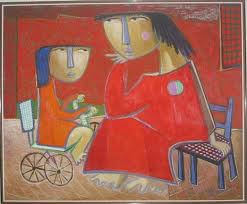
Consider the two paintings to the right. The Campeche woman is classical, in robes, European, religious, idealized yet muted. Campeche painted a world he loved, but in somebody else’s style.

The Botello is Carribean, everyday, personal, ordinary, vibrant. He painted his own everyday world, a world he loved, his family and  he painted it his own way.

Botello developed his own style; Campeche borrowed his from Alcazar, a Spanish court painter banished to Puerto Rico.

Being taught is good; so is being creative, original, inventive, new. We need both, but I think a real danger is to get stuck in tradition, and many people I know, including my own dear and unoriginal self, are stuck with familiarity. What to do?

I think some of ous are being called, by all that is aestheic and good and holy to unharbor more and sail into the sparkling waters of our own visions.

And once we have come nearly to the surface of those, to work them, jump on them, to dive into the center of our sparkling confabulations, to fearlessly throw ourselves into the original, originality of the original us. This will require something, that we be wild and crazy and confident and risky.

But if not, then how will we ever write that uniquely needed song of love and beauty or paint that new and fresh vision of that bright red girl on her little tricycle and paint too, her not-watching mother.

Some of us have been stupidly and persistently and patently safe and it must stop.

Life needs more red paint, and bright yellow too.

My brother Steve and I spent the last two days together in Puerto Rican castles, forts, rain forests and underwater marine parks. We got up and went out and saw it, just like we did when we were little boys. We snorkeled Farardo beaches, tramped El Yunque rain forest, ate and ogled our way through the old San Juan.

We are unwinding time and spooling it back up too.

Yesterday I went down to Starbucks to get fueled up for another days’ hard work goofing off.

That’s when I spotted her, the little girl, looking like a snail in the forest or a butterfly fish in the reef. She sat in her dark pink cotton dress just ten feet from me, or nine and one-half, and lifting her chin to the yogurt in a plastic spoon, she let her daddy feed her. I looked at her adorable little cheeks and eyes and it was so very clear to me exactly how she would look when she is an old women.

Then trailing behind him, she had the good sense to look down and take the steps out of Starbucks carefully. They were huge cliffs to her little legs. It won’t be  so much of a drop to old age.  When little miss pink dress is old she will be fed again from a spoon and take steps down guardedly and slowly, as if they are a danger to her which they will be.

The coffee worked and so we got out to  Old San Juan. There we dithered and doodled around and  saw some  old Puerto Rican men setting in one of the plazas and throwing their  white and black spotted dominoes on a metal table top, the stone bricks at their feet still puddling from the afternoon shower.  The men rose up out of the bricks and came alive in such an adorably idiosyncratic way that was so very and wondrously similar to how the Chinese men distinguished themselves when I saw them in San Francisco last month, sitting close in the park, circled up, gesticulating and jawing over the newspapers.

I can’t stand it; can you? They are all so beautiful, the little girls, the little old men, my brother, all of them,  raising their chins to spoons, to dominoes, meeting in the squares — consorting, confabulating, historicizing, disambiguating. The one with the thin black mustache, the domino man, the character, he is a factor in the community, he has a place at the table — he is absolutely beautiful and amazing.

Listen to me! There isn’t that much time left and there is so unbearably much. The little girl becomes an old women tomorrow; the old men in the park were young boys but yesterday and we will bury them this afternoon and yet now they remain.

Steve and I took the tour of the tunnels in the Castillo de San Cristóbal. Park Ranger Annie led us. I loved Annie, her energy, her enthusiasm for the history of the fort, her fun, her flashlights, her drama, the very herness of the very her. Annie is the little girl in the pink dress grown  up. She told us that she had come to San Cristóbal when she was a little girl and loved it, but then there was  no guide. And then in one perfectly articulated moment, when the exploding cannon ball above the tunnel door had been told on, Annie turned on us and gushed in the most ingenuous and personally, personalized fashion, “I wish I had me when I was a little girl!”

I could have hugged her right there! Yes, yes, yes, yes, si!

This is it! She got it! We all so needed our adult selves when we were little, to protect us and to teach us what we would eventually know eventually. We get just that. If we live, we all eventually become our own guides. We grow old so quickly that the child is swallowed by the adult becoming the child again. Tired of being your age? Blink. Tired of feeling old — remember. They merge, the memories and the now, the young in what is old.

I love my brother Steve.

We had us as little boys, and we have us now and nothing will ever take back the us of the very us of us.

Tomorrow we hoping to do some more holidaying.

Someone is feeding me.

It’s 5:23 am. I’m alone, sitting in my chair with my coffee, thinking, the cats camping out on my lap and nearby.

Last night I went to my friend Tim’s retirement party. About 75 people were there. We qued up for pizza, pasta, and chicken fingers and told stories about various explosions and fires connected to Tim.  Tim confessed at one point,  in a moment of hilarious candor, after numerous fireworks and burning-engine and flaming-Christmas-tree stories,  “I love fire!”

Then he paced the floor thanking people and honoring others and making jokes and flailing his arm about like a puppet in the hands of a maniac,  as he is wont to do when he gets excited, which is always. Tim is no sleepy house cat. He is a wild cat, a man on fire. For a few years he was in the habit of taking 75 or so Christmas trees to the desert, roping them together and lighting them on fire.

This morning, sitting alone with my coffee, thinking about Tim, it comes to me that when life is social, warm, burning, it is best, and that it is always social.

Alone is a fiction. There is no being alone. In a sence I am never alone, because I know Tim.

Tim is one of my very best friends. I’ve known Tim for about 35 years. He was the best man in my wedding. We have a lifetime of talks and some crazy adventures and some rough times too.  I rely on Tim; he relies on me. If he were to do something out of character that brought shame to him, I would feel the shame too. If I were to do something wrong, something out of character, something out of alignment with the good reputation that I have in the community, something that disgraced me, Tim would be disgraced too. And in this way, we are accountable to each other, and not really alone in our behaviors and choices.

We have fed each others fire; we burn for some of the same causes; we have each others backs.

Sometimes we speak of privacy. I write this in a private moment. We have created places of privacy, homes and fenced yards and bathrooms, but we don’t see this thing of isolation even close to correctly. Even in those more hidden places, we are never alone.  Our friends are there, and there is something else there, and on this  I am finally getting my mind straight.

God is there, everywhere, always with me. Privacy is a myth.  The Bible, that best book on life and God and reality, says that God watches us, that he sees it all, that his eyes cast around to see who relies on him and he energizes those who do. Last night when I watched Tim lounging about the room, arms up and down, laughing and waving and yelling and creating warmth and love and kindness in the room, I saw a man filled with God, not alone, fueled up on the watching eyes of God.

And I get it more now, although not yet as I will get it when I finally begin to wake up to our utter and complete and irrevocable not-aloneness. God is omniscient. God sees, it all, and when we know that, and live in that, and live as if that is true, which hardly anyone I ever met does, then we are different. If there is no privacy, then my behavior changes, because there is perpetual accountability and endless energy to do the right thing.

Listen, someone else is always in the room! I am growing wisely paranoid. We are being watched! And we are always creating stories than can and will be told. There is no movement of our fingers that isn’t part of the plot that is being written for public consumption, that can’t be told and retold as we live and then retire from work and love and hate and life.

This begs, pleads for, falls down and cries for the question: How would we live if every moment were filmed and shown at every moment to everyone? It is! God sees every moment of our lives. He is consistently present. He even knows our every thought.  And so we must each one always ask ourselves, “Do I want to do this right now, think this right now, live this out right now, seeing that God is right now watching me and recording my story?”

It burns in me! Pile on more Christmas trees. It explodes. Set off more fireworks. It smolders in me and in you, the glowing ember of God. It flares up in every moment, and it makes me want to live smart, aware, different, as if the lights are never off, and they aren’t and we are never, ever, thankfully ever — alone.

We are living public stories. We are always living out what will be told at our retirement party. We are always fighting off fire, or letting it burn in us. We are irrevocably public, and we would do well to live as if the whole world and God were always watching.

It is.

He is.