“You did a great job during the rough transitional years of this organization,” I said. “Your relaxed, calming personality helped settle other people down.”

The ten other people at the board room table nodded in affirmation. It was good, praising him, for what he had done,  especially considering the fact that he would be leaving our leadership team at the end of the year. Affirmations and goodbyes, like peanut butter and jelly, go well together.  He smiled. He looked pleased. I  was glad I said it. Every authentic compliment is a facelift. The art of giving and receiving compliments — it’s a fundamental and powerful social skill. The well-phrased compliment, like the water lily, graces the whole pond.

“I love you,” I told my wife this morning, “I love your brain.” I’ve told her this before. “You are such a good thinker,” I continued. “It is an honor to live with someone as  insightful as you. You  get it right so much of the time.” I said this because she had just gotten it right, in our discussion of one of our daughters, and I said it because it was true, and because I’ve learned to always compliment the people who feed me —  better food!

Compliments are good, fun, needed, but they can also be complicated.

Someone complimented a talk I gave recently. I think they meant to say, “I want you to like me.” I do like them, but they may not know it. Perhaps I need to tell them more.

Ingratiation is a term coined by social psychologist Edward E. Jones, and it refers to a social behavior in which one person attempts to become more likeable to someone else. Ingratiation is accomplished by complimenting the targeted person, by adopting their values and mannerisms or by promoting oneself to gain the favor of the targeted one. We have probably all complimented someone to their face, or we have complimented ourselves in someone’s presences, in order to win their approval. It’s normal, but that kind of praise is partly a lie, just dressed up in a suit and tie.

To avoid the dangers of phoniness, we might ask before we affirm, “Why do I want to compliment this person?  Is there a real accomplishment to acknowledge, or am I just trying to ingratiated myself to them?”

Winning each others’ favor is good, but the means of doing that involve getting to know each other authentically, over the long haul, not candy coating our relationships with manipulative praises. Those  people who we grow to like gradually — those whose delicious personalities we come to savor like slow-cooked soup  —  they become our true friends.

All this to say,  it is wise to run our words through a meshed sieve of honesty before we release them. If we don’t, a weirdness may enter some of our relationships, and this may bite us, over time.

The smoothest, most ingratiating person I ever knew turned out to be the most dangerous to me. Resentments were cloaked in social niceties. But I  learned, we all do,  from the way it’s not supposed to go. And as we go through the process of learning how to put our affirmations in proper form, we will do well to avoid becoming cynical. The good resident in the authentic praise of others is not sullied by the occasional experiences of social cloaks that hide verbal daggers.

Most compliments are good! Deserved compliments are wonderful; authentic compliments are life-giving. Valid compliments are the entrée of the soul. An affirmed person —  who can hold them back! I know that for myself, I write, in part, because of the praise I have received for it.

Applaud, appreciate, praise, endorse and commend  — more! Please, I beg you, tell the people who have done well that they have done well.

I heard somebody tell a friend who was going through a mess, ” I believe in you. You’re the real deal!” The person who was complimented had made a serious mistake, but that affirmation helped carry them on through it. They made the wrong, right and moved on. They were the real deal. The compliment was solid and true.

It is needed that we compliment our friends and family and coworkers. It is likely that their mothers or fathers failed to tell them that they were good enough, and we must make up for that, so that these loved ones can relax a bit, and calm down, and not go socially wacky,  and so that they can stop over-achieving, and in just the right time become all that they can be and more.
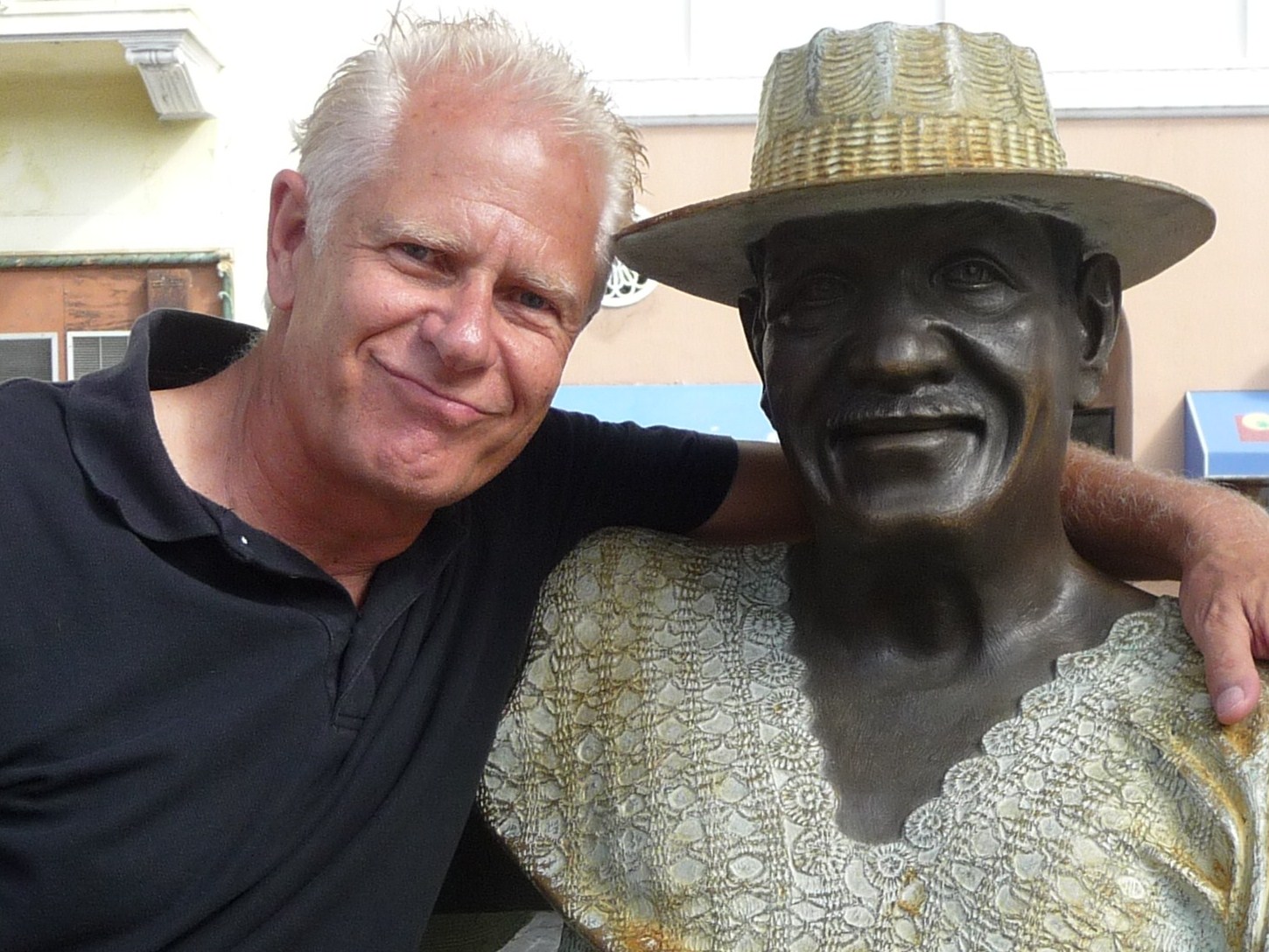
“Don’t do anything for your kids,” he said with a mischievous look in his eyes, “and then they won’t expect anything from you.”

Pat laughed, as he did after so many things he said, then I laughed too. His personality filled the space between us, like an air bag, as it did often, and not just with me. He was easy to be with, and safe. He often quipped about his profession, the noble art of house painting, by saying, “Women like a man in uniform.”

Personality can be hard to define, but when you are up close to a unique one, you know it. With Pat there was this casual, relaxed honesty that included a keen wit, a self-effacing humor and a willingness to let the “somebody slot” be filled by somebody besides him. The “somebody slot” is that opening which occurs when people talk,  an opening for one of the parties to be important. Pat gave other people room to be the star around him — he even invited it. This invitation, this ease, this opportunity —  it rubbed off on you, like fresh paint, a kind of fluid sociality, with no rules.

I told Pat once, “I’m my worst self around you.” We laughed. It was a compliment.

Everybody has one, a personality,  but not everyone lets it out to play. It would be nice if they did, and not just the extroverts. Personality is fun to experience, in ourselves and others. Shy is good, when we to see it peek out, a subtle, beautiful demeanor, lovely in the same way as deer.  And loud is good too. Loud is like a sunflower shouting its bright yellow.  And there are so many fun personalities! I  love gentle, sincere, kind selves.  I especially like droll, sarcastic or wry personalities.

I also like sass, sometimes. “If you don’t like me, there is something wrong with you,” one of my young friends quipped to me recently. I like her.

What is personality? Personality is the tuxedo of the soul.

Personality is our inner self showing up in our outer clothing. Personality dresses itself in gestures, postures, animations, idiosyncrasies and vocalizations. My cat, Shanaynay, has more personality that most three people combined. She yowls, huffs, purrs, begs, greets and deftly inserts herself into any possible opportunity given to play, eat, snuggle or snooze with anyone!

Personality is the expression of the unique self that arrises out of the distinctive core — like magna oozing from the earth. When we encounter it in others, it leaves us with a whiff of them, their cachet, their mark, their social signature. This is deep; it is spiritual; it is residue of the image of God in us.

When I left one of my older friends recently I could still smell her social perfume in the air after she was gone. It was the  fragrance “graciousness,” with sweet, woody notes of gentleness and non-judgment.

But in any one person, we must be careful not to constrain or warp their personality by labels and categories. Personality is a complex kind of thing, made up out of traits and states that swirl together and separate again like the Northern lights. Traits in us persist, but states (as in “I’m in such a state”) come and go. This morning, for a moment, I was grouchy. It left me shortly. The moment of grouch is normal for all of us, and so is the moment of temporary insanity, but these moments do not and should not define us.

But say they do, the dark moods, begin to define us. It’s possible. Something caustic, cynical, critical, mean and dark may overtake us. Then we should get help, and change, as a form of mercy, for the rest of the living, or if we cannot, we should at least remain at home — and not post on Facebook.

Personality can change, heal as it were. Mine has. Thirty years ago, “cautiously reserved” might have fit me. Now, at times, ” wild and crazy” might be much more suitable.  The wall flower may one day climb the wall. I have a friend who is basically shy, but she is getting good at speech making. Out of her shy person she is learning to bring a new, public persona of confidence.

But whether it morphs or not, personality, in all its diverse forms, is something to savor, like a good wine, in ourselves and others. It is also something to learn to give, as a gift, to ourselves and others.

If I could do anything for the many fearful people whom I know, it would be to set them free to be all that God originally designed them to be — unique personalities. Their personalities might yet be the secret sauces of their success.

When the heat from lava began to melt the bottoms of our shoes, we knew it was time to head for cooler ground. We were hiking the Kilauea volcano on the big island of Hawaii, and the black lava field we were making our way through at dusk was filled with little rivulets of lava, break outs and pop ups.

I looked around for a park ranger —  none — and thought, “Should they even allow us to walk out here?” You’d expect a rule, a national park rule, to protect us from the fire, a verbal fence, maybe even a real one, to keep us from being stupid. There was none.

I was suprised. I live in a world full of rules and  make up a few myself now and then.

“Take my arm,” I said, and guided her hand to grip my bicep like a hand rail. Then my daughter and I stepped out into the street. I often do this with her often, because she is disabled and unsteady, and also unobservant. Brain damage. When you are brain-damaged, rules help. They take the place of thinking. They protect.

“The deposits go in this tray,” I said, “the bills in this tray, and the treasurer’s paperwork goes here.” I was explaining to one of the office staff  our new system of organizing financial paperwork. Rules, scripted behavior, categories — they work to keep from things getting lost, to keep order, to prevent bad accounting. Rules organize us. Rules are the magic wand whereby we zap chaos into order. But they can do more than that.

“I’ll do the dishes,” I said, “since you cooked.” Usually I don’t even have to say it. It’s a tacit rule, often unspoken but fully operational in my family, “The cook shall not do the dishes.” Rules, about who does the dishes  — they tend to make for good relationships; they may even make things fair — when followed. They other night my wife cooked and did the dishes.  I thanked her as I headed out the door, on the run. She said that she wanted to do the all this. I let her, want to, and do it —  I let her break the rule.

There are lots of good reasons to have rules, for protection, for order, for good relationships, but there are also some fine reasons not to live by them.

One reason involves the distinctly idiosyncratic nature of people and life.

When the mom didn’t want to move her preschooler to the kindergarten class because she believed that her little one was not socially ready to move up, then we, as leaders of the organization, gave the mother and child respect, and relief from the “promotion” rule in play. The little one stayed where she felt safe. That’s good. Organizations with no flexibility, without a brain, without the eyes to see that it is best to do something different in a particular case, become oppressive and harmful to unique personalities.

Wise by eyes; fools by rules.

Sometimes I think that we have ruined the world with bad rules, rules about what women can and cannot do, rules about what men can and cannot do, rules about what is spiritual and what is not,  rules about what certain racial groups can and cannot do, rules about who can live where and who can do what, how, and when and with whom and for how long!

The development of civilization is the multiplication of rules. Many of those rules began with what was thought to be protection, but in time became brutal oppression, for instance, the tacit, long-standing rule that women must present themselves as both attractive and submissive to men, whatever the personal cost to themselves and their children.

It’s estimated that something like 40,000 new laws went into effect in the United States in 2012, for example, the 100 watt incandescent light bulb can no longer be manufactured. I suppose that’s good, to save energy, but at the heart of the issues is the need to promote and preserve good thinking. If I can see for myself that the fluorescent bulb is cheaper and longer lasting than the incandescent bulb, I will choose to replace mine under my own volition and energy. Consumer choice ultimately rules the markets. Consider the black market that always exists for what people really want.

Often common sense and love will do just a nicely as a pack of rules, usually better. The problem with rules is that they don’t much motivate people. The value in thinking is that once you decide, with your own observation and good thinking, that a course of action is good, then you will be motivated to carry that thinking out. Rules require, but visions inspire.

When Jesus himself spoke about the many laws of the Jews, he reduced them all to two, really to one — love. Love God, love your neighbor. Love, he said, was the fulfillment of all the law and the prophets.

For Jesus, love decimated all rules but itself. The religious people didn’t like that. Neither did the government. They still don’t. Governments and religions love rules. They use rules to control people. They use rules to maintain power. They use rules to opperess. But love doesn’t control others;  it certainly doesn’t oppress. it sets people free.

I have a fondness for a few rules, especially the ones I make up, like don’t eat all the ice cream before I get a bowl. And I certainly like it when people stop at red lights and obey speed limits. It keeps me safer.  I live by a lot of rules, as we all do,  but many of the rules of the organizations that organize our lives increasingly seem to me to be hot beds of irresponsibility. People let rules do their thinking for them. People blindly follow rules that harm other people and ruin everyone’s opportunities to develop.

Too many rules, too fiercely enforced, can keep people from  learning from their mistakes, from suffering  the consequences of their bad choices, from learning  for themselves and from trying new, good things. We need some rules, but I much prefer that we promote more good observing, some fine analysis, some clear thinking, some exceptions to the rules when that works best, and a bit more taking personal responsibility for life without being forced to do so by rules.

To be really honest, I really don’t so much care for rules and I don’t like policing other people when they break them. I much prefer rule-free relationships, and far above law, I’ll stand with Jesus, and hold high the banner of love.

And I like it too, when I get a chance to gawk freely,  even with some minor risk, at the fiery red and orange glow of the beautiful, dangerous lava. Then I know I’ve lived a little.

O how the mighty has fallen — off his bike.

Lance Armstrong has been stripped of his seven Tour de France cycling titles and banned for life from sanctioned Olympic events.  Nike, Trek, Anheuser-Busch, Oakley and several other sponsors have dropped him. Furthermore, Lance has stepped down as the chairman of Livestrong, the cancer-awareness charity he founded 15 years ago after surviving testicular cancer.

Why? Armstrong and his teams used steroids, the blood booster EPO and blood transfusions to help them win the Tour de France. They cheated and lied their way to victory.

USADA’s recent report on Armstrong says the now-retired rider was involved in the “most sophisticated, professionalized and successful doping program that sport has ever seen.”  The evidence from his teammates is that the cyclist not only used banned drugs but bullied others into using them too.

Lance made us proud; now he has made us sad, mad, perhaps more cynical or just numb.

Lance’s losses are big time. He can’t be having fun these days. He had the big rides, he had the adrenaline rush of being the big star, he made cycling history, but the memories and accomplishments are tainted now. They were illegally won. Well, one might muse, he still has the big money that came with the big wins, but even the cash may now be may be at risk. Legal experts say Armstrong may be sued, and that coming clean with a confession could make him even more vulnerable to civil or criminal actions.

So many conclusions can be drawn from this saga and will be over the next few years. Certainly one is this: members of a group sometimes collectively engage in risky, potentially ruinous behavior in order to achieve a desired end. In such groups, a culture develops in which everyone participates in a cover up and a lie. They agree to lie and cheat to win.

How does this happen?

Well, for one thing, group members may buy into that old, trite but highly useful rationalization.  “Everybody is doing it.”

Such group think was most likely a factor for Lance’s riders. The logic was, “We have to dope because all the other contenders are doing it. We have to drug up just to level the playing field, just to have a chance to win.” But at that fork in the road, where one chooses to pedal the shady route or not, that is precisely where each cyclist’s personal responsiblity comes into play.  To fall in with the collective mindset, to decide to push a doped pedal, that was an individual choice for each rider. Why make such a choice? Perhaps it worked like this in their heads:”It’s worth the risk for the chance to win, and with the good doctor’s help, we aren’t likely to get caught.” How did that work out for them? They did win, but they got caught, winning unfairly, and stripped of honors.

It seems clichéd these days to say there was and always is the option in sport to stay clean, to refuse the rationalization, to go for it, fair and square. There was; there is. But, in cycling,  in Lance’s era, clean may have meant  that you simply couldn’t win a race like the Tour de France. It’s sad, but it may have meant that clean, you had to go compete somewhere else, and ride at a lower level. That’s hard, for a “winner’s” mentality, but it’s a good choice for a guilt-free mentality.

Secondly, on Lance’s team, some of the riders seem to have been coerced, intimidated and even threatened to go along with the cheat. You were in or you were out. You doped or you were noped. And worse, there might have been the mindset that if you finked, if you talked and tried to expose the thing, Lance would come after you. There is evidence that Armstrong  used the strong-arm.

Conclusions?

Everybody who doped should own that. They did it. They knew it was illegal.  It’s on them. If they lost their wins, it was their fault. If they lost their reputations, they did it to themselves. If they lose their money — on them too. Lots of loss, but not just individual loss. We lost too, the fans, along with the riders. We lost our heroes, perhaps our trust in winners, perhaps our faith in clean sport, but still they lost more. We didn’t lose one thing they lost: along the way, they lost their integrity. If we are still honest, in what we do, then we haven’t lost that. And for those who have lost integrity, some of it is regained just by coming clean. It doesn’t change the past, but it might change the future. Honesty still makes a good mental insurance policy.

And as for the  team coaches, the team doctors and the lead riders, like Armstrong, who mandated and pushed a doping culture, they operated at another, even more culpable level. It is one thing to cheat; it is another to encourage and or mandate others to cheat. Harm yourself, not good, harm others, worse. Harm others to protect your own lies — that’s a pretty nasty life to live, and live with. To have ruined people to get what you wanted, that changes you, somehow, and not in a good way.

Sports, business, politics, entertainment — this isn’t new, cheating and lying. We’ve seen this before. Cheat, harm, lie, drag others into your scheme, attack, get caught, stonewall. People won’t always live strong; they’ll live wrong. Lance Armstrong did.

I’m not cynical. My conclusions do not include the overreaction, “You can’t trust anyone anymore.”  You can, but this will happen again. And  then again, thankfully — it will not.

Some people won’t cheat, they won’t lie, and they won’t harm others. And some of them will win, out of sheer hard work, practice, skill and fierce determination. And if they don’t win,  they will at least have a clear conscience, and in the end, that has more satisfaction in it than a stripped title.

I’m still rooting. I’m rooting for legit.

The first time I really took much notice was when she was lying on the sidewalk. We went over and presented her with the standard cliché. She said she was, and we helped her get up, and she hobbled off.

I had my office manager email the city. I had images in my mind of them coming out and pouring a cement square and calling it a day. They didn’t. Instead we got a letter in the mail saying that it was our responsibility to fix the problem.

“What?” I said on the phone to the city official, “We own the sidewalk?”

What it really came down to was the tree. Our tree cracked the sidewalk so it was our responsibility to get it fixed. There often seems to be a discrepancy in life, between what we want and what we get.

Actually, the whole thing started about forty years ago because of the sun. Someone decided to solve the problem of the sun shining too much in the west-facing windows of the church. In a moment of brilliance they took a little potted tree, dug a hole about ten feet from the side-walk, right in front of the windows, and put it in the ground. It was a good solution, it worked well for quite some time, but the problem solvers didn’t imagine the end result — another problem. It’s often like that with people who plant trees — they lack the prophetic gift.

When the company we hired came and broke up the sidewalk, all sixty feet off it, they uncovered root work —  forty years of it. Huge python-like roots were exposed, some six inches in diameter, lurking along a sixty foot span of walk, uplifting the cement from two to three inches, creating a trip hazard, eventually upending an older woman.

The fix cost the church close to $7,000 — the removal of the 35 foot tree, the removal of sixty feet of walk, the pouring of the new sidewalk and curb, the purchase of new landscape — non-root invasive.

There is often a discrepancy between what we want and what we get. We want someone to fix a problem; we are required to fix the problem. We want shade, we get a bill for $7,000.

I’ve noticed the discrepancy lately. Recently the son of a friend of mine committed suicide. We were stunned, knocked sideways, and run over by this. I went to the memorial service and came back home kicked in the head. This wasn’t what we wanted. We wanted life; we got a brutal death. A mom planted a tree. The roots broke the sidewalk. There is no fix.

There is a discrepancy in life between what we want and what we get. There is an uplift, a break, a gap and we fall on it, or into it and we don’t much care for lying on the concrete.

I don’t quite know what to do, but one thing comes to mind. What we can’t fix we can love. I love my friends left. I love the good that was in the little boy who grew up and then gave up. I love fixing the things I can.

The discrepancy remains, but it doesn’t overwhelm us, because other things remain too, a new sidewalk, a new tree, new friends, good memories, bravery — love.

It’s odd what juts out from the past, in our minds, as we story and restory what we live through. Bits of narrative lift above the landscape, like mountains pushed up by continental drift, and we grab on to these, to make some sense of the past.

The parking lot lights weren’t working, but we were —  seventy to eighty people swarming the buildings,  fixing, cleaning, painting, planting. We were renewing our church. Then suddenly in the outer hall there was a guy in front of me saying, “I’m an electrician. What would you like done?”

“Really?” I said, “That’s perfect! I’ve got something for you.”

I didn’t know his name, and I wasn’t sure how he knew about what we were doing, but there he was, offering free labor, and I knew what to do with that.

“The parking lights don’t work,” I said, and as I opened a closet door on a couple of old, rusted, steel boxes mounted on the wall, I added,  “We think it’s these timers.”

That was enough. He went to his truck, came back, and he was on it. In short order — problem solved.  He replaced the old boxes with new — clean, bright, functional —  perfect mechanisms that light up the church, on command.

I drove home coasting! Happy! Thankful! Surprised.

That day, that fix, that surprise stands out for me because it’s part of a pattern.

It rained. We found a roof leak in one of the church buildings. It was serious — $5,000 worth of serious. There was no offer of free labor. Right around that time, I can’t remember the exact chronology,  a woman came to me after church one day and said that in her retirement settlement she had received some money, and she wanted to give some to the church. It was a check, for $5,000.

It was odd, in a way I like — the numbers were the same.

There’s more.

As part of our site remodel, we ripped into the old nursery, the  old carpet,  the broken furniture, the chipped walls, the horrific curtains. About that time an older couple began to attend the church. One day, after church, he came to me and said, “You mentioned needing a couch. What about this one?” and he showed me a picture torn from an ad.

“Great,” I said.

“What day would you like it delivered?” He asked.

I remember a couple of us ripping off the protective plastic and cardboard that covered the new couch when it was delivered. Then we just gasped and hooted. It was gorgeous, the perfect shades of brown and dark brown to match our newly painted nursery. The babies and their moms would now repose, in style! Then he bought two more new couches. It was like Christmas, a furniture Christmas.

There were also the cabinets, in the upstairs kitchen. They were a piece of work, right out of the seventies, pine, burnt with a blow torch, and then coated with thick shiny layers of polyurethane. They looked like what they were — remanents of a fire!

What to do?

I went down to Dixieline,  the home repair store just down the street from the church, and asked if there were any cabinets that had been brought back from a job, something that hadn’t worked out, and were being sold for less than they were worth. There were some, but I was told I would need to talk to the manager.

So I made an appointment. I went up to his office, upstairs, nice, impressive. We talked. I’ll always remember his question to me. It took me back. I wasn’t sure how to respond. The cabinets were gorgeous, a whole bank of them, and drawers and doors beyond what I had expected.

He looked across his big desk at me in his big office and asked, “What do you want to pay for them?”

My mind raced. If I said too much I would miss the chance for a deal. If I said to little it would be insulting. They were worth between $1,500 and $2,000, by my best guess.

I said, “We can give you $200.”

“Good,” he enthused. “I’ll have them delivered for you next week.”

The other day I was in the upstairs kitchen. The cabinets are in, installed free by a local cabinet-maker who not only donated the labor, but also gave us the counter tops for them.

I could get used to this. I have.

A donated landscape design by a local landscape architect, a restoration consultation by a woman specializing in historic building remodels, the no-cost installation of huge, new sanctuary windows by a man who had formerly worked for a glass company — all this and more has landed our our doorstep. Surprise!

At every turn we have been given — gifts.

When we decided to install new lighting in the worship center we were looking at an $8,000 project, at least $16,000 if we paid for labor. We didn’t. All the lights were purchased at cost through a friend who works for a lighting company. All the labor, hours and hours, plus the use of a lift were donated by an amazingly generous electrician and a few of his friends. All the labor, days of it, free.

The lights in — beautiful, functional, lovely, perfect for the building.

A patio garden — the dirt, irrigation, labor — free!

A hardwood floor sanded and refinished, free except materials.

The painting of the interior of our worship center — free, even those difficult upper levels, brushed in by a local professional painter, done safely, nicely, a gift, more than we could have asked for

There is more, but the more that really sticks out to me is what has been added to us that is human, not mineral or material.

A renewed site, a growing congregation — we needed staff to care for them.

We went to our local seminary and asked for an intern.

In asking, we were taking a risk. We weren’t controlling who we would get, we didn’t know the outcome, we didn’t even know if we could afford it, we just knew we needed help. We were a continent, of people, drifting.

That was two years ago.

The result of that inquiry is now on paid staff, well-funded for this next year, uniquely suited to our needs, trusted by our people — she is perfect for us! I almost don’t feel surprised anymore.

Things stand out, in the past, bits of narrative rise up, pieces of our continuing story. Our past has a pattern in it. The pattern is good. One could almost draw certain conclusions — that  it was orchestrated.

We have.

Renewal is stubborn, especially at the fringes and edges and the corners of the former. Think of what it takes to restore a classic car or a classic church.

A while back, I was in room 5 at my church, which is a classic,  and there it was, where the tile met the wall —  clean! I remember when it wasn’t.

When I took the job as the pastor of the church four years ago, a nice herd of children attended the private, Christian preschool that operated there.  I loved coming to work to children.  I loved being surrounded by those precious, diminutive, destructive monsters. While I could see that they were vectors (the runny noses and coughs) and carried diseases, I’d had my shots and they were super cute and said funny stuff and gave me chances to tell stories and laugh and get hugs and comfort them when they cried for their mothers, which they did a lot, especially late in the day.

I tend to like the generic noises children make,  the hum that they collectively emanate, punctuated with the yelling, laughing and crying. I especially like it when I’m not immediately responsible for it.

But there was a problem with the school, and so we said a prayer over it — and buried it. It was a private day care operation that was leaking money in the recession, threatening the financial solvency of the church. It had been in existence for forty years. It had thrived, filled the patio with children, helped parents who were working, cared for the children of the church, but it was done, (no children from the church even attended anymore),  and so were we.

The church board discussed it, discussed it again, and again, made the decision, grieved the loss and let it go. We paid the director and the teachers severance and vacation pay, told the parents and children about why we were quitting and closed the doors — at Christmas — on a huge mess. Four big rooms and an office complex of mess.

The preschool classrooms hadn’t had an update in 20 years. They were full of over-painted children’s furniture — red and blue and white paint-encrusted wooden benches, bookshelves and cubes for backpacks. This inexpensive, even homemade furniture, was all paint-chipped, kid scratched and dirty. And so was the floor —  filthy.

We trashed, sold and gave away the school — except a few nice tables and chairs. We gutted the rooms. Huge truck loads went to other schools, and  to the dump. We sold a ton of stuff at a garage sale.  Through this we saw how it is at the end of the end of things institutional.  At the end of visions, dream and institutional successes is a junk yards and a dump. Dumps are full of the ends of schools and businesses and homes and lives. It’s sad, and it’s necessary, and it allows something new to begin.

Once the rooms were almost empty, we painted the walls, scraped paint off the windows,  and tackled the floors.  The floors were the worst. The piles of furniture, the weight of time, the tendency not to see the familiar, the lack of funds — all  this had left the floors layered with filth.

We removed the base boards, and we got on our knees at church, not to worship, but to clean, which is a form of worship, and with our heads bumping the walls, we confronted the spaces where the universes had overly accumulated. I remember it well. I remember the night we employed every means known to man and woman to scrub wax, grime, grit, gunk, hair, insect body parts, dust, paint and whatever disgusting residue human children leave behind them  —  off the floor.

We ran an old buffer with a massive yellow, electrical umbilical cord (we found it lurking in an old closet) over the floors, grinding away at the dirt embedded in the tile. The buffer was wild and could get away from you and clobber the wall,  or your leg, so we let one person run it while the rest stood back and laughed. Once I got on it and rode it, to increase its wieght, and another guy ran it on a spot that just wouldn’t come clean. It did. Then  we got out scrapers and razor blades and scrub pads and attacked the edges and corners. I remember telling the volunteer crew stuff like, “Let’s hit that spot again,” or “I want it better than that.” I remember being fanatical about getting the dirt up, even coming back on my own over the next few weeks with a razor blade, scraping yellow wax and brown grime.

Then I paid to have the carpeted areas cleaned, twice!

Why?

Last week I went into room 5 on a Wednesday evening. It is the church’s new vision, “The Connection,” a place for children and their parents to learn, to recover, to renew.  The room was full of children, so many they were spilling out the back door. Four or five adults hovered over them. There was a quiet hum of voices with a background track of sandpaper running over wood. The children, all who attend the church, were making pine box derby cars.

I walked toward the end of the room where we had attacked the tile floors. They shone. Curtains covered the beautifully clean windows at the end.  I looked back at the children and walked  back through them, just for fun. They showed me their cars. One gave me a hug. She always does. She’s my friend. She used to attend the preschool.

As I left for the evening, I glanced along the wall where we had confronted the most stubborn layers of dirt — good, clean, repurposed.

There is something about a vision, about a church,  about God, about an old room, about scraping up the past, about making a clean space for something new.

I like it; I like the good that exists at the scraped corners and at the clean edges of the present and the future.

Randy Hasper“Men lie in their lovers’ arms, but when they tell the truth, they stand up and deliver it from ten feet away.”

That storyline came to me a few weeks ago as I was drafting some thoughts about lying. The sentence might be classified as a truism, as axiomatic, or as proverbial truth housed in a mini-story. It is a story proverb.

The story is about a word man and a word woman who live in a word sentence. They are inauthentic lovers. One night they speak their endearments to each other and stroke each others’ hair and hold each other close. The two are together in that magically exquisite way in which humans who collide may also merge. But, after the “but,” in the sentence, the mood changes. He gets up, because he has kept something from her. He can no longer lie and lie. And then he tells her the truth. He knew she would be hurt and upset, so when he says it, he stands away from her, about ten feet away. It is a relative safe distance from which to wage conflict.

Perhaps he is afraid. Maybe she cries. He paces the room. There is now a moment of expanding distance and pain between them. Then what happens next?

I don’t know what happens next. It’s not in the line. The line is a fiction, an imagined narrative, unfinished so to speak, two acts, not three: love and then conflict, with no resolution. The story is frozen in print, unresolved, but for a purpose, so that it might aptly carry it’s content and no more than that. The content is something like this: Men lie while they lie, and the lie, once exposed, turns close lovers into distant enemies.

That’s life, or life similar.  Life includes lies and the story lines that follow those lies and a lot of pouting and crying and throwing things. But that’s not all life offers us. The narrative of  real life, a life still being lived, is different from a frozen, proverbial  narrative. A real, ongoing, present-tense story, like each of us is living, is not frozen or stuck in a sentence with a limited meaning and freighted with unresolvable conflict. Life, thankfully, is still malleable, and pregnant with a multi-stranded hope for more.  The life we are each currently living, while it is made up out of the multiple narratives of the past, loosely braided together in our minds, that life is yet still  capable of being further braided into something new.  We aren’t done, like a sentence penned.

Each one of us have options to live past our former storylines, to write a new sentence, to write new pages and even volumes if we will. What I am saying is that life includes redemption. Life includes second chances. Life offers us opportunities for rewritten endings. This is what God gave us when he made us like himself and gave us life — the power to story something good, even after something bad.

I believe that, because I’ve seen it and lived it. And I take from this, that it is my responsibility and yours to take the current pieces of our narrative and make some sense of them, to bring some kind of resolution to our conflicts where we can, even if it is only within ourselves, and to carry on with us our frayed and broken strands if we will, and weave them into something else. We can yet take up a thread of the old and braid it into the pattern of the new.  We can yet make choices to act out where we want the story of our lives to go. We are not frozen in words that do not resolve.

If there is a secret it can be told. If that creates conflict, that can be talked about. If there is pain, and brokeness, that can be healed, or learned and recovered from, even redeemed in perhaps another relationship. For instance, real people, who have “lied” in their lover’s arms, may eventually come to say, “I have learned from secrets kept in one relationship, not to keep them in another.”

I spoke to a woman this morning who said to me: “I am blessed that I have a mental illness and that I have been so physically sick. I am not happy about it, but I am blessed, because without it I would never have known God.  I know that if I had been rich and healthy, I would not have known God. ” This is shocking language, sure to unnerve some people, and yet look at how she is telling her story, making sense of it, stranding it into something good even in the center of something terrible. She is bipolar, and yet she is unipolar, focused when possible on a good narrative that she is struggling so bravely to write.

We are, each one of us, with God’s help, the novelists of our own lives. It is our responsibility and privilege to write a good story that moves toward order and understanding, to exert strength, to be human, to embrace the whole of it, loss, pain, sickness — health, gain and pleasure. All of it, taken as a whole,  makes sense, says something, defines what it means for us to be alive.

Story on.

You aren’t done.

There is no sentence in your past that you can’t rewrite in the future.

You are responsible for the ending of your own story.

Just write it.

Freedom is being responsible for nothing — plus every single choice we make.

If you and I were to slip into a crack and fall to the center of the earth, at the center of the precise center of the earth, we would be weightless. With nothing between us and the middle, there would be no gravitational pull on us, so we would weigh nothing, which of course we wouldn’t realize nor would we even remark on to each other. It would be too hot for chattiness — over 5,000 degrees — about as hot at the surface of the roiling, roasting, egg-frying sun, and so we would just bake together — weightless.

Cool! In a warm, high-pressure, floaty kind of way.

This postulated, in other words, say you and I do fall into a chute that leads to the earth’s core, lets agree to something. Let’s agree that if you don’t want to go there, it is your option to snag a root on the way down, or fall on your ice axe, if you have one. I want to experience 5,000 degrees and weightlessness and view the molten core within the core, but if you don’t then that is your choice.

Here is the thing in life. The places we go, the weightlessness we experience, the temperatures we allow ourselves, the self-arrestments we pull off, the times we choose to fall into a new landscape — these are up to each of us individually.

I’m thinking more and more these days: I am responsible, and you are too, for what we choose, and for where we are.

I am responsible, we are responsible, they are responsible and everyone else is responsible too! We are, the whole lot of us, choosers, travelers, Voortrekkers. Like the Afrikaan Voortrekkering pioneers, we choose to voyage toward the interior, to be “those who pull ahead,” or not.

I’m thinking of staying home less. I am crazed for the interior. I am wild for the core of things.

This summer I trekked to the beach. I hauled along some books and food; I ate the food; I ignored the books; I stared blankly at the ocean. I needed that big, bright blue expanse of liquid to leach from me a couple of pseudo-defamations, one or two persistent self-incriminations, a baker’s dozen addictive infatuations and a handful of snarled and tangled minor intimidations–and such.

Why? Why go there? Because I am responsible. I am responsible for the health of my psyche. I am responsible for where I go and what it does to my soul. I know this, and these days I am prepared to fight for every, freakin’, psychologically healthy moment possible.

I am going to the gym this afternoon to run until my heart pounds so hard I know I am alive. I am going to do this because I accept the premise that I become a very slightly different person with every choice I make, with every place I go, with everything I allow my soul to experience.

I am looking for opportunities these days to fall into deep, exhilarating, life-changing cracks of personal responsibility — cracks like God, love, justice, pain.

Recently I put myself up close to a person in extreme psychological pain. Why? They needed me, and mostly, I needed them, to remind me that life is full of extreme pain that must be attended to, that must be acknowledged, that must be endured, that must be experienced. Extreme pain is certain to make us temporarily insane, but afterwards, we may be able to move into a different future, knowing what we can only know after living in 5,000 degrees of mental anguish. What we know, after such heat, is the loss of weight, perhaps even the heavy fear and anxiety and selfishness that have kept us from rising up, and floating.

On the other side of responsibility, of our responsibility for engaging extreme experiences, experiences like meeting God, doing justice, choosing to love, being healthy, embracing other people’s pain — there is a strange and wonderful landscape with a super-animated kind of beauty — it’s weightlessness.

I’m Voortrekking toward it.

Why?

I am taking responsibility for the health of my own soul and of others.

Do you want to go with me?

As I was driving down a street this week, I glanced through my driver’s side window and found myself looking through a bus window in the lane besides me. And through my window and the bus window, I saw a set of eyes looking at me. We saw each other through two moving windows — my car, his bus —  right in the eyes, maybe six feet away. He was an older gentleman, Mexican I think, with a serious expression.

We were both moving along the street,  framed in our windows and with that one, short glance we traveled together until I looked back at the road to see where I was going.

As I drove on I wondered, “What was he thinking? Was it, ‘I’m glad I don’t have to drive, that I can just ride home peacefully on the bus.’  or perhaps, ‘I hope someday I have a car again, so I can come and go as I please.'” Was he perhaps thinking about something that has happened to him in a small village in Mexico, where he grew up, thinking so intensely about when he was a child, about that time when his mother …

I don’t know, but it brings up the question for me:  How present am I, in the community of the present, in the collaborative  of the moment, in the social within the now, in the car, watching the man in the bus, in the now of the now within the core of the very now?

I remember Pascal’s observation that we wander around in times that don’t really belong to us. Remembering the past, we miss the present; worrying about the future, we may not even see someone right in front of us.

That happens, but increasingly I am find myself wanting to travel in the present, which means to actually look over and see the man in the bus traveling beside me, to see him in all his obfuscated beauty, to not really understand him but nonetheless to  see him as my companion in the now, and understand that we have a shared, universal human journey, asserted and expressed in the raw, transient and yet extant present.

The bus rider and I share the same street, the same city, the same state, the same country, the same world, the same universe. He is my brother. We share the DNA of the present. We share the current animal, vegetable, mineral, social, political, spiritual now. Am I making too much of this? I am not making enough of this! We have missed, missed, missed and missed this infinitely.

I want to see my world. I want to live fully in it and with it.  To see it, I must look at it. To look at it, I must linger on it, for a moment. I must dawdle in time, fiddle around in the present, goof off in the slip and slide of the near and the immediate. Indeed, after seeing the man on the bus,  I should have pulled over at the next bus stop and gotten on, introduced myself as the man in the car, and asked him about himself. Then I would have discovered a bit of how different from me he is, and how much the same, how perhaps, he is really me, and I am him.

I have lived in the same community for a long time.  I know a lot of people! I talk with people all day long. Do I need another conversation, do I need another friend? Do I need to be getting on busses when I have a car, to be accosting old men on public transportation?

I do! We do! We should! We have not even begun to enter into what is present for us, to bridge, to connect, to converse, to empathize, to understand, to laugh, to grieve, to know each other, to actually see, touch, think with and understand each other.

There are no projects, no work loads, no places to get to, no duties waiting here, no responsibilities lingering there that should keep glass between us.

There are no class or economic or social or racial or religious differences that are so compelling that these should keep us from busing a short while with each other.

There are no memories so strong as to erase the moment of your unique presence here on this street with me; there are no worries so strong as to obscure the immediacy of the precious you-ness of you here with me.

I have a prayer I have been praying, and I recommend it to anyone who wants to live in the uniqueness of the social now.

“God, I beg you, send me my people. Send me Indian people. Send me Chinese people. Send me Brazilian people. Send me Mexican people. Send me anyone you wish, but please send them all. God, I beg you, drive your bus up my street and bring me my people so that I can befriend them and take care of them.”

Why pray this?

I pray this out of the awareness that this is my present-tense reality, and that I want more of it  — the bus, the window, another person, our eyes meeting.

There really is nothing else here, right now except this kind of divine, immediate sociality. The past is gone, the future not yet come, nothing but the present moment and all the beautiful people God sees fit to give me in it.