Archive for the ‘people’ Category

Into the paper cupcake holders in two cupcake pans I poured a thin layer of super-moist, triple-chocolate-fudge cake mix.

Then on top of the thin layer of super-moist, triple-chocolate-fudge cake, I poured a thin layer of sweet, whipped cream cheese.

Next — into each cupcake sleeve, I gently spooned, on top of the super-moist triple-chocolate-fudge and the sweet cream cheese, a layer of country-cherry pie filling.

Then I poured another layer of super-moist-triple-chocolate-fudge cake, on top of the surpy, cherry pie filling, which covered the whipped cream cheese, which covered the first layer of super-moist, triple-chocolate-fudge cake.

At this point I grew frightened and decided to put it in the oven —  to kill it.

Twelve minutes later, when the little super-moist, chocolate, cheesy, cherry-filled bodies had baked, and then cooled, as part of the embalming process, I spread a thick layer of rich and creamy vanilla, cream cheese frosting on top of each one.

Then — I – ate five!

I hate myself.

Paul, the amazing Christian super saint once wrote, “I do not understand what I do. For what I want to do I do not do, but what I hate I do. (Romans 7:15)

Sounds like someone else has been into the super-moist triple-chocolate cupcakes. Of course, the truth is that we all have all been there, where we didn’t want to go, doing what we hated to do.  We have overeaten cake or indulged a nasty character defect or shot off a mean-spirited repartee or harbored an infected and moldy core of unforgiveness. Or if we have not done these then we have indulged something else non grata, not fun, a fair bit of  anguish, the loss of control, the doing what we don’t want to do, the regrets later. This is just what we do — the stuff we hate.

And so, what to do?

I backed our SUV into a telephone pole a few years ago. When I confessed my mistake to my wife, she said, “That’s why we have insurance.” Never once then or after did she say anything condemning about my driving mistake.

Good, very nice. There is a recipe in this. There is a culinary treat to write down, on a card and to keep in a drawer, to Facebook to a friend, to use again.

After any one of us have poured down a super-most layer of triple chocolate fudge blunder, we should pour on top of that a thick layer of  sweet, cream cheese honesty. Then it is best if someone else in the kitchen  with us adds a thick layer of cheer pie kindness. If as so often happens, another layer of triple chocolate fudge mistake is added, and it gets baked all together, as so often happens in life, we  should all yet “cool it,” and  top the mess with a thick swirl of cream cheese forgiveness.

Finally, once we have all our layered delights finished and spread out in front of us, then we should each eat five or more of them, just to help us get the layering pattern “down,” and to help us learn to make this unique way of preparing food a real part of us.

A mistake? It needs a loving relationship.

Then,  “We’re really cooking baby!”

I have a lot of friends.  I have friends from school. I have friends from work. I have friends from church. I have friends in my family. I have friends in other countries. I have friends who are dead. I have friends who are not but pretend to be. I have friends who are fun, and I have some other friends who are friends because they aren’t fun. I have friends who I meet for a tête-à-tête at Starbucks, and I have friends who add me on Facebook.

By friends I mean a lot of different things, as we all do — people we got drunk with in high school but now have nothing in common with, a checker at Costco whose line we often choose, people who dabble in what we also waste time on, people who “get us” and leggo-people who used to get us but have now snapped off and don’t, furry friends — our cats and dogs, friends who we keep on call by the bedside — our favorite dead poets, painters, novelists or philosophers, and lastly and most importantly, our real friends, the cherished soul-mates who hang on through it all and just won’t let go, like Taylor in Barbara Kingsolver’s novel, Pigs in Heaven, who won’t let go of little Turtle —  the mythic, profoundly archetypal lost child, “six pigs in heaven and the mother who wouldn’t let go.”  This is it, the core of it, the will-not-let-go friend.

I’ve told my daughters, trying to help them with the vagueness and occasional hurtfulness of the thing, “There are lots of kinds of friends, all kinds of levels and layers and lunacy. Enjoy them all.” It’s hard. Friendship is a garage that we throw a lot of different stuff in, and some of the stuff gets lost and some gets found again and then lost for good, but, “No,” found for good again.  Crazy!

Whatever the “How To” books tell us, friendship certainly isn’t something we can control — much. People will make their choices. They will do what they will do or not do, and what they don’t do will perhaps kick us in the head the most. Martin Luther King said it, “In the end we will remember not the words of our enemies but the silence of our friends.”

King’s observation is clever, provocative, probably garnered in the civil-rights trenches and brutal, when it happens to you. Plain and simple: People — when things get messy — will shut up —  way too much! They won’t ask, and they won’t want you to tell.

Silence is the most eloquent monologue of indifference. Something happens. Silence.  More silence. Wow! It is singularly dysfunctional.

And then there are the friends who in the wars, switch sides and become the enemies. Funny how that works, “Et tu, Brute?”  Samuel Butler quipped that “Man is the only animal that can remain on friendly terms with the victims he intends to eat until he eats them.”

One feeds the chickens until one day — boom. Get out the crock pot, “I love my chicken falling off the bone.” And in a like manner, one man feeds the psyche of another man, until, one day, bam. “Strike three! You’re out!”

It happens. Life goes on. Time shows friendships, real and not. I’ll take the real, even with the not thrown in, the hurley burley of it all, the rough and tumble, the in and then out, it’s worth it. I love my friends. I love the people who love me. And the ones who no longer love me  make the ones who still do, seem sweeter yet.  

Someone once said, “A friend is someone who will help you move. A real friend is someone who will help you move a body.”

“Come on, help me hoist these cold, clammy bodies, buddy. Let’s move ‘em out.”

“Nice work! Hey, will you kick that foot sticking out of the closet back in so I can shut the door?”

Thump.

“Thanks, friend.”

Recently, on a Thursday afternoon, I stopped by the farmer’s market near my work.  It’s on Center Street, between Third Ave. and Church Street in Chula Vista, California. A soft, cooling afternoon breeze was coming in off the San Diego bay.

Ray’s Shoe Repair is here. A red neon sign says “Nails” at the place on the corner.  Fat, short lemon trees and bins of lemons are painted on the side of the wall between the two.  The First Southern Baptist Church of Chula Vista sits at the far corner. Smooth, white Greek pillars pose in front of red brick facing.

As I crossed Third and approached the farmer’s market, walking with a couple of friends, the famers market gently emanated that one-day-outdoor event feel, a kind of  pseudo-gypsy mana,  a small, Euro-market ambience with canopies covering fresh fruit, flowers in plastic cans and hand-crafted jewelry. It was a temporary, civic improvement to the area.  

The hand-written signs (black marker on cardboard) behind the fresh produce proclaimed proudly,   “Grown in Carlsbad.”  Carlsbad is a beach resort city north of San Diego, known for expensive homes and its eastern edge of commercial flower fields. There aren’t so many cardboard signs there.

I did what we all do at the produce market; I picked carefully, rejecting the fruit and vegetables with cuts and scars and culling the ripe, unbattered pieces from the bins. I picked out some nice white squash and some fat, ripe tomatoes.

At the end of the produce stands was the food court. The “Indian Fusion” cuisine caught my attention. The owner was giving away samples, yogurt dips on Indian bread and hot and spicy chicken. It was all a curious and fascinating blend of Indian, Afghani and Chinese food.  It was exotic, tasty, spicy, and I found myself suddenly longing for a large cold Coke – fusion.  

It’s somewhat exciting, really, to meet people selling Indian fusion food, to dialogue, to eat experimentally. On Center Street there are opportunities.

I brought my veggies and went home thinking about culling. We all do it. We cull Main Street and Church Street for the best. And we reject the worst, or what we think of as the worst. It’s normal; it can get weird.

I ran into a guy the other day who was doing some serious culling. He said to me, “The country is going downhill,” he proclaimed to me. “The Muslims are building mosques all over the place.”

“Really? “ I said.

“Yes,” he said. “They hate us. They are trying to kill us.”

I paused. These kinds of conversations require an occasional pause.

“Have you even read the United States Constitution?” I asked.

He looked up at me from his bench.

“It seems to me,” I said, “That there is something in there about the free exercise of religion.”

He sputtered, but I didn’t let him get up a head of verbal steam again.

“Do you remember what Jesus said about people who we think are our enemies?” I asked him smiling.

“Oh, you mean that we are supposed to…”

I went for his spiritual throat with another smile. “I think he mentioned something about loving them.”

I reached down to his bench, shook his hand, wished him a good day and walked off. He was still frothing a bit, but I felt that at least I had taken the moment to throw a brick under his mental front tire. We were on Fifth Ave and E Street, not far from Center and Church. If you go down Fifth and take a left on G you run over to Third Ave and from there you can walk to Center.  It’s not that hard to get to Center Street.

There are actually a million ways to get to where we want to go. One basic way is to say what we are against; the other is to say what we are for.

It’s okay to say what we are against, but I’m for saying more of what we are for. I’m pretty burned out on the narrow, negative, judgmental verbal ordnance that gets launched as conventional wisdom in the nail painting shops, churches and internet chat sessions just off Main Street in downtown America. There is a lot of such railing in America, liberals railing against conservatives, Republicans railing against Democrats, the poor railing against the rich, the Christians railing against the gays, Muslims railing aginst Christians and back and forth, stereotypes and overgeneralizations galore.

I suppose it’s  okay to cull your fruit, that’s what we do everywhere, and to it’s okay to  say whatever you think. Well, we all will no matter what anyone else says.  But the fruit we like isn’t necessarily the best fruit, and the fruit we don’t take home somebody else probably will. And really,  does the rind and surface color we judge  tell all. I’ve picked fruit that looked good in the store and found it rotten at home – and church.

In the last few years I’ve had the opportunity to make the aquaintance of some Muslims. Some of them have been brilliantly educated, enlightened and more than accepting of me and my differing beliefs. And, I have had the opportunity to make friends with some brave young women who are gay. I’ve listen to their stories, and I’ve felt their pain. And, I have made friends with friends who are not homed, and some who don’t want to be. 

I have friends who don’t know what they think, but that they are sure they don’t think what they have been told to think. I have friends who are stoned drunk most of the time but who believe more deeply in God that some people who go to Church Street every Sunday.

I have friends in South Africa, in Brazil, in England and in America.  Many of them think differently than I do. That is why I like to go see them. But often I find that they think the same as I do. I like that too.  I’m interested in how we see things the same. There is a lot there.

And, I’m for getting out on the street here at home more, more farmer’s markets, more locally grown foods, more relationships with local growers, and locally owned eateries, less Von’s and Albertson’s. They are great stores, but the chance to mix, on the street, to discover Indian fusion food, to meet someone outside of your comfort zone – it’s appealing.

And I’m for listening more. And I’m for feeling more. I’m good and sick of people who can’t feel, who won’t feel what they feel and who won’t let themselves feel what other people who are not like them feel, who refuse to feel other people’s disasters. It is not enough simply not to attack.   I like W. H. Auden’s poem, Musee des Beaux Arts.

             About suffering they were never wrong,

            The Old Masters: how well, they understood

            Its human position; how it takes place

            While someone else is eating or opening a window or just walking dully along …

 It’s not new that we don’t identify with other people’s joy and pain. Auden makes his insight come alive with the infusion of an artistic allusion.

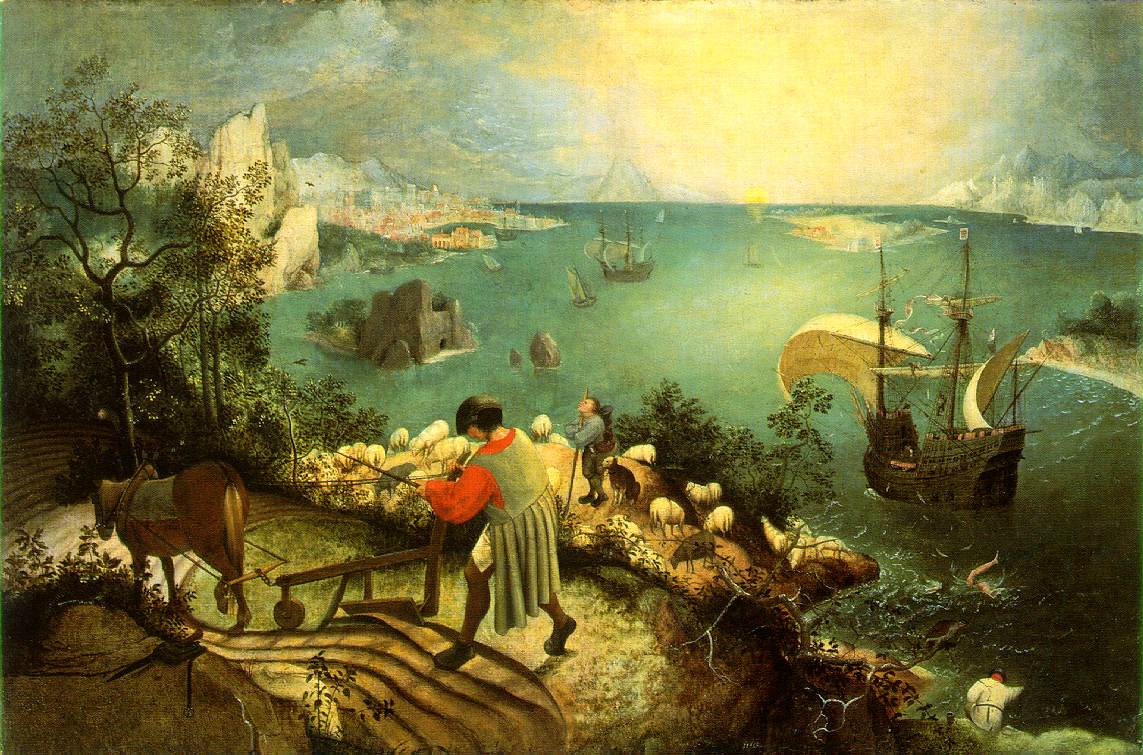
              In Brueghel’s Icarus, for instance: how everything turns away from

              Quite leisurely from the disaster …

              A boy falling out of the sky.

It is true; we all sail blissfully on; we plough our fields; we cull or vegetable, while Icarus falls unnoticed out of the sky. But, I wonder, if we were looking around more, might we not notice such things, and choose to go to the rescue, of  foreign legs disappearing into distant seas?

I’ll say it straight up. I think that it would be best if we were more in touch with people who are different than we are, and if we made more effort to understand their flights and their disasters.

I think we should replace blame with understanding and that we should substitute forgiveness for judgment. Life isn’t simply us and them, it’s more  just  — us.

You can shop where, you want – it’s a free country – and you can cull your fruit as you like, but this much is true: The fruit you select isn’t necessarily better than the battered pieces you reject.
“The conflict with the inspector  happened because she couldn’t read the social cues,” I said, “It’s part of her disability.”

“Oh, I totally get that,” she said, standing behind the food counter. “It’s just that other people don’t.”

“I know,” I replied, “and then it’s like they think she’s just making a choice to be difficult, but she’s not. It’s because of her brain damage.”

I could feel a bit of extra humidity in the corner of my eyes. I could see it in hers too. We looked straight at each other in a way people just don’t do across a public counter.  In this instant we bonded over our understanding of the pain resident in the complications of relationships compounded by disabilities. Our eyes seemed to reach out and touch.

I wonder lately, are there really any other kinds of human relationships, ones without disabilities complicating them? And do we often stop to look at the many shades of emotion resident in our failed attempts to communicate with each other?

A day earlier I sat a lunch in a restaurant on the other side of town.  

“Fear isn’t a disease,” he said. “It’s normal. Everybody has it.”

I sat there not eating, just looking at the astonishment on his face. It was fascinating, his knowing smile. It had taken 30 years  of brilliant psychiatrists getting it wrong for him to realize that inside  he knew the truth all along.

“Everybody is afraid,”  he said, ” not just the people who did drugs in high school”.

“Etiology is tricky,”  I thought to myself; the professionals made a muck of this. They blamed his fears on him.

I nodded to him, flashing back to a few of my own seasons of terrible anxiety. And I thought about how I keep running into this —  learning embedded in feeling. How being human is about some kind of rich affectivity realized and accepted.

I will always remember kicking my fins along the coral wall in Kauai,  excitedly pushing myself toward a large school of Achilles tangs. I still remember the joy of  their dark purple bodies, their bright orange tear drops and their blazing white highlights, the sudden and odd thrill of the unexpected combination of vibrant colors swimming together like some kind of underwater mobile home painted by a madman.

I think that emotions are like this. You turn a corner, kick a couple of times and there — a new school of them, unexpectedly colored, swimming with you. Then, as you approach, off they dart  together into the deep, you in mad pursuit of something amazing.

I like this. It reminds me of Charles Burchfield’s painting, “Oncomming Spring,” where the cold, white snow is melting into the ground and the trees are all ablur with  motion, everything moving in the storm, all of nature alive to the wind and the bright yellow warmth that will bring life to the dry, brown trunks.  I like how the windows open between the tree frames to blue skies. Life is found in such movements toward things not yet fully realized.

Older, I’m more aware of the storms within. Now I find it increasingly odd, how relational Achilles heels and all the emotions schooling with them are so much rejected in the public sphere — those places where we too much see the tight lips, the polyurethane expressions, the harsh judgments and the keratitis sicca.

I feel.

 I am.

 I am open to feel.

I grieve over the emotional damage that has been done by people who refuse to acknowledge the validity of feelings, those who have said to others, after causing extreme pain to them, “I’d advise you not to talk about how you feel. That’s not going to help here.”  Cause a reaction, and stifle the reactor?

I grieve over those who only say to their children, “Don’t be afraid.” Better it be sometimes said, “I too have been afraid. I know how you feel.”

I grieve over how those who have caused extreme emotional hurt to others have then turned and said, “I’m not hurt,” as if it is possible  to damage others and for that not to damage ourselves.

It’s storming. And I will be a Charles Burchfield and  go out and paint it. This is reality.  I see windows opening up upon our emotional realities.

This is reality, beautiful, heart wrenching emotional reality, to go out into the tossing ocean and swim with the purple and orange tangs again.

“Strike thee,” called out the umpire, jerking his hand up, and with that the star player for the San Diego Padres was out, done, over. The hope for runs was flew up into the lights like a mist — there and gone in the cool San Diego evening air.

The San Diego fans went totally loud with booing, yelling, grieving,  resisting. It was wild and western, and I was glad to be at the ball park to see the fun.

Andrian Gonzales turned to the ump, protested the call, got in his face, wouldn’t let it be. Buddy Black came to the plate. He joined Adrian against the ump.

The umpire threw Adrian out of the game. Then he threw Black out of the game.

The stadium went berserk; the crowd metamorphized into a huge, loud angry mass of protest. The ump was wrong. We were right. If he could have, the umpire probably would have thrown us out. We were also in his face to long. But play resumed shortly and we remained.

While the Padres were up, every ball got a cheer; every strike against one of the Padres got a boo. 

 The ump was right when he made calls for our team; he was wrong when he made a call against our team, even if it was right. It became semi-comical! The game took on a kind of silly, goofy feel, the ball and strike calls more the focus than the action of the players. It was like the game turned into a argument between the spectators and the umpire.

I kind of got into it. It was a new plot for the evening,  a baseball drama, and we, the crowd had now taken the field.  We had seen an injustice of a minor sort, and we were making our dissatisfaction known.

The game played out and ended. We had our say but it changed nothing. The umpire strolled off the field. I thought he looked a little lonely.

It was interesting, as I reflected on it later, how in the disagreement emotions seemed to have taken over the player, the manager, the umpire and the crowd.

Baseball, Chevrolet, apple pie and a rowel at the plate — it was about as American as you can get. We don’t see things the same here. We even love to disagree. And when we do, we do so as a stampeding herd with instinctive, stomping, running momentum. But the game ended, and we separated to our own homes to squabble with each other. 

The next time I went to a Padre game, we didn’t carry on where we left off. Were these different fan? Was this a different umpire? Who could tell, but what had been a big deal had been forgotten.

This all seems very familiar to me. I think I’ve seen this before, differences in perception, difference about “the call” that was made. I’ve seen this in my marriage, in my education, at my job, with my friends, in my church.

A few thoughts come to mind about the good old American past-time of not getting along. Despite the plays and calls that are made, the game goes on and so does the fun, except maybe for the umpires. But who knows, perhaps the umpire at my crazy game had fun too, not so much that night, but jawing about it later with his peers, reminiscing and saying, “I remember the night in San Diego when I thought …”  And the others nodding and laughing and throwing in, “You should have seen my night in ….” 

So what’s in this for us, say if we apply the whole event to life. Well, I think that people in power may tend to throw people under them out too easily when they disagree. It’s not so good. It can give the people watching an ulcer and rough up everyone’s psyches on a perfectly good evening.  On the other hand, I think we players should  try not to be so stupidly rude and stubborn when we disagree that we get thrown out. It’s boring to sit out a perfectly good game in the locker room.

And finally, if we look around with any degree of objectivity, we are likely to observe that our own emotional reactions of disagreement, and those of others, at the ball park or in the bedroom , are apt to be surprisingly comic, even sometimes ridiculous.

In conflict, I think we may need to do what doesn’t always come easy but would make things easier, that is to keep having fun and to keep laughing, especially at ourselves

Grumpify or Gentlize?

Posted: May 21, 2010 in people
Tags: , ,

In college I majored in literature. I love Shakespeare! The verbal density; it is rocket fuel for me. I taught literature at the high school and college levels before switching to people farming,  my current passion. My daughter is now a lit student at the university. I love it.

I’ve traveled to England, spent time in London. This year my daughter will  spend a semester in London studying literature. Cool!

Like produces like.

It’s beautiful; it’s normal; it’s good. It can be a problem.

How?

It’s the problem that occurs if or when we get after people to be like us. It’s fine for people to make a choice to choose to be like another person. It’s not fine when people make a choice to force someone else to be like them.

The problem comes in the form of the criticism, the evaluation, the judgment that expects, that demands, that requires sameness, conformity.

Is this common? You betcha! I hear old people whining about how things aren’t right, how they aren’t the way they used to be. I hear young people who are very ramped up about what they like, and don’t like. They are strong, on the attack, very confident that some things “rock” and some not.

Fine to have preferences, not fine to impose them. “Oh, we don’t do that,” everybody pretty much claims. “It’s not good to force things, right?” 

And yet we do.

Politics, religion, education, business, parenting — so many areas of life take up the sword and hack, hack, hack at people to change, to conform, to measure up.

You hear it, “You can’t trust politians.” Really? All of them? None of them are trying to help us?

If you are a good Christian, then you will … blah, blah, blah. Someone told me recently that all Christians should vote according to a slate a Christian organiztion has published.  Wow! Really? I think God expects each of us to take responsibitity to judge for ourselves what is right or wrong.

Teachers are now, according to some, doing too much teaching to the tests. All teachers? 

The people who lost their homes in the recession were too greedy and unwise and the took bad loans. Wack, wack wack!

Parents are too busy these days to raise their kids.  Smack, smack, smack.

Grumpiness, criticalness, opinions, “my understanding”  often becomes a club. We pound the crap out of people with our thinking, while claiming to merely be making a statement and clarifying our opinion.

Two options present themselves as a person matures: gentlize or grumpify, become gracious and understanding or overgeneralize and become as narrow and mean and dangerous as a switch blade knife.

Like produces like is at its best when it is inspired, at it’s worst when it is whalloped and hacked into another person’s softly developing personality.

Unwise ones get hard. Wise ones mellow and soften as they bump  along through life.

Wise ones? They inspire  the “like” not require it.


It could be argued that sometimes we aren’t accountable enough to ourselves.

Students not doing their homework, moms not  taking care of their own needs, employees not doing their assignments, many of us not living out our vision for our  lives  – it’s common.

Recently, someone told me they would do something. They didn’t do it. Asked about it, they didn’t think it was a big deal. But it was important, from two angles. We missed a good opportunity to involve people we needed to involve, and they missed the responsibility to have integrity, to do what they said they would do.

 I said something to this person later, pointing out the missed opportunity. Oddly, they weren’t at all upset by their own omission. A casual, relaxed atmosphere of excuses and minimization reigned. I said what I thought anyway, “It isn’t loving or responsible to not do what you said you would.” As a result, they completed the task and followed through nicely on something else they had agreed to do.

Nothing new here. We’ve all seen this before.  I’ve worked with people who didn’t do their job well for years. It created a mess of missed opportunities and misunderstandings. 

Why don’t people own their work? It’s complicated. Each case might have a unique root cause — insecurity, weakness of character, laziness, sabotaging inclinations due to jealousy, cultural expectations, disabling neediness, perhaps a history of not being well-parented, incompetency. Often the roots of irresponsibility rest in fear. Fear is huge, the fear of making mistakes, the fear of negative feedback, the fear that we can’t be what the job expects us to be or has changed to be.  Fear creates inertia; fear disables.

But a responsible independence that  owns our issues is such a good alternative, so empowering. Recently, I spoke with someone who has failed his family. He admitted that he has made mistakes, that he has engaged in harmfully addictive behaviors, that he hasn’t valued his wife’s feelings, that he has caused a lot of pain. It was refreshing, and as a result of his honesty, he is now changing his behaviors.

An internal mode of self-assessment and self-correction is a mark of high maturity, but it doesn’t seem to be in the defining mode of many modern adults. Too often we operate with a culture of casual excuse; we don’t do what we say we are going to do and that seems to be okay.

It’s not. It’s not loving or mature or professional to be irresponsible.  

I have a friend in the military. He says irresponsibility has become a huge problem in his branch of the service. Many people don’t do their  jobs with high quality, and they won’t own their mistakes and fix the damage done by them. When things go wrong there is often a lot of excusing and blaming others and avoiding  responsibility. Someone he worked with spent money from someone else’s account. Once caught, the person excused the behavior and didn’t pay back what was taken.

But the alternatives to self-accountability aren’t attractive. They are punishment and being brought to task.  But standing over people to make them do their jobs, micromanaging each step they take, punishing them for not coming through, babysitting them on the job – when we reach this level of dependent functioning, something needs to dramatically change. We have a core motivational problem.

At this point, leadership must reassess their approach and find positive, proactive, not negative, ways to help people become independently responsible.  Motivation to work is best inspired, as well as required. Therapy, re-educating, creating win-win solutions, retraining, creating collaborative networks, helping people get excited about using their unique skills – this is the responsibility of a leadership facing inertia and incompetency and resistance. 

But the best solution to irresponsibility is when we each become accountable to ourselves. It is when we grow up and become independent in healthy ways. We can vastly improve our little corner of life by being self-accountable. This is maturity, to come to the point where we self-assess and self-correct when needed.

Here are some things that it would be so wise and loving to people around us to take responsibility for. To be operative they must become personal, our “I” statements of responsibility:

I am responsible to do what I say I am going to do.

I am responsible not to harm others. If I do, I am responsible to fix that the best I can.

I am responsible to do what I am assigned in my job to do, to do it efficiently, creatively and with a high degree of quality.

I am responsible to love the people I work with, live with and make a family with.

 I am responsible to identify my physical, spiritual and emotional needs and to figure out how to meet these in healthy ways that don’t harm me or others.

I am responsible to speak up when something is unfair or unjust and do what I can to change it.

I am responsible for all my actions, thoughts and feelings and the consequences that flow from them.

I am responsible for my spiritual health, to hear and know and act on what is true, good and right.

I am accountable to my own values and standards. If I say I believe something, then I should act on it.

I am responsible to know and defend my boundaries. I am responsible for what I let other people do to me.

I am responsible find solutions to my own problems or live wisely with the problems I can’t solve.

I am responsible to set my goals and priorities and then to move toward them the best I can.

There are more. I’m sure we can all think of more. All we have to do is remember when we failed someone or they failed us to add to this list. We should think about these things. Then we should get busy living them.

On a recent evening I asked one of my daughters if she had done something that she had agreed to do. She had. Peace reigned between us. Self-accountability, independent responsibilty – these are very good for relationships.

Main-Thing Talk

Posted: February 16, 2010 in people
Tags: , , ,

We talk about everything but the main thing.

Not talking directly and openly about the main thing is like not eating enough protein. It is like not getting enough sleep.

What is the main thing? Well, if I say it you might disagree and there we go, not talking main-thing stuff again.

Recently, I talked with my daughter about sex. Now there is a main thing. Ads talk about it a lot and radio songs gush about it all over the place, and so she should know all about it, right? Not really. She’s been saturated with ads and songs and singing ads all her life, but it hasn’t gotten it, and she still didn’t know some very simple and of-the-first-order things about sex. Why? We just don’t talk about it; we let our fear of awkwardness keep us from becoming not awkward with life. So my college-aged daughter and I got down to some honest, simple, raw questions and answers. I know what she doesn’t know, and I’m the safest person in the world to let her know. Dang!

It is so easy to be honest if we just get started and so refreshing too. It’s like leaving a crowded restaurant where there is a constant din of undecipherable noise and moving to a park bench under a quiet tree and sitting close and hearing every nuance of meaning and expression in each other’s voices.

I had a conversation with some one recently about God. Who hasn’t heard of God? But there is a constant din of puzzlement about him too, and silence here too. It’s too weird. People say they can’t talk with certain people about politics or religion. So they don’t. Fine. Who need arguments? But really now? God is arguably a main thing. And he is so main he is integrated with everything else that we talk about or don’t talk about, like sex and violence and pets and movies and the weather. And not bringing him up is bizarre. He is the ultimate elephant in the room. Why wouldn’t we in our role as parent and friend and lover and consumer speak directly and personally about God.

We know stuff and kids have questions and friends have concerns. It is long past time to break the silence and say what we think to each other!  Come on now. We are letting moments pass when we should be jumping on the opportunities to teach and learn and lean while we teach as we just get honest and real and verbal.

The main thing is always the thing below the surface of the thing we have chosen to talk about. To get down to it, we need only look further to the larger structure: what is the branch that is holding this leaf, the trunk that is holding this branch, the root that is holding the trunk, the earth that is  holding this root, the solar system that is holding this earth, the universe that is holding this solar system, the force that is holding this universe? Questions get us deeper, closer to the main things that are so interesting and refreshing and empowering to talk about.

Main stuff needs attention. This is ridiculous. We are shutting up way too much. We are acting like we don’t know about what we do know about. Just go there. Fearlessly dive to the next level.  Admit what you don’t know; say what you do know. Say it plainly, honestly and directly.  People who you love need you to say it, now.

gracious

Posted: November 19, 2009 in people
Tags: , , ,

You can choose to be critical or gracious.  You can sing one of two songs: a sad,  negative ballad or a happy, positive tune. It is hate or love, looking down on people or looking across at people, living by the rules or living in freedom.

In the recession, many people without jobs or adequate funds are afraid, sad, negative and hopeless. I totally understand and sympathize. I lost my job during 2008.  I know.  I now have a new job, but I get it. It’s scary. But how we respond to the recession is a choice. I met some people this week in difficult circumstances who are hopeful, positive, forward leaning — even more generous. 

Yesterday,  I spoke to a woman who is under resourced. She recently found a way to make $200 extra dollars by involving her children in a friend’s business, helping with advertizing. Her eyes gleamed with excitement as she spoke of her children’s success. She was focused on them, on what they were learning, not herself.

Sometime we may not even be aware that we are making a choice. We are. We aren’t destined or fated or predetermined to be afraid, rule-dominated or cranky. Loss and hurt and bad luck don’t destine a particular outlook.   We can choose to see hardship as fuel to propel us into the next good thing.

I forgot to give someone back the keys I borrowed from them yesterday. Her response: “It’s okay. I’ll borrow my husbands.” Gracious! No key rule imposed on me.

The world is populated with mistakes. And there is a rule against every one of them.  Rules say what people can and can’t do, should and shouldn’t do. They have value in creating order. “Give back what you borrow” is a good rule. But “It’s okay when you forget,” is a crucial rule for lasting relationships.

Order isn’t primarily a function of imposed rules  but instead a function of the desire for progress, improvement and freedom. An orderly way of relating best stems from  a  positive, intrinsic, internal drive. When we love,  we bring about an order that is beyond and better than imposed rules.

Take for example  how women have been defined in our culture. Women, like men,  have been defined by by gender rules. These rules don’t always operate, but they do so often enough that they are powerful behavior shapers. Women should be thin. Women should be nice. Women shouldn’t be paid as much for the same job as men. Women shouldn’t intimidate men by being more competent. Women shouldn’t do certain jobs or play certain roles.

Recently a friend told me. “I was told by some male leaders who were not very open to female leadership that I wasn’t a leader.” She is now leading a highly organized and well-funded non-profit effort to feed people during the recession. So much for that judgment. It wasn’t based on reality or openness. At the heart of the matter, it wasn’t gracious, open to possibility, to freedom.

Limit or empower. Shut-down or open up. Live under the rules or beyond the rules. Be critical or be gracious. It’s  my choice — today.