Archive for the ‘people’ Category

Everybody begs.

But not everybody is good at it.

The cats beg in the kitchen for food; children beg in the store for candy, husbands beg for favors, wives beg to be listened to. Singles beg God for good mates — or wisely thank God that they don’t have them — less begging.

And people beg for money.  A lot these days.

The other day a man came to me begging for some cash I told him, “No, I’m not going to give you any.” He left, mad.

A younger person looking on asked me why I didn’t give him anything. She said to me, “He said that his wife is pregnant and stranded on the freeway with no gas.’

“I don’t believe it,” I said. “He lied.”

“How can you tell?”she asked.

“When he began by telling me that at one time he was in the NFL I got a clue. When he rolled out the ‘pregant wife stranded on the freeway’  my suspicions geared up, but when he pretty much demanded I help him, then I figured thatI was up against a seasoned manipulator, who really wasn’t that good at begging.”

What if I was wrong?

Then maybe I’ll burn in hell for not helping him — or maybe not. I’m much not afraid because of what I know about God.  God is a God of mercy, and of truth, and He’s not that much into begging.

Well, you might ask: What about the parable of the  persistent widow? Wasn’t she rewarded for persistent begging.

Yes, but what about the man Jesus told to take up his mat and walk? He had to do something himself, for himself, before God helped him. And in the Old Testament, the Jewish people certainly didn’t gain much from begging. The were exiled when they proved to be unfaithful to God.

I do believe that God is into answering requests — and responsibility.

The other day a woman came to my office with one eye socket empty. That was interesting. She looked me full in the face and asked for money. I didn’t giver her any.

I have to confess that it crossed my mind that she had her glass eye in her backpack, and that she took it out just before she came into see me. Maybe I was wrong. Maybe I’ve read too much Flannery O’Connor, but I couldn’t help but feel that I was being manipulated.

In the current Presidential election this very  issue is at stake. Do we give people stuff, or do we expect them to step up and take care of themselves?

I know the right answer.

Both.

I felt good the other day when my wife again mailed off our monthly check to pay the fees of four children attending schoool in Tijuana. I like myself when I put other people’s kids through a school they otherwise could not afford. This is a good thing to do.

Foster children, the aged, the oppressed, the abused, the sick — we have lost all heart, all touch with reality and all Christian compassion if we think that everybody can and must take care themselves. They can’t. We must.

But, despite that, next week I’ll probably tell some person who comes to my office begging, “No.”  I do not believe that generosity makes a good partnersship with  stupidity, and I think that the good cease being good when they begin to take their marching orders from liars snd manipulators.

I’ll say “no’ and be okay with that if it seems to me that the missing glass eyeball is in the sack that they brought into the office with them.

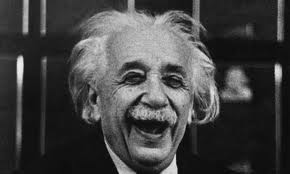
Albert Einstein is of course well-known for his theory of relativity, and E = mc and other cool phy sics stuff. Max Born,  giant of 20th century physics, called his theory of relativity “the greatest feat of human thinking about nature.” But there is a lot more than that to Albert.

Einstein published hundreds of books and articles on all kinds of topics. He thought widely. But perhaps the books, the theories, and the smart reputation as a genius, all the intellectually fancy stuff, has kept us from the man.

Einstein, the man, is worth knowing. He was not just smart; he was fun. He was not just brilliant; Albert was very human. In fact at the very time that he was publishing his theory of relativity, he was in conflict with his estranged wife and wrestling to find a meaningful way to relate to his children. But for all his serious family problems and serious scientific theories he was not just serious, he was droll and naughty in a schoolboy kind of way.

He wrote: “Common sense is the collection of prejudices acquired by age eighteen.”  

I like it!  I’m still trying to recover from common sense,  to finally think at least something uncommon.

Einstein also iconclastically quipped, “Education is what remains after one has forgotten what one has learned in school.”

Touche, even if it wasn’t entirely true! Curiosity and imagination and research lead him far beyond the classroom.

He said that “The only source of knowledge is experience,” and he practiced that, except of course for all the math and physics he learned in the classroom! He never lost his “holy curiousity.”

It’s the bit of rogue in him that I like, the maverick, the unconventional thinker, his,”Imagination is more important than knowledge.”

He advised against reading too much. “Any man who reads too much and uses his own brain too little falls into lazy habits of thinking.” I like it; I read too much, and if I can take Albert’s wry advice, there may be hope for me yet.

Einstein came at God this way, sideways, obliquely, interestingly. He said, “Coincidence is God’s way of remaining anonymous.” He also said, “I am a deeply religious non believer.” His “God doesn’t play dice with the world” has been widely repeated and widely misunderstood.

There is also the down to earth, kind of pure, in-the-moment Einstein. “I never think of the future. It comes soon enough.” It did for him — relatively.

And there is the Einstein who saw all the evils that could come from stupid national loyalties and from war.  I like his passion for peace, his love of our race, his desire to protect, his anger. He roared,  “Nationalism is an infantile disease. It is the measles of mankind.

He also said, “Heroism on command, senseless violence, and all the loathsome nonsense that goes by the name of patriotism – how passionately I hate them!”

Albert was a complicated man, with some complicated family relationships and some complicated math in his head,  and yet he wrote,”Make everything as simple as possible, but not simpler,” and “If you can’t explain it simply, you don’t understand it well enough.”

Before World War II, Einstein was so well-known in America that he it was said that he would be stopped on the street by people wanting him to explain “that theory.” He finally figured out a way to handle the question. He told the people who stopped him, “Pardon me, sorry! Always I am mistaken for Professor Einstein.”

He was practicing his belief: “Creativity is intelligence having fun.”  The wild man with the wild hair and the wild brain — it would have been fun to trade a few quips with him.

Blocks In The Jungle

Posted: June 15, 2012 in beautiful, people

I woke up with the jungle birds singing like crazy to the rising sun.

I awkwardly descended the ladder on my bed and went outside. The air was cool and moist and earthy on my cheeks and shoulders.

It had rained hard in the night.

In front of me was a pile of light grey blocks. The jungle had its light green arms around them.

The blocks sat organized in both their vertical and horizontal obediences. Yesterday we order 200 of them off the ground. Now they sit on each other as part of the rising school.

Last evening, Past Vital and I stood and admired them. “It’s good,” he said. “It’s very good,” I thought. I looked ahead. I could hear the voices of los ninos, the ones yet to come, the children in Rama who don’t have a good place to learn.

It is all in Pastor Vital”s head, a school,a church, a clinic.

He has already done this kind of thing in Kukra Hill and Bluefields.

“How many more do you have in mind?” I ask him.

“Fifty” he says and we both laugh. It can’t be fifty, but it won’t be three.

He has it in mind to fill up spaces around him. . He will not be put off. The rough concrete blocks mind him. Yesterday I saw it. Today I will see it again. They mind his vision.

I like it, this big dream, to push back a jungle and line up some blocks, to push back more ignorance and poverty and sadness and bring order and love.

Yesterday some of the boys in the neighborhood came and helped us. Two of them stuck a stick through two concrete blocks and carried them around to the back of the building.

They are the future builders of this community.

Yesterday about fifty children showed up for our team’s presentation of Noah’s ark. When we broke out the parachute one of the littlest girls cried. The big billowing
red and yellow and blue sheet overcame her.

Someone carried her to the side and looked for her mother. No mother came forward. Then a slightly older girl came rushing to her to hold and comfort her.

This is what the blocks will do. The blocks will make a place where one will rise up and become a leader or a pastor or a teacher and care for another.

Visions work. The blocks in the jungle will work.

Life is hard here in Nicaragua.

But we have been able to be a small part of making it better.

20120615-160959.jpg

We need protection — from voices.

Two potentially harmful voices come to mind.

The first one is our own.

When I finished my first year of professional teaching, I said to myself, “I hate this! I feel like a failure. I want to quit.” My own voice didn’t  offer good guidance. Fortunately my father, in a phone conversation about this,  said to me,  “Now you know how your students feel. Many of them  feel like failures. Now you know.”

That was a good voice, and I went on from there, following the leading of that voice to teach, until now, and I like it. When I finally do quit teaching, I think I’d like keep teaching,  part-time  —  for fun!

My own voice was suspect. This is hardly rare. Most of us have experienced bad feedback,  from ourselves, concerning ourselves.

Beware your own whining and sulking and quitting-talk.

The second kind of voice to avoid is the voice of the unwise family member or friend.  Family members — they don’t always get us right. Over time they tend to stereotype us.  “Well she always has been a bit edgy, or sad or dominant or shy,” or whatever they come to label us. Others in the family, may concur, and the label may stick, when it shouldn’t.

Friends are often also unwise voices in our lives. In giving feedback, friends tend to simply project their own reactive, unresolved feelings onto our situations. We need to face this; most people aren’t great counselors.  If they hate men, they hate our man. If they hate women, they hate our women. If they don’t resolve their own conflicts well, they won’t resolve ours well either.

What to do?

Pick mentors carefully.

Find people who have life experience, good and bad, people who have been able to resolve conflicts, who have learned something about healthy boundaries, who have had some long-lasting relationships, who have raised some kids (and the kids still love them), who have been successful in their careers but who have also gone through some career-hell and come out still feeling like life is some kind of heaven, who know something about God, something along the lines that God loves us and will never, ever stop loving us.

There are many voices. The world is full of talk. The deal is to learn which voices are safe and which ones aren’t, which voices to tune out, and which ones to listen to when we are losing our way a bit.

This is one of those things to figure out, to get right, to get a handle on, to give some time to.

The right voice, the right answer, the wise counsel — it’s beautiful!

It’s protection.

“I think you think that you can’t  hurt me when you say stuff. But when you say stuff it does hurt me. I know in the past I acted all tough and hard-headed but I’m not like that now.”

He sat on the couch in front of her and put his fist on his chest and coughed.

“I don’t know,” she said. “You used to say that nothing could hurt you, and I guess I thought that was true.”

“Well, it’s not anymore,” he replied. “You see how I’ve been lately, all emotional with the kids and with you. I see that what I’ve done has hurt a lot of other people and I’m sorry about that and I’ve been apologizing for that.”

I turned to her and asked, “Can you see that he’s been different lately?”

“I can,” she replied. “It’s like he is becoming more human.”

It’s interesting, the degrees of things, the way things change.  We are all becoming, everyday, perhaps more or less human.

What does that mean? I’m not entirely sure, except to say that part of it can be explained by the progress or regress we make emotionally. To be human is to feel —  pain, love, depression, happiness, guilt, tranquility.

To petrify emotionally is to lose our humanity. To turn to stone regarding other human’s feelings is to lose the human quality of our relationships. To grow numb, to fail to understand or care when our behaviors bring pain to others — this all is part of a process whereby we grow inhuman and inhumane.

This matters.

We must not lose the affective domain or we lose our humanity.

To be human is to be emotionally rich. To break, to soar, to break down, to take courage, to pick ourselves up and explain to someone else how we really feel — this is what it means to be an integrated person, a complete personality, a fully human being.

As long as we can be hurt then we  retain the ability to understand someone elses’ hurt.

To the extent that we can accept and honor our own emotions, then we will be able to accept and honor other people’s emotions.

Feelings feel feelings.

Feel.

Be human.

Thrive.

“We bought a sheep for grandma!” my wife Linda told our daughter Laurel.

Of course she told her. We wanted little, preschool  Laurel in the charitable-gift-giving loop.

Grandma and grandpa had requested that we not buy them any individual presents for Christmas, but that we buy a sheep for someone in Africa or somewhere and give it in their name. The process wasn’t quite clear to Laurel. It wasn’t really for us either.

So Laurel looked up at her mom and asked, “Could we keep it at our house for a few days before we send it to grandma and grandpa?”

It begs the question, “How hands on is our charity?”

Sometimes not very, particularly when it’s just a check in the mail to an organization that handles the sheep.  But, like Laurel, many of us want it and like it hands on. We want our charity soft, wooly, “baaing,” huggable and kissable.

On Sunday Will and Judd were at church. I hugged them both, their scruffy, unwashed beards against my cheek. It was sheep,  up close — their stale alcohol breath, dirty clothes and vacant eyes right there, very near and personal. I prayed for each one, leaning in towards them, putting one of my hands on the back of their heads.

After praying for Judd, I looked into his glazed eyes and said, “I am asking you to make the choice, to stop drinking, because it is killing you.”

He looked me steadily in the eyes and said nothing. His brain wasn’t working, or was, just a little, but processing extremely slowly.

He knows I love him.

This is better for me than the check in the mail, even thought the check in the mail is good and sent sheep, good.

I’m wondering, how hands on is my love for my own flesh and blood. How near am I willing to get, because it’s interesting, getting close to the sheep.

The closer I get, the weaker I feel. When you get right next to mental illness, to addiction and to extreme social dysfunction, its makes you feel small and inadequate. Often, you aren’t sure of how to bring lasting, meaningful solutions.

But despite that, it’s so right and good and meaningful to be there, smack up against the stale,  broken, dying essence of of charity. I’m learning things there. I can’t make choices for other people.  I won’t be successful in helping if I try to do too much for them. They have to choose, they have to want change, they have to fight, hard, for their own lives.

But, I and we can do something. We can open up opportunities, we can present clear choices, we can resource possibilities and we  can pray for the sheep  and we can love them and stand with them even when they choose to not choose to change anything.

And some of us can even bring some sheep  home, if we want, for a bit, and give a wooly hug.

Last night I dreamed.

I was fishing in  a small but deep place, the water was dark, green and beautiful.

I fished alone with an old pole that I knew well.

I put on a small lure, plain and simple.

I ran the lure deep and in the first pass took a heavy fish.

The fish ran hard under the water, pulling my pole down, then it broke the surface with a splash.

I waited for another run, the thrill of the fight, but the fish had surrendered, and I pulled it in to the bank.

It lay in front of me,  beautiful and quiet. Very gently I removed the hook from its soft, red mouth.

I looked down and admired it. It was dark green with a pattern of vertical black stripes, long, healthy, fresh and lovely.

Then the fish looked up at me and said, “We are here.”

And I threw my line back into the pool.

I’ve always been a dreamer.

When I was little I had nightmares of huge bowling ball rolling in narrow halls toward me.

When I was in college I dreamed of clocks whose hands spun quickly and of the resurrection.

Once, during a time of difficulty, I dreamed of a large Magnolia tree. A huge slab of rock had fallen into the top of it, crushing it’s branches, but around the rock grew a limb, full of dark green leaves and huge white flowers.

I receive my dreams as they are, and wait. I am a rationalist; I test everything, and yet in me there is also the mystic. I know that I don’t understand everything. We will see, and yes, we will see and then see and see again, and time will tell us what we will see.

I sit quietly this morning, and I take hope from my good dreams, and  I keep fishing.

I fish for men, women and children, trolling deep, throwing back in, hopeful of catching more beautiful ones.

Thoughts occur.

Come fishing with me.

the good coins

Posted: June 27, 2011 in people

Jessica stood in a the front of her church in San Juan, Puerto Rico reading the story of the woman who gave one coin. I listened intently, but could only understand the Spanish here and there. No matter, Jessica was the story anyway,  her eyes so beautiful softened by her worship-grief. Every few minutes she  wiped them with a folded tissue that gradually took on more and more salt water, but then she went on.

Her grandma had died that morning. Nothing Jessica or anyone else said was more eloquent than Jessica’s presence. She was her coin, all she was, given gladly.

This week I read on Google news that Peter Faulk had died. It happened on  June 26, 2011.

Columbo will be missed. Faulk as this character was endearing , especially in a fumbling, disheveled, thumping about kind of way. And he got the bad guys.

“This is, perhaps, the most thoroughgoing satisfaction ‘Columbo’ offers us,” Jeff Greenfield wrote in The New York Times in 1973: “the assurance that those who dwell in marble and satin, those whose clothes, food, cars and mates are the very best, do not deserve it.

Bingo.

But who deserves anything. Yeah, probably none of us. But perhaps Jessica.

It’s interesting what intrigues — Jessica and Peter. It’s the personalities that matter, that we remember, that are the gift.

On Friday I visited the Camuy Rio caves.  Nice — a 17 story underground room, its door ways draped in jungle. But as is par for life’s course, it wasn’t the cave that was the big deal; it was Val and her mom, the friends I made on the tour. Riding there,  we chatted it up, and we ciphered it down and it looked to me like Val, a junior in high school is another Columbo and another Jessica.

She is wicked smart and godly beautiful, in love with science and ramped up to help children. Couldn’t get better, the potential, the unfolding narrative, the super righteous possibilities within the existential, ontological, epistemic essence of Val. I told her I thought she should definitely  get  a graduated degree in the sciences and keep being godly.  I bet she will, and that she’ll give the old woman’s mite too.

And then there was Saturday night in San Juan, with the gang, tossing down Mahi Mahi and yakking it up and then getting down to business discussing charity. Lisa, who I had just met through my brother Steve, was spot on. She lectured, and we leaned forward. Lisa talked about the money from her organization, just sitting, waiting, for Haiti, but how the Haitians hadn’t come up with a plan as to how they would use it, how they would do something sustainable.

Wow and wow. She said that one group bought solar panels for a school, I think, and they were stolen that night. They bought them again, and bam, gone again. They quit. The conclusion, you aren’t helping people who won’t own the help.

I loved it! Lisa was a hoot, of information and experience incarnate concerning the NGO and non-profit Christian charity business.

Again, like Val, Lisa was the coin.

What to do? Life is good, and not, and helping is good, and not, and when all is said and done, it seems more and more obvious to me what to do.

Jessica, Peter, Val and Lisa — love those coins.

They kinda deserve it.

sex

Posted: April 5, 2011 in people
Tags: , , , ,

Two weeks before he was to be married,  the student chaplain at the university where my daughter goes to school  told the girl he was about to marry that he was gay.

And so, ended, the dream, they had together; they dropped  the wedding plans, the marriage and then shortly afterwards, the young man resigned from his leadership role at the school. He graduates from college this spring — in pain. And he’s not the only one.

My wife and I, talking over coffee this morning, wondered, about the conversations, behind the scenes, between the couple, with the parents,with friends and with the school leaders —  painful, excruciating, gut wrenching. The words said to this young man will be remembered by him, for life. And some of the words will have to be recovered from.

Sexual identity is no small issues; our reactions to it are so powerful and so life changing. I really suffer for this young man, and his fiancée and their parents and friends and the school’s students and leaders. This is hard, and I can see that the pain of it has not be adequately acknowledged by the school, by those involed and  by the students. But it is there, and it will not just go away. There will be a painful, ongoing conversation, and it will last much longer than some people  want it to.

I know pain.  So do so many people. A girl told me a while back that she was being pressured by an older guy to have sex with him, even though he is married. This isn’t new for her. Sex has been a huge factor in shaping the last ten years of her life.  She’s pained by it and marked by it. What to do? I have told her again and again, “God loves you.”  He does.

As my wife and I talked this morning, on the TV news, operating background to our dialogue, their was a blub about college guys voting on girls, “hot or not.” My wife remarked, “So, is that considered fun or  is it harassment?” The conversation about that and all things sexual  is being had, at the most public level, but much of it will be a report and a few people’s opinions not the much needed exposé of the pain, within the story. The news doesn’t often deal with the pain of men and women who are or who feel or who are made to feel unattactive. Not many people publically talk about the massive, universal insecurity young people have over “how I look,” or with the brutal question some young people pose to themselves, “Am I hot enough to be loved?”  That is not even a healthy question, but it is out there, and we all know it, but we won’t often hear it put that straight.

Too often, when it comes to sexual issues, we don’t have the conversation that is within the conversation, that really matters. Christians, for instance, are known to talk a lot about sexual morality, and of course, morality is very real, and good, and Biblical morality is from God and very important,  but the converstation about what is right must be combined with talk about what has already gone wrong.  Young people need to be able to talk to older people about what is currently happening. They need to talk about  birth control, about STD’s, about sex and marriage and about homosexuality. They are talking about these things with their friends in their dorm rooms but not as much with their parents or grandparents. Why? Sometimes the older people simply will not have this conversation. They may not even know how. But young people still need to talk, to someone who is open and wise and  who has lived for a while and failed and learned to be gentle and forgiving.

The conversation  about sex must include the forgiveness and grace that need to follow failure. We need to talk about how our society and the church and schools have responsed to sexual issues in the past and whether those ways of responding are ways we want to keep using.  There has been a lot of judgment in the past that ignores our universal failure in this area. When it comes to issues of sexual morality, we all fail, actually quite similarly, and that is precisely what is too often ignored. The things to talk about are “our” sexual issues, not “their” sexual issues and we all we need to confess more and pronounce less.

Why confess about this more? Because others  are confessing, openly.  The confessional conversation is  already  going on, in public, in private, in everywhere. Proof? Just go to the movies.

Two nights ago my wife and daughters and I went to see the movie “Lincoln Lawyer.”  It’s a fairly fun movie. Matthew McConaughey actually gets a chance to act, and he does pretty well, at being cool, and fun. In the story, sex is for sale, and  murder after. It’s interesting, what entertains us. Are sex and murder entertaining? Of course they are.  Why? Because sex and violence have a powerful grip on all of us.

Sex is in the conversation that people are having, and if we want to be part of the conversation we must openly talk about sex. And if we don’t talk about sex, well, then we don’t, but that won’t stop everyone else from talking and interpreting it in ways that may not be honest or real. Sex is on the docket, and won’t be taken off, and if we don’t say anything,  we’ll be left out, without weighing in on one of life’s most significant issues.

Weigh in. I will.  Intepret or it will be interpreted for you. Sex is good, normal, fun, exciting, healing, and don’t plan on it stopping anytime  soon. And sexual issues can also be terribly and profoundly painful, because sex is not just a physical act, but a deeply ontological, psychological, social and spiritual part of all of us. It is wonderful and makes a wonderful life, and not.

A friend  sent me a text yesterday, “It’s a boy!”

“Cool!” I texted back, “Congrats!” This will be this young couples’ first baby. Lots of fun ahead for them.

A bit later, my daughter just texted me from her dorm room. “A girl on my hall just told us she’s engaged. Sorry I didn’t get back to you after you texted me, but I was yelling with everybody.”

“Whoohoo!” I texted back. “I guess.”

Of course its “whoohoo!” and I’m sure it will be fine, I guess, but I don’t know.  But it  will have a chance, I think, of being more fine if this young couple has people to talk to before they marry about sex and career and babies and fidelity and about times  coming when life won’t be “Whohoo!”

A happy marriage and happy babies after the wedding is absolutely fantastic, but it isn’t what some people end up as a result of romance, and love and sex. For many, the  relational and sexual stuff, as life goes along,  gets just plain excruciating —  a woman I know who was sexually abused as a child and then cheated on in her marriage as an adult, the  young man at the university who came out as gay, his fiancée, several of my conflicted gay friends, a woman I know who regrets not getting the degrees she always wanted to have before she had  babies. I love them, but they hurt, over choices they have made or others have made, and I know this because they tell me.

This morning my wife and I talked about a couple of people we know who are gay. One of them is in so much obvious pain that I worry about him. His sister just had a baby, made the family proud. He didn’t. I suffer for him. He needs to talk to someone, who is safe, and can understand. If he doesn’t find places to be heard, and understood, then he will really, really suffer, like he is right now. I know that God loves him and wants to enter into this struggle with him, but is this young man hearing this, enough, and does he understand this? I don’t know.

Here is the deal. I’m not shutting up about this, and I don’t think the rest of us should either.

We need to talk. And it needs to be talk that is first of all without judgment regarding people who are outside the norm and people who have made mistakes, and people who are in pain. And we need to talk more to young people who have questions and have never had honest answers from parents or leaders who have the wisdom that comes from experience and thought and morality and God and love.

In my house sex is a common topic. We laugh about it, make jokes about it, answer serious questions about it, have moral standards that we discuss, and yet we are open about our weaknesses and failures to be all we want to be.   We treat sex as a normal part of life, and we take it very seriously when there is ambiguity, uncertainty, mystery,  pain, beauty or love surrounding it. And there is, all this and so much more hovering at the edges of our sexuality.

Sex is a complex issue, and it needs some complex thinking and a complex dialogue. The people with the easy answers are fooling themselves and so they will be fooled, as life unfolds. The main thing is to  be open with ourselves and others and to get to know both ourselves and other people,  especially people who are different from us, and who have had different experiences, and to hear them, and feel with them and understand them and their pain so that we can better understand ourselves and our pain.

We need to have a conversation about sex, that doesn’t stop, with sex, but extends on into morality and God and pain and grace and unconditional love too.

Let’s keep talking.

For more of my thoughts on this, you are invited to visit www.modernproverbs.net  Click on the topic button, “Sex.”

the same

Posted: February 16, 2011 in people
Tags: , , ,

I once sat in a small group in San Diego and listened to Henri Nouwen speak about how we are  different and the same. He said that too often we define ourselves by how we are different from each other. Nouwen noted that we modern Americans  are into being unique, but that this is not actually where the joy of life is  found.  Then he had one of his friends, who was disabled, speak to us. They were the same, he and Nouwen; both deeply needed to be loved and accepted.

Nouwen writes, “True joy is hidden where we are the same as other people: fragile and mortal. It is the joy of belonging to the human race. It is the joy of being with others as a friend, a companion, a fellow traveler.”

The famous professor, writer, priest — a fellow traveler with us all. I like it, but I struggle to live it. Many of us do.  There are so many angles by which we are tempted to declare our differences: republican or democrat, conservative or liberal, orthodox or free thinking, gay or straight, poor or rich, educated or blue collar, white, black, brown or red — the points of view encamp around us and invite us to join them for supper and an after dinner yak about —  the enemy. We live, we speak, we react, we differentiate as easily as we breathe.

What is the cure? It is silence, sometimes. Yes we need to dialogue, to say what we think, to put up our boundaries, to air things out,  to be honest, to negotiate and compromise and to work the differences out, and then sometimes we just need to do some serious shutting up. To see how we are alike, sometimes we need to quit talking about how we are different, and then we might begin to put effort into the seeing how we are the same. 

Silence is a quiet opportunity to observe, similarity.

We woo each other gently, by quietness.

My cat Megan sat on my lap this morning. We said nothing. We luxuriated in a blanket and closeness and touch. We couldn’t be more different. She is wise and fuzzy and minds her own business. We couldn’t be more the same. We both needed a moment for a quiet purr, together.

A friend and I recently strung an internet cable through an attic. He pushed the cable through a hole; I retrieved it. We are different; we are so very much the same, especially when we share a common task, like stringing cable. We are the same in that we need each other to be successful.

The solution to different is to get busy doing the same.

I like it better than the different.