Archive for the ‘becoming’ Category

At that moment, the main thing I felt was fear, but I also knew I wanted to do it anyway. Something inside of me was pushing me, hard.  “Step up now,” a voice inside of me said fiercely to me, “and say it.”

I raised my hand, and then I spoke for maybe 17.4 quivering, stammering, but nicely contributing seconds. I was aware of each tenth of a second. When I got done, I was all shaky inside.

That night, after the group ended, someone told me that they liked what I had said. Nice. I hope so; it cost me.

It’s stressful when the impulse to be quiet is fighting with the impulse to speak. It’s stressful being immature, plus shy to the fourth power, especially if you also want to be heard so much that you are willing to be scared shaky and yet still try. Between the ages of 18 and 28 shaky was common for me. On my way to getting to know myself, I experienced a lot of rattled. Many of us do.

During our figuring-it–out years, the years between child and adult, between immature and mature, between amateur and professional, many of us suffer from a significant and debilitating lack of confidence.

I remember that in high school I was afraid of girls. I adored girls, but from afar. I had no confidence around them. They had grown into something too beautiful, and I was unused to that. When they were little, we could play games together. I had some grade school friends who were girls, but when they and their kind got all perfect, I didn’t know how to reply to their amazingness. It took me quite a while to recover from their awesomeness.

The transitional years are often defined by insecurity with the gender we are not. We are trying to figure out how to relate to other newly remodeled creatures, to know what’s acceptable, when we are with them, what crosses the line, the line that is invisibly drawn in some unknown place that we don’t  know how to find. And we massively struggle with what to do with our infatuations, crushes and  transient moments of pure and true ephemeral love.

In high school I loved Linda, a cheerleader, but I didn’t know how to tell her. I smiled at her across the room, and I enjoyed the electrical shock therapy I received from her, but I couldn’t walk up to her and have a normal conversation. In the college years I think I  was for a brief moment adored by Valerie, a tall, leggy beauty,  but I was never quite sure, and I think she didn’t quite know how to alert me to the possibility of us. The not being sure if they love you, it can torture you — playground to grave.

It was the same with academia. Early in my education, I knew I wanted to be a writer, to say stuff, in the classroom and to the rest of the leaders of the world,  but I wasn’t sure I had it in me. After all, I had no manuscripts, and I had no adoring readers. I wrote a poem in grade school. I still have it. At the university, I wanted to step up and to enter the conversation, the centuries old discussion about the great ideas, but I didn’t because Shakespeare, Hegel, Plato and my literature and history professors were over-wowing me everyday.

Those of us who want to be included in the conversation, those of us who even want to go to the front of the room  before we know what it feels like up there or what a leader is, we suffer. The want-a-be-contributors take it on their aspiring chins. Those of us who feel like we can be more but have never proven it — we eat it until we become the more within the less of the very us.

Hard — this was hard. There was no small amount of  awkwardness and a truck load of social pain in my years of low confidence, and that pain lasted a good ten years, even, to some degree, ten more.

Why?  Why do we suffer in the becoming years?

For one, it’s all the new stuff. New stuff makes newbies feel incompetent, and a bit of aloneness can pile in on us during those years. We keep graduating, into new levels,  new roles, new kinds of relationships. We are  incompetent transitioners because we are semi-incompetent in each new place, and also because sometimes we are too much alone when working out all the new stuff.

Between 18 and 28 or 35 or 43, or somewhere down the road, most everything turns into something new and perhaps a bit isolating for most all of us   At 18, I moved out of my family home. It was new to go it on my own, to make dinner, to pay the bills, to not have a family to hang out with in the evening. I was lonely and couldn’t even admit that. There was no new safe place once my parents stopped parenting me. They wanted to stop, and I wanted them to stop, but that meant that I was navigating the new while newly alone.

Neo-solo isn’t confidence building.

I went off to college to study literature, philosophy, psychology,  history and linguistics. There were suddenly new concepts, new world views, new ways of thinking which resulted in new excitement for learning and some new confusions.  I found a new form of lostness, in ideas.

Plato’s Republic got me to questioning the Biblical world view that I grew up with. What was the ideal society made out of? I didn’t know, but now I knew there were options to the monolithic view I was handed as a child.

In my becoming years, I took new jobs. Every new job put me in the role of the fumbling beginner. I became a janitor. That didn’t turn out well. My boss fired me for not having a good attitude. I didn’t have a good attitude.  A good attitude while vacuuming was new to me.  I hadn’t always done my chores at home with a good attitude.  I also worked building a freeway. I didn’t get fired from doing that. That job paid my first year’s college tuition, but it had some sucky working conditions, like moving every time we finished a new stretch of road.

Really, that’s what the transition years are all about, moving.  We keep moving, while we build the highway that we will  spend the rest of our lives driving on.

During the schooling years, I worked as a grocery store box boy, I shelved books in a library. Every job, every new social part to play brought its own social challenges. I  became a part of  a church; I met a bunch of cute girls; I survived them telling me that they liked me when I didn’t like them the way they liked me, That was awkward.

I found the right cute one that I liked,  but she liked someone else. That was awkward, but after a bunch of drama I got past her awesomeness and saw her personhood, and we fell in love so hard that we got married.

Wow! My transition years didn’t flow; they bumped along,  they pounded down the road, they careened into the ditch and they bounced back on to the highway, spun around and set me headed in the opposite direction. I brutally pounded and spun my way toward maturity.

Right when I got married, I began a career  as a teacher, the front-of-the-room guy who I always kind of wanted to be. It threw me into a total nervous disarray. To stand in front of five classes everyday, to have a conversation with a whole room full of people, all day, it made my stomach hurt.

What can we do, to grow into our own skin, to become more confident, to grow into a professional status? I have some ideas, from my experiences.

I am no longer new or in the grip of the new as much as before. In fact, I am in a second career now, and my daughters themselves are in the transition zone. I have learned just a few things, and they make me want to help a little, because I know what it is like to move toward maturity,  and move again while experiencing low self-confidence.

Here it is. Do this, my young friends, to get through it. I urge you to rush down the pipe, and kick down the door. Knock the steel door off its hinges and jump head-long into the sea of things that are in your hearts to do. Do this. Do the very things that make you feel incompetent. Try to be the thing you want and need to be even when you won’t immediately be successful at being it.

And if you can’t do that, if what you try is not your thing, if it is not within where you are going or really can go, then you will find that out by trying. If you do learn that something good is not your good something, then you must have the courage to drop it and move on to the next good thing.

I always wanted to be a musician. I practiced and practiced the guitar. It was not my thing, and I learned from playing the guitar, to put it down. I still play, for fun, on the side, very minor, so that I can major in the major things that I do much better than playing the guitar.

That’s the thing, finding what you it feels like you were meant to do. And then,  if it is in your heart, and within your reaching grasp too, and it is going to be your thing, then you must rush it. You must raise your hand and speak to the group even while you are shaking inside with insecurity.

If it is in your DNA of aspiration and ability, then you must walk to the front of the room, and stand and play the part of the teacher or leader while all the time thinking that you are perhaps a total fake and that everyone watching knows it, but of course they really don’t, and of course you really aren’t. I know. I did it.  Pretending to be something is the first step toward becoming it.

And about the girl-boy thing, there you must learn to be brave and to tell awesome girls and totally cool boys that you love them when you do, or  to sometimes tell them not. You must sometimes tell them not when you can discern that they don’t and won’t reciprocate. Then you will protect yourselves from that completely unnerving experience of  unrequited love.  You must learn when and when not, and when “when” is the most important unknown factor in the when-and-when-not social equation.

It comes down ro this regarding the confidence factor and confidence-building-type-things.

Do what you need to do today and you will become more confident tomorrow. Experience is the fastest road to get to the that very cool place that we called confidence. Your personal insecurity is bested when you are willing to be insecure in order to become more secure.

And one warning. Doing nothing for too long may lead to being nothing for a long time.

If you are afraid to become what you want to become then I urge you to do the opposite of what your fear is telling you to do.

Go for it, because I wish you, my lovelies, my beautifully insecure and shaky road makers — more confidence.
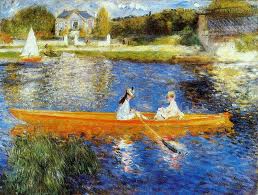
In the National Gallery in London Pierre-August Renoir’s “The Skiff” lights up the room. I am falling in love with it a little more every minute, and I can’t understand why someone  put it in a small corner.

It overwhelms the space it is in. The green grass jumping up out of the lake in the foreground, the sparkling blues blue water grabbing the sunshine out of the sky, the women in the white dresses calm in the middle of the burning orange skiff.

It is the orange that gets to me, the orange, very, very orange skiff, I can’t get over the orange skiff – all that warmth absolutely dominating the blue lake, leaking off the canvass and banishing the picture frame, the museum wall, the museum floor, and the whole of the room we sit in. I can’t see anything but orange. I am totally smitten by incandescent orange paint. I can’t stop ogling it.

The women in the painting are so calm. One is reading, the other is sitting and rowing so casually. They seem so un-startled, so undisturbed,  much like the people around me in the museum, shockingly respectful and settled.

But I am not so calm!  I don’t know what to do. Perhaps I should stay right here on this bench for a long time looking and pulsating. I will; I am deciding  right now to eat here tonight, and then sleep here. Now I am deciding not to. It won’t work; this Renoir won’t stop glowing, like a fire, and it won’t go down, like the sun. If I stay, it will be too bright to get any rest at all.

I won’t stay, but I will stare. At the bottom edge of the skiff I can see that the orange is coming off of the wood, and it is getting in the blue water. Renoir let it can away from him. The orange paint is jumping around in the ripples of the water that are coming off of the boat. The orange paint is getting all over the blue paint, taking over the gap between the boat and the lake. I can’t stop smiling. I like it that the orange has taken this step, has crossed over, has created an interface, has made this transition.

We leave the National Gallery. We get on the tube to ride through London to our refuge in West Finchley, our suburban home away from home that is housing our stay. We stand in the isle of the train because there isn’t enough room to sit down. A bell rings. The electric doors whoosh closed, and off we whir into the tunnel, rushing madly beneath the streets of London. We come to another station, we slow, then stop. The train doors open, and a woman’s voice, very British, says, “Mind the gap between the train and the platform.” We get off.

We mind the gap.

We always do, or not, depending on how well we are doing.

I love the gap. I love the people in the gap. I love young people crossing the gap between their immaturity and their maturity. I love me, crossing the gap into the next stage of life.

The spaces that exist between are always the most interesting, where the boat meets the water, where the blue meets the orange, where the train meets the platform – interesting, disturbing, transitional, difficult, formative, painfully beautiful.

Take the gap between childhood and adulthood — wow and superwow! This transition shapes the rest of life.  To get out of the boat, to step across gap, to bring one’s babyhood, ones adolescence, ones teenafication, one’s “becoming” into ones “I have become, “  to splash the colors from one place into another, this is at the core of the very core of every rippling and  transforming identity.

What is this thing,  this growing up? What are the paint strokes that get us across the gap? How do we paint the immature past into the mature present?

I’m not always sure, but here are a few of the brush stokes that may need to be mastered to paint across the gap:

We must overcome the fear that makes us not want move our brushes beyond what we have known before, or beyond what others like us have done.

We must come to  relate to the people in the boat, wisely, and not sit when they are sitting if standing is what we really want to do, or we must just jump, out of the boat, and into the orange water if really that is the only thing to be done when we are  so ready for change that sitting doesn’t work for us anymore.

We must learn, must we not, when not to judge but still to discern what is right and what is flat-out, dead wrong for us, even if not for everyone else.

We must try, and test and test again, our limits, when one more, or one is less,  or one is one too many, or too few or just right, if you know what I mean.

We must grow in confidence, to splash paint, from the boat to the water and on to the sky.

And what else?

What else must we do to get across the gap?

Tell me, so at the very least it is out here, on the canvass, to deal with, to face, to enjoy, to revel in.

“I feel like I’ve wasted the last year,” she said, as she looked at me through the camera on her laptop.

“Perhaps not,” I said back.” She and I were miles apart, but it felt like we were close together. We had screen faces and screen smiles and screen delivered nuances of expression that helped us to speak freely.

“We learn from everything we go through,” I said. It sounded cliched.  “Now you know more about yourself and about the kind of relationship you want in the future. If you hadn’t gone through this then you wouldn’t understand yourself or other people as well as you do now.” That sounded better.

It was really not much me telling her that.  My wife said something like that to me recently, and  I was paraphrasing  her, as I so often do. There is a significant advantage in being married to a smart women. Not long ago, I had bemoaned to my wife my regret over the emotionally difficult experience that I went through in switching jobs in 2008.

My wife had listened, and then responded. “It’s made you who you are.”

She got it right, as she usually does, and I liked it as I tried it on,  for me, for my friends and everyone else.

“Hmm.” We may not like what we’ve been through and it may seem a loss, a waste, an unwanted detour, but that is not the only way to view our experience.

Every hard thing we go through has the potential to shape us, make us.

When someone has been hurtful to us, this might at first bury us, but then  we might learn that we really don’t want to do something like that to anyone else. When someone has dominated us,  we may learn something mean from this, how to dominate others, or we may learn a much better lesson — to not dominate others. When someone has not honored our emotions, we might learn that only some people are safely entrusted  with our deepest emotions. When we have made a mistake, we may know not to make it again, maybe.

Jesus said, “The truth will set you free.

The past is a form of truth, so “the  past will set you free too,” if you can  see the truth extruding out of it.

I am learning to make friends with my past. The past is my best friend. It has given me everything I now have. It has been my teacher. It has been my lover.  The past has humbled me, and it has honored me.  It has left me angry; it has also taken anger out of me. The past has shaped me into the me of the very me inside the core of the very me.

And lately, I am realizing that the past has turned me into the me that I am learning to treasure.

Around him sat at least 15 open paint cans, a half-dozen paint trays half-full of paint and a good 20 rollers and brushes with paint hardening at the edges.

He looked up at me from the mess, smiled wryly and said, “It would have been a lot easier to do it myself with a paint gun and one helper.

This was what the end of a church painting project at a campground in Mexico.  About 20 people had been recruited, transported, armed with paint “weapons” and turned loose on a couple of now shinning buildings. It worked — kind of.

It’s typical. The  end of most attempts to order the earth have a behind-the-scenes disorder to them.  It’s called clean-up.

Last week, I got out the ladder, and took down the Christmas lights. There was a pile on the lawn, then a pile in the box, then Christmas was again on the top shelf of the garage.

Life is a lot about the clean up, about ordering the disorder created in our attempts to bring about order.

I talked to someone yesterday who is in need of redoing their taxes, in a better way, a more orderly, honest way. They told me that they  have a sense of an era closing. They simply aren’t going to cut corners they used to cut. A new definition of what’s orderly has inspired them and a mess is going to be cleaned up, as best it can be cleaned up.

Paint rollers, taxes, Christmas decorations, the kitchen sink, our minds, our hearts — all need attention, ordering. To leave them as they are is to complicate the future. To order them is to bring about the next thing, to provide an opportunity for something new to happen.

I just cleaned out my clothes closet in my bedroom. Some of the shirts and pants that I had not that long ago bought, placed in my closet, wore, washed and returned to the closet  were now tossed in a box to be donated, in order to restore order to my closet. Some of them, I just wasn’t wearing anymore and they were complicating and hiding the clothes I am wearing.

When I finished, I felt ready, for this year and I felt something else. I felt calm.

Isaiah the Jewish  prophet,  claimed that the effect of being right and doing the right thing is peace.

Order equals calm. I like it,  calm, a sense that for the moment things are okay.

What’s next? We decide, what to do with disorder in our lives.

A good plan for any chaos or mess  might look like the following:

First an ordering of the disorder, then calm.

The garage.

The closet.

The past.

A broken relationship.

A mental confusion.

The inner-most closet of the heart  — think cleanup.


Our level of confidence defines the quality of our social relationships. When we are insecure  our relationships may seem fearful or dangerous to us. When we are confident, our relationships tend to feel energizing and safe for us.

What to do?

I’ve been thinking about this and something interesting comes to mind.

Think about this if you are want to thrive more socially.

I remember going to a young couple’s party at their house one evening a few years ago.  I hated the whole experience. I felt very insecure there.  Come to think of it; they were very insecure too. An atmosphere of social ineptness reigned.  We sat on couches around a coffee table, but there was no coffee to spike our energy and no comfortable table of conversation to chew over.  The young couple and some other people present controlled the conversation. I couldn’t think of things to add.

Wow! It sucked! It felt unbearably awkward. My wife and I left early. I felt like a social failure, no confidence that evening, no social success that night. But now, years later, with much social water having run under and over my bridge, I better see the truth of the thing.

We are powerless in social relationships, when we think we have no control. This sense of powerlessness adds to any insecurity we might already have, and when other people control the conversation, when the turf is theirs, then this is very confidence-deleting for us.

I see now that much of the insecurity was within me, and then so was the solution. I let it happen. I did nothing. I thought of myself a guest with no responsibility. Not good, now I realize, not good.

I’ve changed. Enough weird parties, enough awkward conversations, enough counseling,  enough personal responsibility to make social events happen —  I’ve begun to have different experiences.

Recently I met a quiet and awkward young couple. I asked them questions. I expressed interest in their personalities. I took time to explore some things we have in common. I invited them to meet me again for coffee. The next time we met, they told me that they had really enjoyed their previous conversation with me and they wanted to talk more, to get to know each other.

What a difference a few years makes.

The real difference? My level of confidence. I’ve gotten more confident, more secure. I know who I am now,  and I am not afraid to let that be the social oil  or the social glue in awkward situations.

I used to think of myself as socially powerless.

Now I have come to generally think of myself  as in charge of any social situation I am in.  Wherever I go, I consider myself a co-host with those present. I see myself as in the position of  a self-affirming impresario, one of the masters of conversational entertainments. I see myself, in the role, if needed,  of group discussion leader.

This isn’t a total panacea. There will be and even lately has been social awkwardnesses. I mistook someone recently for someone else! Awkward! I still sometimes want to leave the party early.

But things have largely changed for me.  I like it. I  refused to be as silent as wall paper. No more. I now  refuse to engage in debilitating social silence. I refuse to be socially helpless. I refuse to act like I have no control. It’s good; it’s better this way. This is working for me, because social confidence is largely a matter of self-perception and self-actualizing behavior.

If you and I see ourselves as  leaders in  social situations then we usually will be.  Act confidently, and we will generally act socially competently.

Social confidence — it’s a way of seeing, and it’s a way of chosing, one thing and not another. It is about chosing to take control. It is about chosing to not be socially helpless.

Parties, better? They can be.

Take charge, my gentle friends and thrive!

“I think you think that you can’t  hurt me when you say stuff. But when you say stuff it does hurt me. I know in the past I acted all tough and hard-headed but I’m not like that now.”

He sat on the couch in front of her and put his fist on his chest and coughed.

“I don’t know,” she said. “You used to say that nothing could hurt you, and I guess I thought that was true.”

“Well, it’s not anymore,” he replied. “You see how I’ve been lately, all emotional with the kids and with you. I see that what I’ve done has hurt a lot of other people and I’m sorry about that and I’ve been apologizing for that.”

I turned to her and asked, “Can you see that he’s been different lately?”

“I can,” she replied. “It’s like he is becoming more human.”

It’s interesting, the degrees of things, the way things change.  We are all becoming, everyday, perhaps more or less human.

What does that mean? I’m not entirely sure, except to say that part of it can be explained by the progress or regress we make emotionally. To be human is to feel —  pain, love, depression, happiness, guilt, tranquility.

To petrify emotionally is to lose our humanity. To turn to stone regarding other human’s feelings is to lose the human quality of our relationships. To grow numb, to fail to understand or care when our behaviors bring pain to others — this all is part of a process whereby we grow inhuman and inhumane.

This matters.

We must not lose the affective domain or we lose our humanity.

To be human is to be emotionally rich. To break, to soar, to break down, to take courage, to pick ourselves up and explain to someone else how we really feel — this is what it means to be an integrated person, a complete personality, a fully human being.

As long as we can be hurt then we  retain the ability to understand someone elses’ hurt.

To the extent that we can accept and honor our own emotions, then we will be able to accept and honor other people’s emotions.

Feelings feel feelings.

Feel.

Be human.

Thrive.

who are you?

Posted: January 24, 2011 in becoming
Tags: , , , ,

“`Who are you?’ said the Caterpillar.

This was not an encouraging opening for a conversation. Alice replied, rather shyly, `I–I hardly know, sir, just at present– at least I know who I was when I got up this morning, but I think I must have been changed several times since then.’

What do you mean by that?’ said the Caterpillar sternly. `Explain yourself!’

`I can’t explain myself, I’m afraid, sir’ said Alice, `because I’m not myself, you see.'”

Alice, as in Wonderland, is caught up in one of our universal human dilemmas — explaining ourselves. The problem? Who we are is not fixed, and it can’t be easily explained to someone else or even to ourselves.

But we are not always as lost as Alice. Consider your bio or your resume. I wrote a short biography of myself recently for my website.  It was supposed to be brief, but I’ve lived long enough that the trouble was in knowing what me to put in, what me to leave out. Then when my office manager transferred my biography to another website which had a different purpose, it didn’t quite feel right there. So I changed it, to fit the context.  Like Alice, I had several iterations to choose from.

Resumes? The same thing. We tailor them to the job we are going for. We present ourselves as a good fit for a prospective employer. At resume time, we are all Alice, before the caterpillar, being asked “And who are you?” and we stand and deliver that we are an Alice that will  fit in caterpillar’s world. And in that moment, we profess,  to know ourselves. Fine, all is well, welcome to selling yourself.  It’s appropriate and so professional to offer up a me-for-them on 24 pound linen paper with a water mark, a well-edited self that briefly presents the me of me that fits the them of them. “Make a good impression,” says my mom, your spouse and her best friend Tom as we all  head out the door for the interview —  “Knock ’em dead!”

But dead or not, at the interview or the funeral, there is yet, the Alice-dilemma. Someone may think I am this, or another may eulogize me as that, and I may myself put this  or that on the fine paper , but who am I really? Who am I to me? Who am I when I-as-caterpillar asks me-as-Alice, “Who are you?”  In other words, who am I employing when I employ myself? This identity is more difficult to get a hand on.  It’s harder, penning the slippery, holistic, authentic day-to-day resume, the one we never write but always live, in front of ourselves and others.

My wife, Linda, is a  survivor. Now there’s a label that offers an identity many people own. She grew up with a dad who said nothing too many times in a row after muttering nothing and yelling again nothing  while devotedly popping another top off another beer after the beer just before the last one. One way Linda survived was to find her place among the stacks — books, and films in a place of something, of resources, a library. She found  a career in storing and organizing help, information, resources. The result? She is an interlibrary loan specialist and a phenomenal resourcer of research professors and students. Have a need for a book or an article? “Call her.” She’ll get it for you or find out where you can get it.  So while a support group might think of her as a “survivor,”  she is really, through and through,  a thriver. Contexts change; we change;  labels change. Is she a child of an alcoholic parent, always? Is recovery always. How long does the past define us? Only as long as we let it.

I’ve noticed that people tend to like  slice-of-the-pie assessments — “survivor, vet, precocious, slow, hot, not.” They don’t so much like the longer, nuanced, whole-pie critique, except when they write their memoirs. Most people go for the quick  labels: “cute, bright, slut, jerk, fun, good girl, bad boy, smart ass.” What are these really? Short hand idenitfications,  stereotypes within the stereotypes of  the stereotype.  Some one told me recently, “You’re smart.” I thought, “Thin slice of me. You just haven’t seen  me dumb, but sometimes I am.” Maybe I just haven’t let them see me dumb. I am, as we all are, a walking contradiction — smart here, dumb there, good here, bad there. Of course, obvious, sure — “Get real.”

I want to. I do. I do want to be authentic, and with authentic people, in the moment, congruent, projecting who we are and have been and still can be. This even means being honest about the me of not me and the them of the essential them. Paul, the radical Christian  interrogator of the self, in one of his finest letters wrote, “I do not understand my own actions. For I do not do what I want, but I do the very thing I hate.” Touche! Paul has it right. He is not always the person he wants to be, and I, like him, do not always act out the me-of-me and the me-I-want-to-be. And so when I define myself, this must be included. Every resume needs an,  “If-you-want-a-different-twist-on-everything-you-just-read-then-talk-to-Frank category. Or perhaps we should add   “Blunders” with dates and references.

The other day a girl told me that she was  in recovery from abusing alcohol and drugs. I told her that in high school and college I had done too much drinking too, and had to move away from that to figure out who I was on my own, without a little help from my friends. As I confessed, I was writing my resume for her, an honest one, a human one, one that she could understand. I like that, authenticity. Who am I? I am a person very much like everyone.

And this gets at one more thing I’m learning — not to listen too much to talking caterpillars wherever they appear, but to look after something much more important, helping the them of not me figure out the them of the essential them. This works, nicely, in diverting the soul from excessive introspection. I live best not storying a self, not inventing a self, but instead spending time reflecting back to other selves who they might yet prove to be.

The other day, I happened on an ordinary thing, that later turned weird, a black mustard plant in the uplands down by the Sweetwater Salt Marsh who was freaking out.  She was a beauty, a Cruciferae, yellow and spring green with long shapely roots, but  she was so  upset. She was out of it really,  insanely exclamatory,  “Wow upon double wow and wow squared!” she  gushed madly, her eyes bent on a black and yellow Swallowtail butterfly who was flapping home to  the cathedral arch of a Sweet Fennel.

It didn’t turn out so well. I was told later, that when this mustardy beauty could take it no more, she grew all crazy for the air and ripped herself from the ground.  And it was said by those who know that she proceeded across the marsh, beating the breeze apart with her quickly withering leaves, and with dirt still trailing off her roots, that she crashed into the ground only about 1oo feet from where she came. 

“Oh!” I grieved for her and for all other selves not happy within the boundary of  themselves, and then I went and sat down with Alice again to hear her out.

Later in the evening, I wrote the tragedy up and posted it on my blog.

Then I kicked back, stretched my long, spotted body, nibbled a leafy snack, checked the feedback from my maxillae, and thought, “Now this is the me of the essential me.”