Archive for the ‘beautiful’ Category

Then I asked, “Why do you like the trees?” speaking loudly to be sure she heard me.

“They make me feel calm and peaceful,” Elizabeth said.

“I like the trees that grow over the walk,” she went on, pointing to the ones that met and formed a canopy ahead over the sidewalk. “I like the birds in them, and I like the clouds that look like angels.”

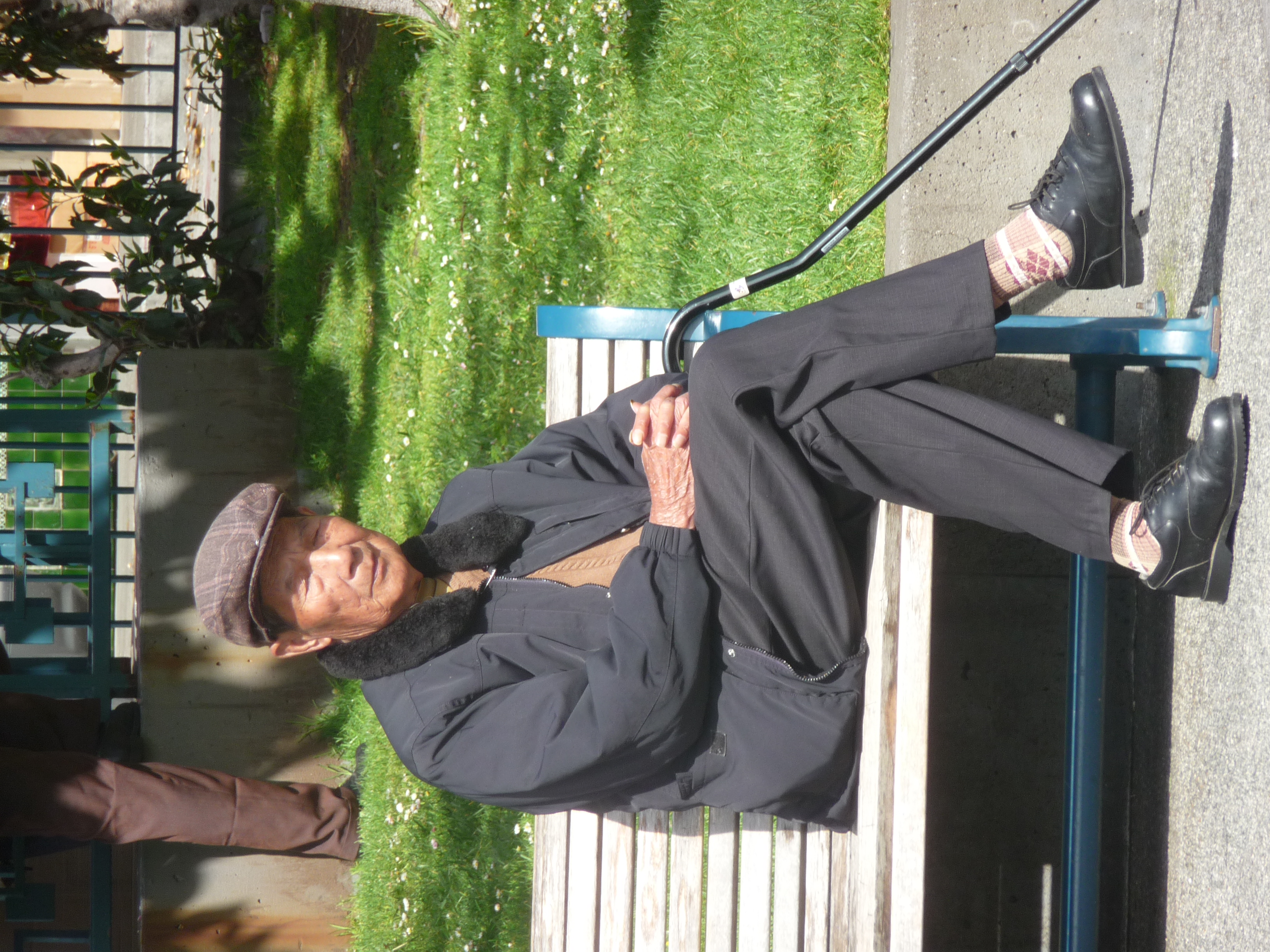
I looked up as we walk along together, slowly, to accommodate her cane. There were some patchy white cumulus clouds overhead, but I couldn’t see the angels.

“The birds sing in the trees,” she said.

We walked under the leafy canopy, I luxuriated in time with her, ambling along beside her, passing now through this wonder and that, and suddenly the world felt magical to me, seeing it from her angle, through her eyes.

“I have a lot of memories of this community,” she said. “My mom and I pushed a shopping cart up the hill from Target with our Christmas tree in it.”

“How long have you lived here?” I asked.

“I lived here with my mom for twenty-one years,” she said.

When we reached her apartment, I felt like I was entering a sanctuary. Right away, our focus went to the cat, sleeping on a paper bag under the old TV. Cinderella got up, and came over for some love, rubbing against her leg.

“She likes me to pet her,” she said, “and rub her ears. What color do you think she is?” She paused and then answered herself, “She’s white, and black, and gray around her head.” Then she asked uncertainly, “Isn’t she?”

“That’s right,” I said. “Those marks around her eye are gray. She is a sweet kitty. She’s perfect for you.”

“She’s skinnier than when I got her from the animal shelter,” she said,”I think she lost some weight. Probably needs to lose more.”

The cat was overweight. It was also deaf. It had formerly been abandoned, but it now it had bonded with her, in only two weeks.

She looked up at the wall above her, covered with photographs, clippings and paintings.”My mom liked Indians,” she said. She paused, then said, “It’s really hard sometimes, with all her stuff here around me.”

“You’re doing really good,” I said, “With Cinderella and your therapist, your recovery groups and your church family.”

“I guess,” she said. “I’m trying. I’m trying.”

We talked a bit more. I left with a hug. Her hearing aid screeched.

Walking back though the old neighborhood, under the canopy of bird-filled trees, underneath the unseen angels in the clouds, I thought about her life.

Fifty years, side-by-side with her mom, fifty years of being completely taken care of, and then suddenly, boom, her mom is gone, and she is alone, deaf, caned, uncertain, grieving desperately, struggling like all of us, for sanity, and yet ever so bravely, taking the first, small, courageous steps forward into a new world.

I’m so glad I know her.

Elizabeth is taking care of her cat.

Elizabeth is taking care of herself.

She is taking care of me too.
As I looked up, I saw one of the little ones jumped to a higher rock, slip — all gangly legs and feet — and slide down again from where it had started. It was a mistake of inexperience.

The lambs had been born in February, and now — only the beginning of April — there hadn’t been enough time yet for them to master the heights.

Through the spotter scope I watched three ewes and three lambs hop to another rock, stroll into a grassy spot to munch on the new grown green of spring, then scramble on up the high ridge. They stopped for a moment at the top, white bodies silhouetted against the bright blue California desert sky, and then disappeared.

To find these reclusive Bighorn Sheep, I had looked high, I had looked low, and I had looked  long, through the binoculars, and then –magically –they were present, like unicorns found when turning the page in a fairy tale. They were high in the rocks above me. When the rangers brought over the spotting scope, a small crowded gathered.

“Oh, I see them now. Ah, there are the little ones!”

We ogled and oohed for a while, a community of lookers, looking.

I loved the day in the Anza Borrego desert, the sheep, the fellow gawkers, all the wonders that we saw.

We hiked the cactus loop trail, clomping up the mountain between flaming magenta blooming beaver tail and hedgehog cactus. The chollas glowed all around us as if they had put on halos.  In a nearby wash we found a sand plant, growing by a cheese bush. It looked like a tiny pine cone with purple and white flowers popping from its dry, grey sides. It was small, and we had to kneel to focus in on its tiny flower-decorated sides.

Later we off-roaded back to a Kumeyaay Indian site where we scrambled through round boulders to find mortero after mortero in the rock tops, proof of family and community and lambs and ewes of a different kind previously thriving in the desert.

On the drive home, up the mountain and out of the desert, we switchbacked through the mountain lilac all purple and blue-flamed around us a wild turkey flushing in front of the car, sailing over the top of us to the road side, finely feathered and stately as it strutted down the bank and under the bright green trees.

We chatted as we swept up the fields and forests in our wake, trekking down from Julian and back to San Diego. I mentioned the very young homeless couple who I had found sleeping in one of the classrooms at the church last week. They broke into the church, ate up all the children’s snacks, smashed an unlocked storage cabinet, and when discovered in the morning, explained their behavior thus: “We were hungry.”

That gets it. These young broken ones, addicted to the meth, are very hungry, and I think they will be more and more.

And the mountain sheep and their lambs are hungry too, for the bright green grasses growing high on the ridges, and the Indians too, who lived here long ago, they were hungry, hunching over their morteros in the desert, grinding grain for bread and waiting to eat. And the sand plant hungry and thirsty too for more spring rain to sooth it’s drying sides, and the turkey crossing the road, headed somewhere to feed and drink in safety, and me and my friends too, headed back to our homes, from a day out —  all hungry.

I love the desert!

I need the desert.

It fills me up, just a bit, to live a little more, in a stunningly beautiful and hungry world.

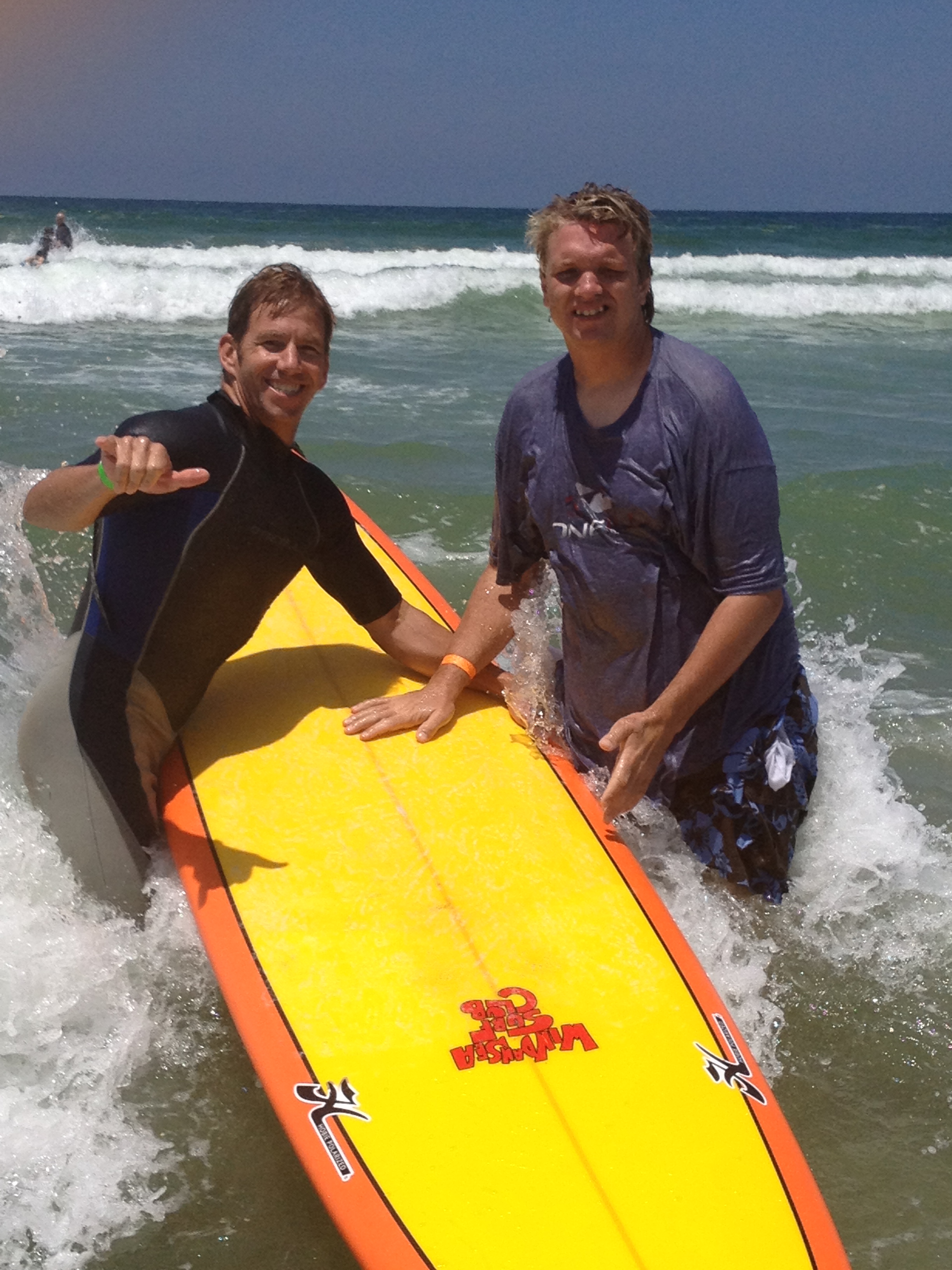
Steve is twenty-five but he had never been out in the ocean much past his ankles before last Saturday, but then again, there are a number of things Steve has never done that most American twenty-five year olds have — driven a car, read a book, spoken a complete sentence.

I like to talk to Steve; he’s my friend, but with us it’s mostly simple signs and growls. We growl well together.

My friend Daniel also has a disability. I know lots of people with disabilities. I like them the best. They are happier than anyone I know just to see me, and I never feel a need to prove anything to them or saying anything ritualistically weird like is required with my “normal” people. My friend Daniel’s mom told me once that he used to stand at the ocean and order the waves to go back. Awesome! Kind of like Jesus, but with Downs.

Last Saturday, Special Surfer Day at La Jolla Shores, Steve went into the ocean up to his waist, lay down on a surf board, allowed himself to be towed out to where the waves were setting up, and then surfed to shore on his stumach. We called his mom from the beach to tell her.

One of the leaders of the event told everybody. There were a few humid eye lids under the canopies — salt water.

Steve lay down on top of fear and rode it to the shore.

I hooted!

On his second ride, Steve came up out of the white water bloody. He had taken one on the forehead. I gave him five, and we took him to the lifeguard.

“He can’t talk, I told them,” although that isn’t totally true because there is the growling and a few words and the signing, I said that so that they wouldn’t bug him too much with questions and frustrate him.

I was proud of him. I told him so. It was a small cut.

“You’re a real surfer now, ” I told him. “Real surfers all have scars!”

He was happy. We went home happy. I like the beach! I want to go back this summer with my daughter Roz. She isn’t “normal,” whatever that means either. She has seizures, so we always have an eye on her at the beach, but what a water dog that girl is! She loves the ocean!

What is it with the ocean?

My precious ones — they rule it.

This morning on the way from the airport to our accommodations on Corn Island, we passed by a beautiful new home being constructed. It was stucco with beautifully shaped windows.

Around the next corner were dirty and rusted wood and tin shacks.

Last week I had a delicious chicken shish kabob. Today I am sick. Perhaps it was the chicken. More likely it was the delicious fried shrimp eaten more recently, or some predatory bacteria living in it. I’ve had nothing but water today. I can’t imagine enjoying food. I take a travelers antibiotic and wait.

In Soweto, South Africa, I once sat in a tent and worshiped with the Zulu. The floor was dirt. The worship was full of pain and loss, but it was also thick, resonate and noted, more than any worship I’d ever heard before, with love.

In 2008 I went to my office at my church and cleaned out my desk and book shelves. It was a broken moment full of hurt and anxiety and pain. 20 years of success ended in a cardboard box. Only two months later, I carried those boxes into a new office and began a new job in a different church that would come to duplicate and even surpass the success of my earlier work.

I now have a friend who smokes crystal meth. But I was privileged to lead him to accept Christ. He has a family of nine children with one more on the way. His children are good; they are beautiful. I love them. But his drug addiction is ugly, selfish and destructive to the whole family. He is trying. The war between the beautiful and the ugly is not over in his life. Nor for any of us.

Out of a mountain, on top of Corn island in Nicaragua flows an amazing jungle full of tropical flowers and fruits and iguanas. Out of the same mountain flows a polluted stream, full of black water, trash and E coli. Impoverished children play near by.

This was and is and it will be so again and again. I could go on about this as long as the earth has and does and will exist.

The beautiful and the ugly live next door. The sublime and the broken are neighbors. We live in an abused and loved world — full of splendor and horror.

Today I am a bit discouraged. I am sick and far from home. Tomorrow I will be home. I will be happy.

This is life as we know it – replete with wretchedness and laced with beauty.

Blocks In The Jungle

Posted: June 15, 2012 in beautiful, people

I woke up with the jungle birds singing like crazy to the rising sun.

I awkwardly descended the ladder on my bed and went outside. The air was cool and moist and earthy on my cheeks and shoulders.

It had rained hard in the night.

In front of me was a pile of light grey blocks. The jungle had its light green arms around them.

The blocks sat organized in both their vertical and horizontal obediences. Yesterday we order 200 of them off the ground. Now they sit on each other as part of the rising school.

Last evening, Past Vital and I stood and admired them. “It’s good,” he said. “It’s very good,” I thought. I looked ahead. I could hear the voices of los ninos, the ones yet to come, the children in Rama who don’t have a good place to learn.

It is all in Pastor Vital”s head, a school,a church, a clinic.

He has already done this kind of thing in Kukra Hill and Bluefields.

“How many more do you have in mind?” I ask him.

“Fifty” he says and we both laugh. It can’t be fifty, but it won’t be three.

He has it in mind to fill up spaces around him. . He will not be put off. The rough concrete blocks mind him. Yesterday I saw it. Today I will see it again. They mind his vision.

I like it, this big dream, to push back a jungle and line up some blocks, to push back more ignorance and poverty and sadness and bring order and love.

Yesterday some of the boys in the neighborhood came and helped us. Two of them stuck a stick through two concrete blocks and carried them around to the back of the building.

They are the future builders of this community.

Yesterday about fifty children showed up for our team’s presentation of Noah’s ark. When we broke out the parachute one of the littlest girls cried. The big billowing
red and yellow and blue sheet overcame her.

Someone carried her to the side and looked for her mother. No mother came forward. Then a slightly older girl came rushing to her to hold and comfort her.

This is what the blocks will do. The blocks will make a place where one will rise up and become a leader or a pastor or a teacher and care for another.

Visions work. The blocks in the jungle will work.

Life is hard here in Nicaragua.

But we have been able to be a small part of making it better.

20120615-160959.jpg

The Artist played out in front of us as low light jazzy music filled in the large room and  black and white images flickered on the screen. There were no voices in the filled theatre — except mine.

I  whispered the title cards to Rosalind, seated close beside me, as they came up on the screen. Like the silent actors on the screen that we watched, she said nothing.

Half-way through the film, a youngish man seated in the aisle across from us said loudly in our direction, “Be quiet; you’re ruining it for everyone!”

Rosalind’s head came up, and looking aggressively toward him, she called out loudly, “Shut up, “shouting out her rebuke with just as much if not more much pain than was present in the filmed narrative streaming in front of us.

At that point, with that cry into the dark room, the pain in the film jumped off the screen  and entered the audience.

Rosalind, as if shot,  slumped down in her seat and broke, sobbing. You could hear her soft cries through the theatre. I could feel her head and her warm tears on my chest and then I could see over the top of her head,  faces turning in our direction.

She cried, I held her. It wasn’t over.  From across the isle a man jumped to his feet, and suddenly he was there standing over us.

“I’m so sorry!” he said, “I’m so sorry!”

“Go away,” cried Rosalind up toward him, “Go away,” and she hid her face in my arm.

He lingered just a moment and then rushed out of the theatre. A few minutes later, another young man seated beside him got up, and left also. I was sorry for him. He missed the point of the film because he didn’t understand what was going and left too early to get in all figured out.

Rosalind’s cries softened. We didn’t leave, although for a moment, I thought of it.

We’ve learned to stay.

It  won’t go away, it won’t really ever go away,  and  besides, there was a movie to be watched and finished and more title cards to be read, although more softly now, with my mouth right up to Rosalind’s face, my warm breath warm on her ear, my arm around her shoulder.

Rosalind and I finished the film, together,  and laughed and danced over the final redemptive Singing-In-The-Rain tap dance of the artist and his partner, Peppy.  We loved it.  The artist didn’t quit! He didn’t commit suicide. The artist, with help from a friend made a come-back!

I learned something. I need to be more careful in silent films.

Not everyone is ready yet for talkies.

What is really beautiful?

It is an old woman, in hospice, waiting to die, as she is remembering.

I know.

I saw her yesterday.

She is there in a dying place, seeing again those moments when she was young and agile. She is a young girl again, and her hands are moving now like the leaves in the wind-blown trees outside of her room.

You’d look at her, if you didn’t know her and not see anything of that, and only perhaps see age and disease  –unless you looked closely into her eyes and then, if you wanted to, you could see the young girl in the old woman. To see that kind of thing, it helps to know the person, and even then you have to look closely, and not blink at the dry, thin film of agedness and the unloveliness of the dying. You have to look past the things you tend to turn your eyes away from.

Sometimes I want everything to be beautiful, to live in a perfectly beautiful community of people,  in  a beautiful city, in a beautiful world set in a beautiful universe.  I want everyone to have all the beauty they need, but they don’t, and I don’t and it isn’t all perfect and it isn’t  easy to see the beauty through the aging and the dying and the brokennes and the stains.

Today I saw a man who has more than enough money not to have to work, work.  He worked; he put up new lights in an old church. And when he was done with the electrical part of the work, his specialty, he stayed to do the non-specialist part of the work, the clean up, the patching of a damaged ceiling, the covering up of the scars where the old lights had come down. Beautiful!

It is beautiful to see a person work who is not incentivized by money, to see care, work, love — gratis. My friend, the electrician, is  motivated  by his love for God, his desire to be useful and his care for his friends who asked. He earned nothing, but he did everything needed.

It is a kind of dancing, I think, to care for a person who is dying or to restore a  building that needs to live again.

We are quick to praise beauty when we see it, the full moon rising in the early evening sky, the lovely girl strolling past us along the way, the sheen of a new car rolling smoothly down the city street.

These are beauty clichés.

But twice lately, I’ve seen the real thing. I ‘ve seen deep beauty peeping from the wrinkles of an old face, and  I’ve seen warm, alabaster light glow from the old ceiling of a sacred space.

There is more to this world  than youth and glitz and everything up and to the right on the graph.

I’m looking forward to tomorrow.

I am looking forward to seeing the beauty hidden in the seam and crack of life.

I am looking forward to something more beautiful than previously imagined.

I dreamed last night that I was by a large blue lake. I was eager inside; I  wanted  to fish.

Suddenly, no words spoken, someone handed me a fishing rod, baited and ready.

I cast a smallish bait fish, which had been perfectly placed on the hook,  into the large lake in front of me and immediately I felt  a taut line, a jerking in the rod and a sudden sense of surprise.   It took a few seconds to apprehend the reality — a large catch was on the line.

I reeled and immediately there at the bank, appeared a giant, blue fish, its mouth upturned,  looking straight  towards me.

It was certain that the line would break if I tried to lift the fish up the steep bank, but suddenly the fish was out of the water, on the bank, cleaned and ready to grill  — a feast prepared,  enough for a crowd of family and friends and strangers.

It’s interesting, my dreams. These days, I’m having fish dreams.

And it’s interesting, my reality. These days I’m seeing extreme need.

It’s the norm. You don’t have to go far to see it; just get out, look around, or stay home, and look inside.

Yesterday, I saw a man moving slowly home leaning into his walker.

I saw man who had to be lifted into a car, from a rolling chair, by a friend.

I saw  a  woman cry.

I saw a man who tried to talk and couldn’t.

I saw a family who didn’t have enough to eat.

I saw a woman pray, for relief.

I saw a couple try to connect after years of disconnectedness.

I saw children playing today, but I know that no one is saving money so they may one day go  to college.

What should we do, with extreme need?

Fish.

Why?

Because a rod and bait have already been handed to us …

Because there are fish in the sea waiting to be caught…

Because we must not hide from our own ….

Because more can be done than we have yet thought or imagined …

Because God himself will give us large, cooperative, blue fish to put up against extreme need…

Because of love…

More thoughts occur. They make me feel quiet.

What about you?

Come fishing with me.

“Content makes poor men rich; discontent makes rich men poor.” 

 Ben Franklin

It’s hard to get the contentment thing right, but we want to, for being content is at the heart of being happy. Being content is the highest form of being rich.

So how can we be more content?

To move forward in contentment, first we must come to understand the moment, each moment. If the moment asks for someone  to be helped, then it is not the time to be content with the status quo, and we won’t really be content until we do something.

I helped a friend obtain a trusted counselor last week. Looking back, I am content. I saw that she absolutely needed someone to unburden her soul too. It was unacceptable for me to do nothing. I am content, having done something.

Each moment asks for something. If the moment begs for art, then it is unacceptable to be content with utility. I put up several new, beautiful lights in my home this week. They glow with a warm, soft beauty in the dinning room and kitchen nook. I am content with them. Nothing more is needed there.

Recently I met with a friend to discuss money. We determined needs, we explored sources of income, we made plans to prosper. We applied knowledge to problems and found solutions.

If the moment begs for knowledge, it is unacceptable to be content with ignorance. But what then? After addressing need, we are ourselve in need. The moment then requests, rest.

And if the moment asks for rest, then it is unacceptable to push anymore. Driven isn’t wise when our bodies are tired. Driven isn’t called for after we have just enjoyed a success. Hungry for more, at some point, should be laid aside when we have had enough.

What is called for after success is  contentment, the contentment found in celebration and rest. “Just one more thing” after “one more thing” is a fast and furious route to too many crazy things ad nauseum, but contentment is it’s own reward.

And so we need to learn to exercise contentment  everyday.

Content is what we need to be at night, when all that can be done has been done.

Content is what we need to be at the end of the day, when what has been given is all that will be given.

“Godliness with contentment is great gain.” That is to say, the content have learned to accept what God has allowed.

Being content is what makes poor men rich and rich men richer.

unharboring from the familiar

Posted: June 24, 2011 in beautiful

So many thoughts; so many ideas to chew on and maybe swallow.

As I ambled through the Museo de Artes de Puerto Rico today, I came across the following one.  Puerto Rican’s artists remained sheltered, provincial and traditional through the first half of the 20th Century, artists like Campeche, Pou y Becerra  and Oller, then changed.

In the 1970’s Puerto Rico artist began to struggled for independence from the aesthetic paradigm of social realism and representational painting.

I like the struggle: sheltered in familiarity or open to new movements.

Campeche was traditional, old European; Ángel Botello modern.

Both are good; I like the Botellos.

I like being taught, I value many traditions, but I jump up and down over change when change is needed, especially in art and everything else in the world, and I like to see in a fresh way.

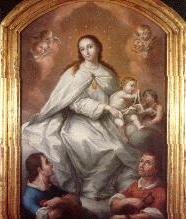
Consider the two paintings to the right. The Campeche woman is classical, in robes, European, religious, idealized yet muted. Campeche painted a world he loved, but in somebody else’s style.

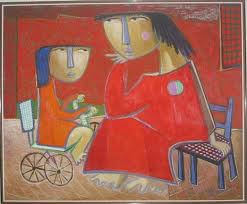
The Botello is Carribean, everyday, personal, ordinary, vibrant. He painted his own everyday world, a world he loved, his family and  he painted it his own way.

Botello developed his own style; Campeche borrowed his from Alcazar, a Spanish court painter banished to Puerto Rico.

Being taught is good; so is being creative, original, inventive, new. We need both, but I think a real danger is to get stuck in tradition, and many people I know, including my own dear and unoriginal self, are stuck with familiarity. What to do?

I think some of ous are being called, by all that is aestheic and good and holy to unharbor more and sail into the sparkling waters of our own visions.

And once we have come nearly to the surface of those, to work them, jump on them, to dive into the center of our sparkling confabulations, to fearlessly throw ourselves into the original, originality of the original us. This will require something, that we be wild and crazy and confident and risky.

But if not, then how will we ever write that uniquely needed song of love and beauty or paint that new and fresh vision of that bright red girl on her little tricycle and paint too, her not-watching mother.

Some of us have been stupidly and persistently and patently safe and it must stop.

Life needs more red paint, and bright yellow too.